Fans of SGS may remember that early in this blog's history, we posted about the parallels between two of our favorite megalomaniacs, Richard Wagner and Kanye West. But, as a conversation over beers tonight revealed, it is entirely possible that we missed a time when Wagner was Kanyed, by which I mean that once Wagner was told Imma Let You Finished. By Nietzsche. In print. Which was, perhaps, less immediately provoking than Kanye's comments directed at Taylor Swift, but is now indelibly entrenched in history--only time will tell if Kanye's act that launched a thousand memes has achieved the same notoriety.
Allow me to explain.
1) In 1888, Friedrich Nietzsche published The Case of Wagner, a book in which he criticized the master's operatic oeuvre. This stance contradicted the one that Nietzsche had posited in his earlier work, The Birth of Tragedy (1872), where he hailed Wagner as a figure of such importance that his works were in the process of ushering in a revival of classical Greek civilization--specifically its ability to blend the Apollonian and Dionysian impulses inherent in all societies (I'm not making this stuff up. It's really in there. Also something about the veil of Maya).
2) In The Case of Wagner, Nietzsche made an extensive argument that Wagner's stage works were deeply flawed because of their misunderstand of true culture. One of the most evocative phrases in his critique is 'Senta-sentimentality', by which Nietzsche means Wagner's tendency to imbue his plots with too much idealism in their reflection of society, an idealism molded by a dangerously nationalistic and chauvinistic lens. Nietzsche argued instead that Bizet's Carmen, to paraphrase, was 'one of the greatest operas of all time' because it was a love understood through natural impulses (feel free to disagree with this. I'm simply reporting on what happened). However, since Nietzsche was not appearing live at the MTV Video Awards, he could not be booed off, and instead he wrote an extensive essay about the ways that Carmen succeeded while Wagner failed.
Most people view Nietzsche's stance as one of provocation: he was reneging the support that he had lent to Wagner's works in the past by instead putting forward an opera that was, on the surface, far more salacious and sensuous than the works of Wagner, whose sensuality was underpinned by flawed beliefs. Did Nietzsche genuinely enjoy Bizet's most famous opera or was his choice more of a direct challenge to Wagner? The nuances of Nietzsche's argument remain a point of contention.
So it's time that we ask the many questions that arise from these unexpected parallels: did Kanye really believe that Beyoncé's video for 'Single Ladies' was the greatest of all time? Or was this simply a platform that Kanye took in order to criticize the overall aesthetic that Taylor Swift represented? Is this an example of Swifty-Sentimentality? Or was Kanye putting out a rallying cry for the importance of 'put[ting] a ring on it' as an artistic statement? Does this make Taylor Swift a Parsifal amongst 'Single Ladies', and Kanye both Wagner and Nietzsche? Tune in next time, when SGS finds more unlikely parallels between 19th-century aesthetic arguments and contemporary pop music figures.
As a historian, I feel leery at claiming that every ten years or so, a hip hop album emerges of such fundamental importance that the genre is changed thereafter--a simplified (and potentially spurious) notion of history-in-cycles. And yet, when I first heard Kendrick Lamar's To Pimp a Butterfly last week, I almost immediately thought of a 10-hour road trip I took in 2005 with Kanye's College Dropout effectively on repeat for the whole time because I was so thoroughly entranced with the album. That was ten hours each way, resulting in almost a full day's worth of 'Ye when all was said and done. I would do the same for To Pimp a Butterfly in a heartbeat, and I cannot think of an album that has had such an immediate effect on me. My only question is why it took me until last week to discover it, but at least I can now rectify my ignorance by listening to it incessantly on repeat while at work.
When I listened to College Dropout a decade ago, I was struck by the singular sound that 'Ye had managed to produce, a sound that was very unlike what had come before. He did not limit his producing skills to his own album, but also worked with artists such as Common to incorporate this new hip hop aesthetic that featured soaring vocals and grandiose sounds:
But while Common's challenging rhymes were ideally paired with this new and challenging sound, one could argue that some of 'Ye's lyrics delved into the mundane (seatbelts for safety first) or even the absurd (pick whatever you want, there are plenty of examples):
In contrast, one of the most notable features of To Pimp a Butterfly is the sophistication of both rhymes and sound on the album. In fact, Lamar conscientiously fuses references to blackness in a variety of media to create a reflection on black culture as a whole. It is, I feel, nothing short of a masterwork, while simultaneously featuring tracks as catchy as this one:
There is much to be said about this video (and much has been said already) and about the imagery itself, turning around the main character of Alex Haley's Roots from a slave into a king--Kunta Kinte has taken over Compton as King Kunta, replete with a throne sitting in his driveway. Just as Lamar reimagines this iconic 70s black figure, he reinvigorates funk while drawing on its main indicators. It's hard not to hear the numerous exhortations of wanting the funk at the end of the track as parody.
If you haven't heard the album, please do not think of 'King Kunta' as typical of its sound. In fact, there is no 'typical' sound as each track ranges widely from sultry, jazzy big band:
To a Curtis Mayfield-inspired track that might simultaneously reference Kanye's 'Touch the Sky' (the repeated lyric in the chorus 'I love myself' could not be a better parody of 'Ye, really):
And beyond! Including spoken word tracks and a dialog with Tupac. That's right, he's still releasing albums from beyond the grave.
To Pimp a Butterfly is also quite clearly a concept album: a work that is meant to be understood as a coherent whole rather than what most albums present, which is an assemblage of individual tracks that do not depend on order. That Lamar sees the tracks as interwoven is undeniable since he presents a series of spoken-word lines at various points in the album. The first two lines are heard after 'King Kunta,' then are repeated and expanded as the album continues. It is only in the final track, 'Mortal Man,' that the poem is heard in its entirety, presented in a 'dialogue' with Tupac that intersperses a 1994 interview with Lamar's observations. That Lamar is reflecting on hip hop--and by extension, black culture--is apparent throughout To Pimp a Butterfly in subtle and blatant ways.
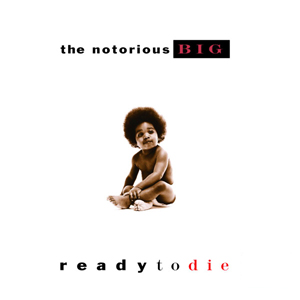
By presenting a concept album, I also see a parallel between Lamar's project and Notorious B.I.G.'s Ready to Die--an album that came out in 1994, so almost twenty years ago in keeping with the 'every ten years' idea. I would not characterize Ready to Die as a reflection. Instead, it is a provocation, from its lyrical content to its front cover, which features a black baby juxtaposed with the album title. Biggie was seeking to capture his world with its oppression and paradox, a world where a black man was ready to die as soon as he was born.
The reception of Ready to Die, particularly through its radio-friendly songs such as 'Juicy' and 'One More Chance' (in the remixed version specifically), makes it easy to forget about the more hard-hitting tracks that appear on this album as well. Through them, we are exposed to the ways in which the protagonist sees the world: at times its hope and promise, but also its insurmountable difficulties that eventually lead the narrator to suicide on the final track. 'Juicy' is the most optimistic moment of the album, although the verse opens with the line 'It was all a dream,' creating an immediate (and unanswered) question about whether the song should be understood as truth or fantasy. There is no ambiguity about how this album ends: a gunshot and an incredulous friend on the phone who has aurally witnessed a suicide.
Just as I am reluctant to claim that there is some mandated ten-year cycle for hip hop albums that indelibly change the genre, I am equally wont to suggest that hip hop is 'evolving' as time goes on--genres do not evolve so much as they shift and change. What I would suggest instead is that these three albums demonstrate the profound variety of responses that hip hop has grown to accommodate: from Biggie's provocation to Kanye's stylization and now Lamar's sophistication.If you haven't yet had the chance to listen to To Pimp a Butterfly, I hope you will take the time to check it out, as I have only scratched the surface in terms of what could be said about it.
If you could speak what tales your tongues could tell,
You voiceless mirrors of the storied past!
Do you remember when the curtain fell
On him who learned he was not God at last?
There is perhaps no palace as famous in the world as Versailles; in fact, I would hazard a guess that it might be the only palace name that comes automatically to mind for most people.* In part, this continued familiarity is a testament to Louis XIV, who sought to create the most splendid palace of his day, and in fact was so successful that it remains the most well-known palace three centuries later. But the reason that it has remained so pertinent has changed over time, and with two (relatively) recent (and prominent) Versailles references, I wanted to revisit it as a historic--and sometimes not so historic--site.
Last week, I rewatched the documentary 'The Queen of Versailles,' which documents the Siegel family and their attempt to build America's largest home just outside of Orlando, FL--a home that they named, without any trace of irony, Versailles. One of the reasons that they chose the site was that they could see another faux palace nearby, with the nightly Disneyworld fireworks visible from their home. Adding to the irony was David Siegel's primary source of income, which was derived from timeshares. One of his most prominent properties was in Las Vegas, another place that takes the re-creation of faux palaces and historic sites seriously. Regardless, the financial crash of 2007-08 brought work on Siegel-Versailles to a halt since the time-share industry--along with any other industry based on mortgages--fell apart. The trailer gives you a good sense of them:
If you're curious, yes, they do have such gaudy knick-knacks all over the home. The trailer missed out on some of the many paintings that re-create famous paintings, only with the Siegels in them.
The Siegel Versailles is remarkably similar to the original in a sense. Louis XIV also wanted to make a palace that he could fill with amazing items to show off to his guests, all of French provenance. In fact, he commissioned many of the works and even bestowed a patent of nobility on Gobelin, the maker of tapestries. My favorite new fact about Versailles is that they hired and repatriated Venetian mirror makers to create the Hall of Mirrors, but that Venice then tried to assassinate them to keep the mirror-making business in Venice. The Siegel Versailles is more global in its scope, bringing the 'best of' goods from around the world to adorn their home. However, the outcome is, presumably, the same: to project a sense of awe to their guests. If their current home is any indication, that sense of awe will likely be tempered with a sense of gaudy--that is, if they even manage to complete their dream home.
Construction stopped in 2010 because of a lack of funds and the Siegels put it on the market. With no takers, they maintained possession of it, and still hope to complete it. This, too, is a bit like Versailles, which was constantly being renovated and changed. They have not yet come up with the idea to throw a pageant and raise money, as Louis XIV did in the early stages of construction, but I'm sure they'll figure it out eventually. 2016 update: still not done
The second recent Versailles reference is, of course, Kimye, who purportedly wanted to get married there but were purportedly denied by the French government. Fortunately, a suitable replacement palace was found in Italy (Fort Belvedere) and the ceremony took place there instead, much to the chagrin of local royalty Prince Ottaviano de Medici. While I am simply dying to cut this post short and research what the Medicis are up to these days, for now, let's get back to Kimye and their wedding celebration. As you undoubtedly guessed, the wedding and its pre-game celebrations were completely over-the-top, particularly as documented by André Leon Talley, who was a guest. His account of the brunch at Valentino's chateau the day before the wedding reads like something out a historical document in its attention to detail and excessive....well, excess. We are not too far off from Louis XIV here.
Is the semi-sepia meant to convey a sense of history here?
As an aside, I am thrilled to report that Kanye seems to have located a giant marble table--so giant, in fact, that it was hauled into Fort Belvedere by crane. Now he can finally host those conferences that he was so excited about back in August 2010.
Since Versailles has long been the palace of excess, why deny Kimye the opportunity to marry there? Undoubtedly, this denial is in part to fend off the inevitable slew of social media mogul/hip hop luminary weddings that would follow (or, more realistically, the nouveau 1%). But it also suggests that Versailles is now, in the eyes of French authorities, officially a museum piece, a place that should be celebrated for its history but not put to use in the present. The understanding of what Versailles should be has also morphed over the years as the palace has served as a home to royalty, soldiers' hospital (in Napoleon's time), art museum, and crucial site of diplomacy. After all, it was in Versailles that Germany was created, when Kaiser Wilhelm crowned himself there in 1871, and it was in Versailles that Germany was humiliated after the First World War.
This is the coronation, not the humiliating defeat
But in hosting such pivotal events, Versailles remained living. Now it is more of a shadow, despite its vivid appearance, a place where re-creations of royal furniture and furnishings gives the impression of a long-ago time. The wedding of Kimye might be little more than a paean to excess, but surely this is precisely what Versailles has accommodated for much of its history.
Lastly, a fun piece on The Daily Beast by Kevin Fallen that asks which wedding was more ridiculous: Wedding #2 (Humphries) or #3 (Kimye)--we have already eliminated Wedding #1, making this a Monty Hall Problem. His summary of the Versailles caper:
The rehearsal dinner? That took place at Versailles. Versailles.
Did you read that? I remember going to a rehearsal dinner that had
lobster tail on the buffet and thinking that was decadent. Theirs was at
a flipping palace. Guests were greeted at the palace gates with glasses
of champagne and chauffeured in horse-drawn carriages to be met for
their private tours of the palace grounds. Then came the actual dinner
party, which included a performance by Lana Del Rey. The grand finale
was a fireworks display outside palace. Good lord.
I think this makes Lana Del Rey the modern Lully. There is some food for thought. Someone warn her about large conducting staffs.
*I'm cool with viewing Neuschwanstein as most recognizable since it was the model for the Disney castles, but I suspect that far fewer people know its name.
"My theme is memory...These memories, which are my life—for we possess
nothing certainly except the past—were always with me." Evelyn Waugh, Brideshead Revisited
Last week, I binge-watchedthe mini-series version of Brideshead Revisited (my dog has now seen the entire series three times in his short life), and perhaps that is what has put me in a wistful mood. This week, I found myself listening to original songs that were later remixed into hip hop and getting annoyed with the kids today, what with their remixing and maiming originals and grumble grumble grumble. This isn't really a post about memory, per se, because I have no memories of these songs in their original format. But it is a post about feeling that something is missing in the present day that existed in the past, and what could be more Brideshead-inspired than that?
1) Curtis Mayfield, 'Move On Up' (Remix: Kanye West, 'Touch the Sky')
Let's start with the Mayfield:
Correction: let's start with that suit. Wow.
Let's move on to that vibe. Also wow. The high-energy, the sound of the brass, the multiple layers. What do I mean by multiple layers? There are many different things going on simultaneously. For instance: follow the drums, which have a driving, complex beat (it's not just drum kit here but also features congas, which adds to its depth of sound). The horns, which are tight and brassy. The strings, which add an important ostinato above (move on up, get it?). Most of all, notice the tempo, because it is integral to the drive of this track.
Kanye's version:
Do you see how he missed the whole thing by slowing it down???
I feel like this is part of some ca. 2006 trend by Jay-Z and Kanye to add funky horns to hip hop (which would be a great campaign slogan for someone, possibly Hornography):
And I guess in slowing it down, there is more of a relaxed-soul classy vibe or something. The Jay-Z video certainly implies some kind of upper-class, sophisticated, fondue-plate eating aesthetic. But I hates what Kanye has done to the Mayfield track now, after listening to the original a few times. Also, where did the awesome drums go? Now the beat is far more generic. Boo!
2) Trammps, 'Rubber Band' (Remix: The Game, 'Hate It Or Love It')
You may not know the original here, unless you happen to play Grand Theft Auto 5 (I only know this because of YouTube comments):
Outstanding. Also, the matching one-piece suits: outstanding.
You may be familiar with the remix, which was featured on the 2005 track 'Hate It Or Love It,' a collaboration between 50 Cent and The Game:
My objection here is more subtle. Listen to the original and count carefully. You'll notice something during each chorus. It doesn't fit into groups of 8! It breaks off at 'Palm of your hand,' which is on 7, and it never really recovers. Pretty much all dance music ever fits into groups of 8 (hence why, when you go to dance class, people count to 8). Here, instead, it breaks in the middle. You can follow the vibraphone part if you want to hear this a bit more clearly. What does this mean? I'm not sure. I could read something into it about how the singer feels broken or disjointed or whatever. But honestly, I just think it sounds great. A bit of irregularity in a very unexpected place.
Of course, this is not the case in the 50 Cent/The Game version, where this irregularity has been neatly straightened up to make groups of 8. Take another listen, I think you'll be able to hear it pretty quickly. It even loops at the vibraphone, so you can here the repeat. Boo!
We recently learned that the Kardashians have what is, essentially, their very own church. While we were mildly surprised to discover this fact, we were even more surprised that Kanye has not taken over this whole operation and named it the Khurch of Kanye. However, we feel that this is inevitably on the horizon and we at Schenkerian Gang Signs want to be prepared. So we have culled 10 Kommandments, made up primarily of Ye's deleted tweets. Now we also know why he deleted them all: so that he could reissue the ten most important as gospel.
Incidentally, if you missed Josh Groban performing Kanye tweets, you should listen to this before reading the Kommandments:
THE TEN KOMMANDMENTS (with kommentary):
1) “I'll say things that are serious and put them in a joke form so people can enjoy them. We laugh to keep from crying.”
Here Kanye encourages his followers to find a way of finding the 'jokes' in life. Life is so serious that otherwise we would cry. It is incumbent upon the followers of Kanye to instead find joking ways of expressing serious ideas.
2) “If you admire somebody, you should go ahead and tell them. People never get the flowers while they can still smell them.”
Here Kanye borrows from another (lesser) prophet of his time and encourages us all to YOLO--in fact, this quote has been misattributed to Drake. In the Khurch of Kanye, you only get one chance at this life, so you should live it to the fullest by sharing flowers with those closest to you. That way you will bring joy and happiness to the world, plus everything will smell a little better.
3) "Do you know where to find marble conference tables? I’m looking to have a conference…not until I get the table though."
Followers of Kanye must be precise and meticulous in all details. After all, is there any point in having a conference without marble conference tables? Surely that would be a conference in joke form (see Kommandment 1).
4) "I ordered the salmon medium instead of medium well I didn’t want to ruin the magic."
Is this magic? No, of course not. But we should follow Kanye's model and seek the magic in the mundane for lo, even salmon can be magical when prepared medium.
5) "You may be talented, but you’re not Kanye West."
This Kommandment crosses over from the more traditional Judeo-Christian ones, for thou shalt have no other gods before him.
6) "I hate when I’m on a flight and I wake up with a
water bottle next to me like oh great now I gotta be responsible for
this water bottle."
Responsibility can be seen as a challenge and a burden. You should not take on more responsibility than is your due. For truly, it is the job of the flight attendant to take away the water bottle, and not Kanye (or you).
7) "I just threw some kazoo on this bitch."
This Kommandment should be understood as a metaphor, of course. What that metaphor means remains opaque.
8) "Sometimes I get emotional over fonts."
Fonts are not merely decorative. They inform what we read, how we read, and--in this day of electronic communication--our entire perspective. Fonts should not be chosen haphazardly and, indeed, the choice of Comic Sans is grounds for ex-communication from the Khurch of Kanye. Choose your font wisely, for your font is your avatar in written form.
9) "IF YOU COULD FINISH MY SENTENCES THERE WOULD BE NO REASON TO START THEM."
Listen closely to each and every sentence that Kanye imparts. You cannot predict what he will do or how he will finish his thoughts.
10) "Ever since I was at preschool I had little kids following me around. The
teacher just said I was a natural born leader. But I’m always going
left until everyone is going left, then I’ll go right again."
You should follow Kanye in all that he does, but keep a close eye out, for he may dodge right when you are expecting him to go left.
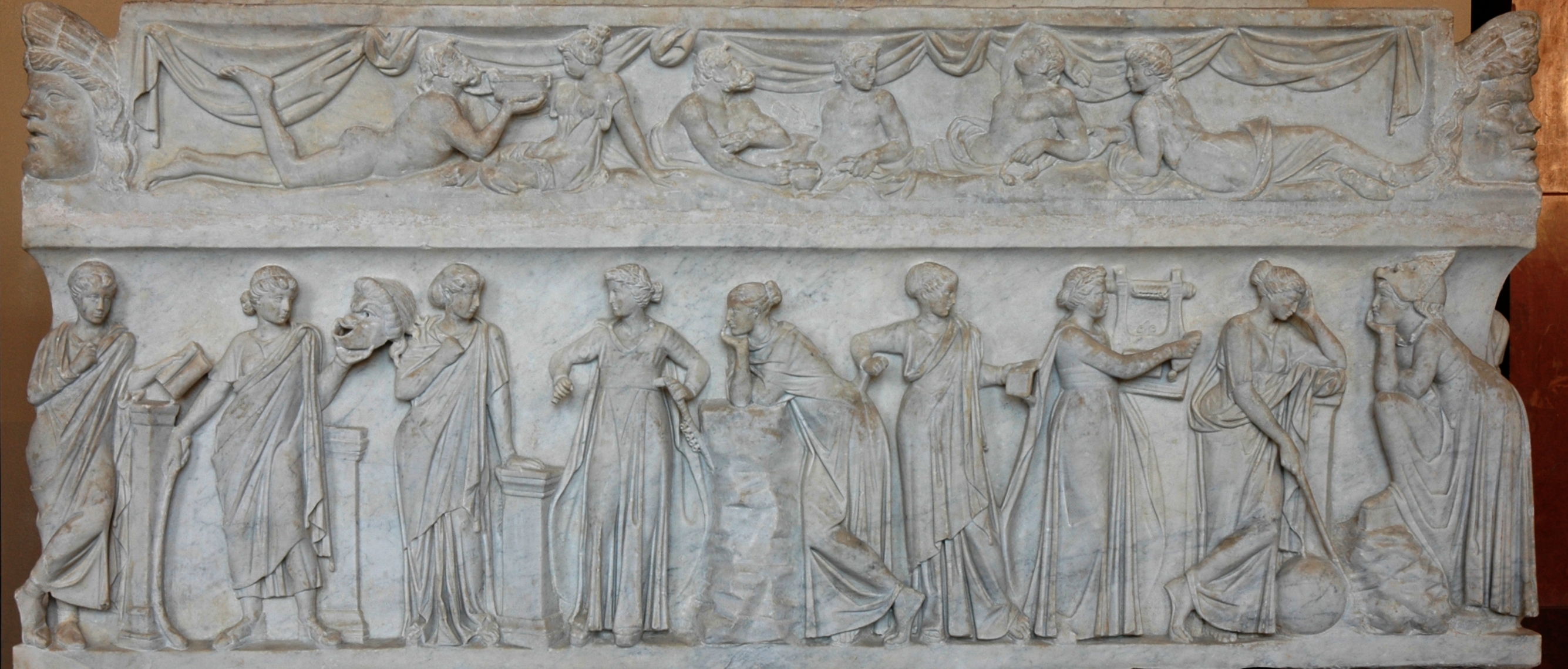
My consideration of the Vogue cover got me thinking about KK as a type of modern anti-muse, and more generally about the idea of the muse in the first place. Muses have been around for a long time, as you undoubtedly know, dating all the way back to the Greeks. They were supposedly the inspirational force that helped artists create their products. The Greeks had nine of them, each of which represented different disciplines:
It's funny how 'Thalia, Muse of Comedy' and 'Salome, Beheader of John the Baptist' could be easily confused in this depiction
The concept of the muse has been around for a very long time, likely because anyone who is creative knows how hard creativity can be. What causes that spark of inspiration (or lack thereof)? That being said, the role and personification of the muse has changed drastically. In fact, I recently argued (on a different blog) that Annie Wilkes in Stephen King's Misery is effectively a muse, only a nightmare version of one, because sometimes you need some tough love to complete your creative work. By which I mean, sometimes you need to be hobbled and in fear of your life to write a novel.
However, there can also be those who hinder creativity. For the sake of this post, I am calling them anti-muses (which is oversimplifying the situation), and they too have a long history. In the modern context, anti-muses are women (but not always), which is a reflection of how genius has been construed over the past couple of centuries in Western culture (a brief history of genius, from Antiquity to present, is summarized in this review of Darrin M. McMahon's book about this topic). Around the eighteenth century, a genius was viewed as a man who possessed great talent, but who had to struggle with it to share this talent with the world in its truest artistic form. Women could not share in genius because they had other roles, the most important of which was motherhood. They could create life, whereas men could create art. Gendering genius was inherent in the concept from its origins in Antiquity, but became particularly powerful during the nineteenth century, when (European) women would willingly give up their creative endeavors because they felt their contributions were less meaningful than those of men. My background is music, so I can think of numerous female composers whose outlook adhered to this philosophy. Clara Schumann, for instance, was hailed as a great interpreter of genius in her piano performances, but her compositions were deemed less worthy of attention--and the genres that she chose were most often the types of pieces that would be performed in the home (such as Lieder and piano works) rather than grandiose, public performances of symphonies or operas. Fanny Mendelssohn gave up composition once she was married because she felt it was no longer an appropriate activity for her with her domestic and familial obligations. Perhaps the most maligned figure is Alma Mahler, whose penchant for creative men led to this delightfully misogynistic summary of her life, portraying her as combination slut, magically temptress, and harridan:
If you're interested, Alma Mahler's compositions are very interesting. She gave up composing while married to Gustav Mahler because he felt that her work impinged on his genius.
By now, you're probably thinking of one of the best-known recent anti-muses, Yoko Ono, whose relationship with John Lennon was the subject of much ridicule during his life. Ono's fame as an avant-guard performer and artist has been re-evaluated since then, as has that of Alma, Fanny, and Clara, which I feel is a great step forward in putting the genius/muse model aside and acknowledging that creativity can stem from either direction, without a need for gender--this trope remains stunningly persistent. There is even a (sort of) nice song about Yoko (even though it mocks her artistic creativity, and implies that John 'gave up musical genius' for her):
In fact, there are select cases where both couples can be admired for their creative ability on almost equal footing. Let me present the couple (and work) that I think most fully represents the ideal of the creative pair today:
(If you're curious, Beyoncé did contribute to writing this song, so she is not simply a performer here).
There is a peculiar dynamic between KK/Kanye and Jay-Z/Beyoncé, at least in the court of public opinion. I have no idea what kind of dynamic they share behind closed doors. Jay-Z and Kanye have a professional relationship in that they have collaborated on albums (Kanye produced The Blueprint's 'Izzo (H.O.V.A.)'....okay, maybe he is a genius). One of Kanye's most infamous moments occurred because of Beyoncé, when he interrupted Taylor Swift on stage at the 2009 MTV Video Awards to definitively state that Bey deserved the best video of the year (or possibly of all time). More recent news stories have speculated that Jay-Z does not want to be best man at Kimye's wedding if it will be later featured on a reality show and that Beyoncé may go so far as to boycott the event all together. Are they friends? Enemies? Frenemies? Is KK Kanye's Beyoncé? Is this an Illuminati plot? No lack of speculation.
I suspect that part of this public perception of a peculiar dynamic involves creative inequality. As I mentioned in my previous post about the Vogue cover, many (most? all?) of us find KK to be a bewildering celebrity. She has seemingly attracted an enormous amount of attention for accomplishing almost nothing. How is this possible? No one has cracked this code yet--I mean, there have been proto-KKs, such as Paris Hilton, but they seem to have faded more quickly. If anything, KK may be even less talented than Paris. I submit to you their singles:
Shut up, I kind of like 'Stars are Blind.' 2006-2007 was a tough time for pop music:
Brit Brit was out of the zone
Rihanna was okay but not 'Please Don't Stop the Music' good
Lady Gaga was just a sparkle in Stefani Germanotta's eye
Beyoncé was all Dreamgirls, which is fine, but not 'Crazy in Love'
This song is terrible. It has no redeeming qualities. In fact, it may have one quality that makes it even worse: it was 'released' as part of an episode of Keeping Up with the Kardashians. There, you feel really icky now, don't you, and you want to go get your ears cleaned out with soap.
Perhaps KK peaked at the right time, with the advent of media like Twitter and reality shows becoming the predominant genre of television. But if she is famous due to luck (and money), then what is even more bewildering is the fact that she is engaged to Kanye West. Certainly, we should all be skeptical about his claims about his own genius, but he has had a lasting and profound effect on popular music. It is hard not to ask questions, Arrested Development style, about what KK is doing with him.
All of this skepticism came to a head when Kanye released his video to 'Bound 2,' a video that, once you have seen it, you can never unsee (and I am not embedding to this post for that very reason). I likely do not need to detail what happens, since it was all the talk for a week or two there, even inspiring parody videos and an episode of 'South Park.' In a sense, Kanye wins again, because he has created a work that is now inextricably linked to the song, just as Michael Jackson did with 'Thriller,' Britney Spears did with 'Baby, One More Time,' and Nirvana did with 'Smells Like Teen Spirit.' This is part of the role of the video, of course: to provide a lasting visual association with the song. But the criticism (positive and negative) leveled against Kanye for 'Bound 2' ranged drastically, from uncanny valley, to covert critique of American society, to Kanye's Gigli moment. Honestly, I am still not sure what to make of it, but I'm still not sure what to make of Yeezus as a whole, so maybe that is not surprising. If you are the type of person who feels that Kanye is being led astray by KK, then you are probably in the appalled camp, since it seems that a talented man is under the spell of a talentless hack and creating a sensationalistic video with little artistic merit. In other words, an anti-muse. You might even blame all of Yeezus--undoubtedly Kanye's most divisive album to date in terms of public approval--on KK. This falls into the 'it's all her fault that the genius has lost his touch' trope of the anti-muse, much like those New England Patriot fans who blame Gisele for the lack of recent Superbowls. The gendered genius returns, bereft of the muse he needs to succeed.
I would like to suggest that KK may have been Kanye's muse for longer than was immediately apparent. One of the (bizarre) facts that has been revealed in the course of their relationship is that Kanye has waited for years to have the opportunity to date KK, but she was always with football players or basketball players or busy recording the single worst song ever to emerge from a recording studio and I am including 'Popozao' in that assessment. This unrequited desire may have surfaced a bit earlier in Kanye's career, because if this video is not meant to depict KK through its blatant inclusion of a KK look-alike, then I will watch 'Bound 2' again by choice:
As with my post about the Vogue cover, I am left with more questions than I began with:
1) What on earth would it say about Kanye and KK's relationship if this is meant to be some kind of Kanye fantasy? Because I HAVE A LOT OF QUESTIONS. Beautiful, dark and twisted, indeed.
2) These lyrics seem remarkably acute in describing KK, particularly her love of all things material. But they seem remarkably inaccurate in describing contemporary Kanye (trips to Florida? He hangs out in Paris now). This leads to another great puzzle in the Kanye canon: has Kanye changed? Is Kanye allowed to change? (Yes) Has he lost it because of these changes? Were these changes effected by his anti-muse? Or is his anti-muse symptomatic of these changes? Can change be good?
The general public opinion seems to be not in this case, as evinced by the countless YouTube comments asking 'What happened to you?' on Kanye's more popular tracks (like this one. I had to add 'Homecoming' because it has been stuck in my head for the past week or so). There is a larger question here about artistic development--one that I hope to address in a future post--and I would always caution against mapping biography too closely onto artistic products. But this is my question time, and these are my questions.
I feel slightly remiss that we here at Schenkerian Gang Signs are just now getting around to discussing the Kimye Vogue cover. Obviously, a blog that seeks to contemplate all things Kanye needs to address the plethora of commentary surrounding this publication, as well as consider what the hashtag 'World's Most Talked About Couple' hath wrought. Let's start with the history: Anna Wintour, editor of Vogue, and KK are rumored to have not gotten along very well, so much so that AW totes did not invite KK to the Met Opera Gala, which is literally the worst thing ever if you are a celebrity fashion type (and you don't understand the meaning of the term 'literally'). And KK has long viewed herself as a celebrity fashion type, so that was undoubtedly somewhat insulting to her. However, she did get to attend last year as Kanye's date, even though the outfit was pilloried by everyone in every media outlet on earth, and possibly even on other planets that have not yet been discovered.
Then the next thing we knew, KK was on the cover of Vogue, like she totally belonged there, with Kanye playing runner up and barely being seen at all. This is Kanye West we are talking about here, people. The guy who is not known for playing second fiddle to anyone, ever. In fact, if Kanye were in a string quartet, it would be a string one-tet, because everyone else could just go home since Kanye would be all you'd want to hear.
I'm not going to lie, I think she looks really pretty here:
I also think that if she didn't look really good on the cover, then Vogue needs to do some hiring/firing ASAP, because come on, people. This is Vogue.
Fun fact: there are now rumors that Kanye is a vampire (Pro tip, CNN: 'Is Kanye West a vampire' is not 'News of Note').
Then there was the inevitable backlash. I say 'inevitable' because I feel that almost anything KK does creates backlash. KK could go pet puppies on the head and I can guarantee that the most 'liked' comments on Yahoo would be something about how she needs to go away and never be in the media again and how she probably exploited those puppies and now plans to do something heinous to them and her name should really be 'Kartrashian.' In part, this backlash is fair because I think we're all confounded by her still. It's hard to get your brain around a person whose fame rests on a sex tape, reality show, and being known for some seriously objectionable fashion choices--I mean, I make some seriously objectionable fashion choices, but I don't have her money or stylists or anything like that, so I feel justified in the occasional boo-boo. However, because her family seems to have something in the ballpark of a gazillion dollars, she can do pretty much whatever she pleases without this backlash affecting her in any significant way. Heck, she can even have willingly worn this (and walk around with this) and still make the cover of Vogue.
What I find interesting about the Kimye Vogue cover backlash, though, is the hefty weight being given to it. No one seems to have a quick comment (except on Twitter, which I will cover below). The gals over at 'Go Fug Yourself' had a seriously lengthy consideration of the Kimye cover, which can be summarized as a criticism of Anna Wintour, and the sense that she has completely sold out. Cara Kelly, writing for the Washington Post Style Blog, suggests that the problem is KK's achievements, which are sparse. Historically, the cover of Vogue is not limited to fashion models, but those who are included are either: A) actresses who are kind of like models or B) Women of Distinction and Respect (like Oprah and Hillary Clinton). So maybe AW has sold out or maybe a Vogue cover is no longer an actual achievement. What seems clear from these comments is a sense that some kind of sea change has arrived to Vogue, perhaps one that signals its decline--or at least Wintour's decline--and that this could be the End of All Things Fashion as We Know Them. And perhaps there is some truth to this. It is hard to view this cover as more than some kind of pandering to someone, whether that is the younger audience that eagerly consumes all things Kardashiana or for some reason, Kanye (Why is Anna Wintour pandering to Kanye though? Why would she need to? Can we really live in a world where the editor of Vogue needs to pander to Kanye West? Because we can't. We just can't).
There has also been backlash in the form of parodies and witty Tweets about the cover. Indeed, why is there a hashtag on the cover in the first place? Likely this is some kind of testament to Kimye, who are new moguls in this new world of social media. But you can also read this as an attempt to get to the 'kids today' with their 'Twitter' and their 'hashtags' and their '140-character conversations.' So is this a calculated move by Vogue to attract a younger audience? Anna Wintour's attempt to win Kanye to her side? The revelation that Kanye is of the undead? The only thing that I know for sure is that Nori West peed on Kanye during the photoshoot.
There is some history with regard to that last one.
Let me conclude with some words of wisdom from KK herself:
He’s kind of like the strength of our relationship. When I am stressed out he just wants to alleviate that stress, so even
if it’s something that he’s not really into, he’ll figure it out just
to help me not be stressed out.