Showing posts with label Funk. Show all posts

Tuesday, May 26, 2015

Ready to Pimp a Butterfly Dropout: the hip hop concept album


As a historian, I feel leery at claiming that every ten years or so, a hip hop album emerges of such fundamental importance that the genre is changed thereafter--a simplified (and potentially spurious) notion of history-in-cycles. And yet, when I first heard Kendrick Lamar's To Pimp a Butterfly last week, I almost immediately thought of a 10-hour road trip I took in 2005 with Kanye's College Dropout effectively on repeat for the whole time because I was so thoroughly entranced with the album. That was ten hours each way, resulting in almost a full day's worth of 'Ye when all was said and done. I would do the same for To Pimp a Butterfly in a heartbeat, and I cannot think of an album that has had such an immediate effect on me. My only question is why it took me until last week to discover it, but at least I can now rectify my ignorance by listening to it incessantly on repeat while at work.

When I listened to College Dropout a decade ago, I was struck by the singular sound that 'Ye had managed to produce, a sound that was very unlike what had come before. He did not limit his producing skills to his own album, but also worked with artists such as Common to incorporate this new hip hop aesthetic that featured soaring vocals and grandiose sounds:


But while Common's challenging rhymes were ideally paired with this new and challenging sound, one could argue that some of 'Ye's lyrics delved into the mundane (seatbelts for safety first) or even the absurd (pick whatever you want, there are plenty of examples):


In contrast, one of the most notable features of To Pimp a Butterfly is the sophistication of both rhymes and sound on the album. In fact, Lamar conscientiously fuses references to blackness in a variety of media to create a reflection on black culture as a whole. It is, I feel, nothing short of a masterwork, while simultaneously featuring tracks as catchy as this one:


There is much to be said about this video (and much has been said already) and about the imagery itself, turning around the main character of Alex Haley's Roots from a slave into a king--Kunta Kinte has taken over Compton as King Kunta, replete with a throne sitting in his driveway. Just as Lamar reimagines this iconic 70s black figure, he reinvigorates funk while drawing on its main indicators. It's hard not to hear the numerous exhortations of wanting the funk at the end of the track as parody.

If you haven't heard the album, please do not think of 'King Kunta' as typical of its sound. In fact, there is no 'typical' sound as each track ranges widely from sultry, jazzy big band:


To a Curtis Mayfield-inspired track that might simultaneously reference Kanye's 'Touch the Sky' (the repeated lyric in the chorus 'I love myself' could not be a better parody of 'Ye, really):


And beyond! Including spoken word tracks and a dialog with Tupac. That's right, he's still releasing albums from beyond the grave.

To Pimp a Butterfly is also quite clearly a concept album: a work that is meant to be understood as a coherent whole rather than what most albums present, which is an assemblage of individual tracks that do not depend on order. That Lamar sees the tracks as interwoven is undeniable since he presents a series of spoken-word lines at various points in the album. The first two lines are heard after 'King Kunta,' then are repeated and expanded as the album continues. It is only in the final track, 'Mortal Man,' that the poem is heard in its entirety, presented in a 'dialogue' with Tupac that intersperses a 1994 interview with Lamar's observations. That Lamar is reflecting on hip hop--and by extension, black culture--is apparent throughout To Pimp a Butterfly in subtle and blatant ways.

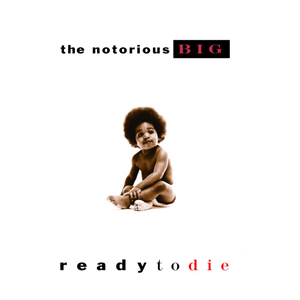
By presenting a concept album, I also see a parallel between Lamar's project and Notorious B.I.G.'s Ready to Die--an album that came out in 1994, so almost twenty years ago in keeping with the 'every ten years' idea. I would not characterize Ready to Die as a reflection. Instead, it is a provocation, from its lyrical content to its front cover, which features a black baby juxtaposed with the album title. Biggie was seeking to capture his world with its oppression and paradox, a world where a black man was ready to die as soon as he was born.

The reception of Ready to Die, particularly through its radio-friendly songs such as 'Juicy' and 'One More Chance' (in the remixed version specifically), makes it easy to forget about the more hard-hitting tracks that appear on this album as well. Through them, we are exposed to the ways in which the protagonist sees the world: at times its hope and promise, but also its insurmountable difficulties that eventually lead the narrator to suicide on the final track. 'Juicy' is the most optimistic moment of the album, although the verse opens with the line 'It was all a dream,' creating an immediate (and unanswered) question about whether the song should be understood as truth or fantasy. There is no ambiguity about how this album ends: a gunshot and an incredulous friend on the phone who has aurally witnessed a suicide.

Just as I am reluctant to claim that there is some mandated ten-year cycle for hip hop albums that indelibly change the genre, I am equally wont to suggest that hip hop is 'evolving' as time goes on--genres do not evolve so much as they shift and change. What I would suggest instead is that these three albums demonstrate the profound variety of responses that hip hop has grown to accommodate: from Biggie's provocation to Kanye's stylization and now Lamar's sophistication. If you haven't yet had the chance to listen to To Pimp a Butterfly, I hope you will take the time to check it out, as I have only scratched the surface in terms of what could be said about it.

Monday, May 19, 2014

Boney M's 'Rasputin': Exotic and Historic?

'Someday, I will inspire a great disco hit,' contemplates Rasputin


My previous post on exotic and historic disco led some readers to suggest that Boney M's 'Rasputin' should be placed in both categories, and not simply the historic one.  I wanted to explore this issue some more, mostly because the question of what signifiers indicate 'exotic' is an important and interesting one.  Exoticism is not a neatly defined category, but one that is tricky and can be interpreted in varied ways.  To me, 'Rasputin' does not sound exotic in the same way as some other songs.  However, I can certainly understand why others would disagree with me, and I would like to take this opportunity to further explore why categories like 'exotic' as so complex.

Russia's engagements with Europe have long been complicated by the idea that the country may or may not belong to the 'West.'  Part of this ambiguity stems from Russia's vast geography since its boundaries extend across much of the Asia to the east while remaining on the eastern edge of Europe to the west.  In terms of historiography, the question is also complicated.  The first chroniclers of Russia lived in Kiev from the 9th-13th centuries and descended from Scandinavian raiders--as a reminder of how complex Russia's history becomes, Kiev is now in the Ukraine, but holds the same esteemed position as a seminal part of Russia's history.  However, Mongolian tribes conquered much of Russia (including Kiev) and surrounding territories, occupying this land from the 13th to the 15th century, imposing a more 'Eastern' culture.  While later monarchs worked hard to foster Westernized ideas and structures (such as Peter the Great and Catherine the Great), unifying all of Russia in terms of culture never worked.  Even during the Soviet years, when Russian became the only official language for the entire country, problems continued in what would become the breakaway republics--breakaway republics that identified themselves more closely with the culture of the Middle East and Asia in terms of religion, language, and traditions.

This ambiguity between East and West was one that Russians themselves acknowledged, and this exoticism was frequently used as a means of making Russia seem more intriguing.  Take the case of Vaslav Nijinsky, for example, who was one of the central dancers in Diaghilev's Ballets russes, the company that performed to phenomenal success in pre-WW1 Paris.  Nijinsky's talents at ballet were prodigious, but part of the way in which was presented to audiences emphasized his potentially exotic qualities, both in terms of the roles he danced (such as a 'golden boy' in Scheherazade) and his actual appearance--even though Nijinsky himself was of Polish descent, his features were thought to be Tatar or even Japanese. 

The idea that Russia could be either East or West (or both), then, has long been a part of discourse on the country.  In this sense, 'Rasputin' can be understood as an exotic work based on subject alone.  The way in which he is portrayed from the song emphasizes potentially exotic qualities: he is 'Russia's greatest love machine,' and he does not die easily (I am reminded of Bartók's Miraculous Mandarin, in which an ambiguously 'Chinese' character proves challenging to kill).  I certainly see how the depiction of Rasputin here appropriates some of the same discourse often found in exotic characters, and there is a much longer tradition of viewing Russia as a nexus of East and West; at the same time, perhaps this is too much analysis for a song that also proclaims that its titular character '...was a cat that really was gone.'

Musically, though, I do not hear this particular song as exotic.  In fact, it is very much in the tradition of funk/disco that preceded it, even though some of these musical features overlap with what are often considered to be exotic musical tropes.  Main examples of these tropes include features such as unusual instruments (such as the the sitar in the Rolling Stones 'Paint it Black', which Mick Jagger declared at various points sounded either 'Turkish,' 'Indian' or some other exotic culture chosen at random), unorthodox scale systems for Western music, and particularly chromaticism (which fits with the 'unorthodox scale system' idea).  These tropes are not necessarily specific to regions of music; instead, as the Mick Jagger example reminds us, they serve more broadly to indicate something from 'outside' of the typical Western system.

While many of these tropes were established in art music during the eighteenth and nineteenth centuries, they continue to have a long reach.  Going back to Carl Douglas' 'Kung Fu Fighting,' for instance, the vocal line uses one of those unorthodox scale systems.  It is pentatonic, which means it has only five pitches (Western music, whether it is major or minor, typically has seven pitches).  Pentatonic scales are very common in East Asian musical traditions, such as those found in China and Japan:

Every-body was kung fu fight-ing
1        2        3    5      4  4      5


Those kids were fast as light-ning.
1        2      3      4    3   3      2

Now go back and listen to the opening 'Oh's.  Same thing.

'Rasputin' is pretty clearly in a minor key, although there are some parts that incorporate major elements.  This might seem like an unorthodox scale system at first glance, but it is a very common system in such styles as jazz and funk, where flipping modes or incorporating unexpected moments within a standard scale is common.  The term 'blues' note is exactly describing this phenomenon, for example.  Jazz and funk were working to undermine aspects of Western classical music, but they did so by incorporating unexpected features, not replacing the system entirely.  If this explanation feels convoluted, let's turn to Shaft for a clearer version.  Listen to the opening, which seems to start very clearly in G major, particularly with that guitar playing the series of repeated Gs:


But then suddenly at 0:10, the bass shifts to an F natural, suggested that perhaps instead this opening is in C major.  Is this exotic?  I would say not, since it relies on a comprehensive knowledge of Western classical harmony to make it work.  Is it a holdover from jazz, where major and minor become interchangeable?  I would certainly say yes.  This song also bridges between funk and disco, so it serves as a template for what would happen next.

There are some other elements that could be understood as musically exotic here, particularly the emphasis on repetition.  However, repetitive lines are another feature commonly found in funk, as numerous examples show:


If you follow pretty much any one musical line here, you will find a great deal of repetition (I would recommend the brass).

[HOW WAS THIS ON GLEE?  NO.  THOSE ARE NOT THE VOWELS.]

'Rasputin' has several of these qualities that are attributable to disco/funk, including repetition and major/minor mode shifting (the verses are minor, the chorus is major).  Yet there are some exotic qualities too, like what sounds like a balalaika (traditional Russian instrument) and even performances that seemingly emphasize the exotic qualities of the song through the costumes:


For me, it isn't enough to proclaim this song as exotic.  I am happy to proclaim it descending from its funk ancestry.  At the same time, though, I don't feel that my opinion is definitive.  Concepts such as 'exotic' or 'Western' are dependent on often ambiguous signifiers, and as such, what I might hear could differ from what another person hears.  I don't deny that there is an exotic factor in this song--made even more complicated by the fact that the performers are part of a German band comprised of black people performing in English.  While I am not quite ready to put 'Rasputin' in the same category as 'Kung Fu Fighting' exotic-wise, the complexity of this example shows how seemingly simple pop music can mask clashing and conflicting sophistication under the surface.