Showing posts with label Stephen King. Show all posts

Thursday, March 27, 2014

Kim Kardashian and Anti-Muses

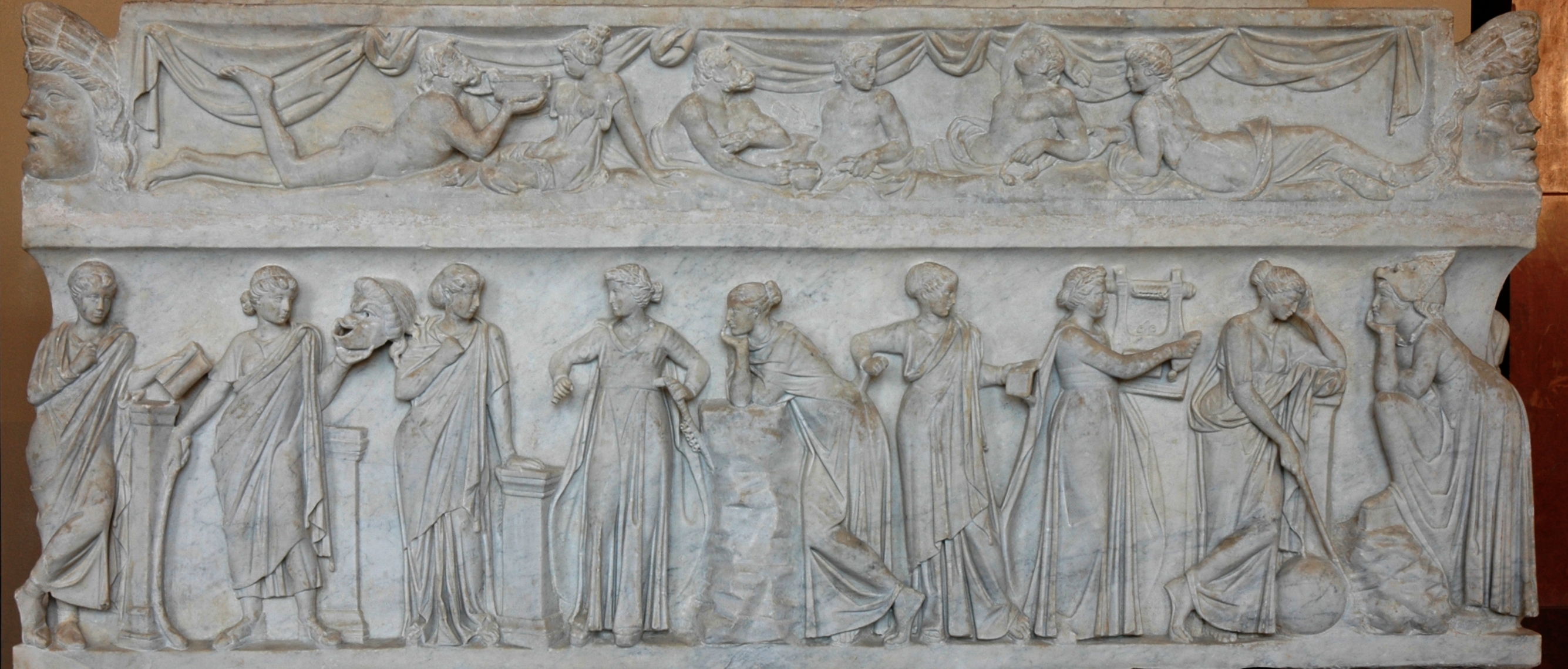
My consideration of the Vogue cover got me thinking about KK as a type of modern anti-muse, and more generally about the idea of the muse in the first place.  Muses have been around for a long time, as you undoubtedly know, dating all the way back to the Greeks.  They were supposedly the inspirational force that helped artists create their products.  The Greeks had nine of them, each of which represented different disciplines:

It's funny how 'Thalia, Muse of Comedy' and 'Salome, Beheader of John the Baptist' could be easily confused in this depiction
The concept of the muse has been around for a very long time, likely because anyone who is creative knows how hard creativity can be.  What causes that spark of inspiration (or lack thereof)?  That being said, the role and personification of the muse has changed drastically.  In fact, I recently argued (on a different blog) that Annie Wilkes in Stephen King's Misery is effectively a muse, only a nightmare version of one, because sometimes you need some tough love to complete your creative work.  By which I mean, sometimes you need to be hobbled and in fear of your life to write a novel.

 However, there can also be those who hinder creativity.  For the sake of this post, I am calling them anti-muses (which is oversimplifying the situation), and they too have a long history.  In the modern context, anti-muses are women (but not always), which is a reflection of how genius has been construed over the past couple of centuries in Western culture (a brief history of genius, from Antiquity to present, is summarized in this review of Darrin M. McMahon's book about this topic).  Around the eighteenth century, a genius was viewed as a man who possessed great talent, but who had to struggle with it to share this talent with the world in its truest artistic form.  Women could not share in genius because they had other roles, the most important of which was motherhood.  They could create life, whereas men could create art.  Gendering genius was inherent in the concept from its origins in Antiquity, but became particularly powerful during the nineteenth century, when (European) women would willingly give up their creative endeavors because they felt their contributions were less meaningful than those of men.  My background is music, so I can think of numerous female composers whose outlook adhered to this philosophy.  Clara Schumann, for instance, was hailed as a great interpreter of genius in her piano performances, but her compositions were deemed less worthy of attention--and the genres that she chose were most often the types of pieces that would be performed in the home (such as Lieder and piano works) rather than grandiose, public performances of symphonies or operas.  Fanny Mendelssohn gave up composition once she was married because she felt it was no longer an appropriate activity for her with her domestic and familial obligations.  Perhaps the most maligned figure is Alma Mahler, whose penchant for creative men led to this delightfully misogynistic summary of her life, portraying her as combination slut, magically temptress, and harridan:


If you're interested, Alma Mahler's compositions are very interesting.  She gave up composing while married to Gustav Mahler because he felt that her work impinged on his genius.

By now, you're probably thinking of one of the best-known recent anti-muses, Yoko Ono, whose relationship with John Lennon was the subject of much ridicule during his life.  Ono's fame as an avant-guard performer and artist has been re-evaluated since then, as has that of Alma, Fanny, and Clara, which I feel is a great step forward in putting the genius/muse model aside and acknowledging that creativity can stem from either direction, without a need for gender--this trope remains stunningly persistent.  There is even a (sort of) nice song about Yoko (even though it mocks her artistic creativity, and implies that John 'gave up musical genius' for her):


In fact, there are select cases where both couples can be admired for their creative ability on almost equal footing.  Let me present the couple (and work) that I think most fully represents the ideal of the creative pair today:


(If you're curious, Beyoncé did contribute to writing this song, so she is not simply a performer here).

There is a peculiar dynamic between KK/Kanye and Jay-Z/Beyoncé, at least in the court of public opinion.  I have no idea what kind of dynamic they share behind closed doors.  Jay-Z and Kanye have a professional relationship in that they have collaborated on albums (Kanye produced The Blueprint's 'Izzo (H.O.V.A.)'....okay, maybe he is a genius).  One of Kanye's most infamous moments occurred because of Beyoncé, when he interrupted Taylor Swift on stage at the 2009 MTV Video Awards to definitively state that Bey deserved the best video of the year (or possibly of all time).  More recent news stories have speculated that Jay-Z does not want to be best man at Kimye's wedding if it will be later featured on a reality show and that Beyoncé may go so far as to boycott the event all together.  Are they friends?  Enemies?  Frenemies?  Is KK Kanye's Beyoncé?  Is this an Illuminati plot?  No lack of speculation.

I suspect that part of this public perception of a peculiar dynamic involves creative inequality.  As I mentioned in my previous post about the Vogue cover, many (most?  all?) of us find KK to be a bewildering celebrity.  She has seemingly attracted an enormous amount of attention for accomplishing almost nothing.  How is this possible?  No one has cracked this code yet--I mean, there have been proto-KKs, such as Paris Hilton, but they seem to have faded more quickly.  If anything, KK may be even less talented than Paris.  I submit to you their singles:


Shut up, I kind of like 'Stars are Blind.'  2006-2007 was a tough time for pop music:

  • Brit Brit was out of the zone
  • Rihanna was okay but not 'Please Don't Stop the Music' good
  • Lady Gaga was just a sparkle in Stefani Germanotta's eye
  • Beyoncé was all Dreamgirls, which is fine, but not 'Crazy in Love'


This song is terrible.  It has no redeeming qualities.  In fact, it may have one quality that makes it even worse: it was 'released' as part of an episode of Keeping Up with the Kardashians.  There, you feel really icky now, don't you, and you want to go get your ears cleaned out with soap.

Perhaps KK peaked at the right time, with the advent of media like Twitter and reality shows becoming the predominant genre of television.  But if she is famous due to luck (and money), then what is even more bewildering is the fact that she is engaged to Kanye West.  Certainly, we should all be skeptical about his claims about his own genius, but he has had a lasting and profound effect on popular music.  It is hard not to ask questions, Arrested Development style, about what KK is doing with him.

All of this skepticism came to a head when Kanye released his video to 'Bound 2,' a video that, once you have seen it, you can never unsee (and I am not embedding to this post for that very reason).  I likely do not need to detail what happens, since it was all the talk for a week or two there, even inspiring parody videos and an episode of 'South Park.'  In a sense, Kanye wins again, because he has created a work that is now inextricably linked to the song, just as Michael Jackson did with 'Thriller,' Britney Spears did with 'Baby, One More Time,' and Nirvana did with 'Smells Like Teen Spirit.'  This is part of the role of the video, of course: to provide a lasting visual association with the song.  But the criticism (positive and negative) leveled against Kanye for 'Bound 2' ranged drastically, from uncanny valley, to covert critique of American society, to Kanye's Gigli moment.  Honestly, I am still not sure what to make of it, but I'm still not sure what to make of Yeezus as a whole, so maybe that is not surprising.  If you are the type of person who feels that Kanye is being led astray by KK, then you are probably in the appalled camp, since it seems that a talented man is under the spell of a talentless hack and creating a sensationalistic video with little artistic merit.  In other words, an anti-muse.  You might even blame all of Yeezus--undoubtedly Kanye's most divisive album to date in terms of public approval--on KK.  This falls into the 'it's all her fault that the genius has lost his touch' trope of the anti-muse, much like those New England Patriot fans who blame Gisele for the lack of recent Superbowls.  The gendered genius returns, bereft of the muse he needs to succeed.


 I would like to suggest that KK may have been Kanye's muse for longer than was immediately apparent.  One of the (bizarre) facts that has been revealed in the course of their relationship is that Kanye has waited for years to have the opportunity to date KK, but she was always with football players or basketball players or busy recording the single worst song ever to emerge from a recording studio and I am including 'Popozao' in that assessment.  This unrequited desire may have surfaced a bit earlier in Kanye's career, because if this video is not meant to depict KK through its blatant inclusion of a KK look-alike, then I will watch 'Bound 2' again by choice:


As with my post about the Vogue cover, I am left with more questions than I began with:

1) What on earth would it say about Kanye and KK's relationship if this is meant to be some kind of Kanye fantasy?  Because I HAVE A LOT OF QUESTIONS.  Beautiful, dark and twisted, indeed.

2) These lyrics seem remarkably acute in describing KK, particularly her love of all things material.  But they seem remarkably inaccurate in describing contemporary Kanye (trips to Florida?  He hangs out in Paris now).  This leads to another great puzzle in the Kanye canon: has Kanye changed?  Is Kanye allowed to change?  (Yes)  Has he lost it because of these changes?  Were these changes effected by his anti-muse?   Or is his anti-muse symptomatic of these changes?  Can change be good?

The general public opinion seems to be not in this case, as evinced by the countless YouTube comments asking 'What happened to you?' on Kanye's more popular tracks (like this one.  I had to add 'Homecoming' because it has been stuck in my head for the past week or so).  There is a larger question here about artistic development--one that I hope to address in a future post--and I would always caution against mapping biography too closely onto artistic products.  But this is my question time, and these are my questions.

Thursday, March 20, 2014

Why do we still like epics?

We live in an age where brevity is the soul of...well, it's basically our soul.  It's an age where there is a truncated manner of expressing that something is too long, and therefore that we didn't read it (TL:DR).  An age where an entire form of communication has been constructed around images/clips/animated GIFs to express our sentiments and feelings (Tumblr).  An age where a medium for exchanging information limits our responses to 140 characters or less (Twitter).

And yet, somehow we love sprawling, time-consuming, wordy epics.  For those who feel that they are TL, these epics are available in multiple media forms, such as the movie franchises of Lord of the Rings or Harry Potter [Ed. note: it would probably take less time to read The Hobbit than to watch all three movies].  However, I don't want to discount the fact that people are reading books, long books that one might assume are TL, but that, in fact, people do read (which, confusingly, is also DR).  In fact, we are almost inundated with epics in our culture, possibly to an unprecedented degree: in addition to the ones listed above, there is also Stephen King's Dark Tower, George R. R. Martin's Game of Thrones, and even epic-lite in those Twilight books (which also spawned Fifty Shades of Grey.  This is probably not epic, unless you are referring to epically bad writing). 

Why do we love epics so much?  Maybe the better question is, when have we not loved epics?  One of the oldest recorded works of literature is The Epic of Gilgamesh, of course.  Countless other examples have survived through the ages.  Even for those unfamiliar with the originals, the classical epic continues to exist in the cultural imagination in forms such as Troy.  But there is a significant difference here.  I suspect that your average person on the street would not be as familiar with the Iliad even when it did star Brad Pitt or the Chanson de Roland [Ed. note: this one kind of goes on, sometimes, in places, while fair Roland climbs a hill for what feels like forever, so maybe it is good that we are not so familiar with that one any more], but that this same person would be familiar with the modern versions listed above.  So perhaps the question is better framed as, why do we love these epics? 

You may be wondering why I haven't mentioned the most sprawlingest, time-consumingy epic of our age, which has to be Star Wars, especially when you consider the wealth of literature, film, commentary, and other cultural references that it has spurred [Ed. note: there is even a 70s variety show holiday special, which you would think would be hysterically funny because it has to be so bad, but then somehow transcends to an entirely new level of bad that you never even thought possible, even in your wildest dreams.  If that's not 70s enough for you, then how about the disco medley of themes from the original movie as featured on Dutch television?].  Indeed, this post was motivated by the fact that I have consumed an alarming quantity of Clone Wars episodes now that they have become available on Netflix Instant.  For the sake of my dignity, I will refrain from telling you where I am in terms of the whole series [Ed. note: Chewbacca has shown up].  Part of Star Wars' appeal, of course, is that it dabbles in many of the same kinds of themes that are so common in epics throughout the ages.  There is the hero on his quest, in the form of Luke (and, as we learn in the earlier movies, his father).  There is the conflict between father and son.  There are hints that a larger power binds us together, but can also be harnessed to pull us apart; in the Iliad, these were the gods, whereas in Star Wars, it's The Force.  There is the fear of death and questions about the afterlife, which is found all the way back with Gilgamesh.  There are a series of wandering characters that have either lost their actual homes (the Jedi in the later movies, Leia after the destruction of Alderaan) or their perceived ones (Anakin, which is one of the routes to his downfall).  Undoubtedly, these timeless conflicts are part of why Star Wars remains so appealing--in fact, there is a Jungian analysis of an episode of Clone Wars that seeks to uncover some of the age-old themes contained within this particular series.

However, I don't think that these themes are the only reasons that epics are so hip right now.  Instead, I think that it is the possibility unveiled in the epic world, and the ability to translate that 'world' into a form of reality--or at least a form of online reality--in a way that never existed before.  To fully get this idea, imagine if Wagner's Ring cycle came out now.  People would make a Wagnerpedia to trace characters and backgrounds.  There would be Wagner blogs, Wagner websites, and general Wagneriana as everyone tried to find even more hidden connections between each of the music dramas--this does exist, in a way, but it has been sanctioned instead as scholarly work and musicology instead of fandom.  I totally see a graphic novel.  In fact, I totally want to see a graphic novel and someone should get on this.  Fans did exist, in a way, even back when these works debuted.  They created 'listening guides' so that audiences could follow along with the themes (German musicology scholar Christian Thorau has discussed the importance of the leitmotiv as a concept in his book Semantisierte Sinnlichkeit, if you are interested in finding out more on this topic).  But an entire Wagner world was out of most people's reach, unless you happened to be King Ludwig of Bavaria, who re-created the grotto from Wagner's Tannhäuser at his Linderhof Palace:


Probably not the best use of taxpayer money

I would like to submit that part of the fascination with epics now is that we have an unparalleled way of visualizing the worlds that are contained within them.  These worlds can emerge in obvious ways, as in film adaptations, but there are even more ways in which these worlds are being brought to life:

1) New Zealand has actual Lord of the Rings tours so that you can immerse yourself in the landscape seen in the film--or, if you prefer, the vision of the landscape found in the books as imagined by Peter Jackson:

Actual epic-looking figure in foreground will likely not be part of your tour
2) There is Harry Potter Land (better known as The Wizarding World of Harry Potter).  It exists at Universal Studios in Orlando, FL.  Not only can you 'see' Harry Potter, you can also 'live' parts of the books by consuming such delicacies as butterbeer or candy treats from Honeydukes:

I selected this photo because I feel like no one would mistake these park-goers for Hogwarts students

3) To the best of my knowledge, there is no Star Wars Land, or if there is, it is wholly housed in some guy's basement (don't worry, Disney is already on this).  And there have been virtual Star Wars worlds, in the form of the MMORPG The Old Republic.  This expanded world also exists in digital form through the Wookieepedia, a website that (as you may have guessed) replicates Wikipedia, only for the universe of Star Wars.  It is a remarkably comprehensive chronicling of every possible character, planet, or other feature to do with the Star Wars universe.  In fact, it is so comprehensive, that if you need basic information about some character, you may sometimes find yourself reading the article introduction, obtaining the basic facts that you wanted, then realizing that there remains an entire article whose information is not even necessary.  Take, for instance, the Nightsisters, which has a four-paragraph introduction providing an outline of their history and purpose, then has eight more subsections in case you want to know more (it's okay to say TL:DR here.  Don't feel bad.  If you have no idea who the Nightsisters are, or why they are important to the plot of Star Wars, as I mentioned above, Clone Wars is on Instant Netflix).

[Ed. note: I have read the entire Nightsisters article]

It's worth taking a moment to consider the history of the encyclopedia, which originated in the Enlightenment as a means of discovering, classifying and documenting the world as interest in science overtook belief in religion.  We take encyclopedias for granted now, since we have such easy access to an unprecedented amount of information; even (the much reviled by those of us who teach) Wikipedia provides a wealth of knowledge about arcane topics that may not be found in any other resource.  Where else can you turn quickly when you forget the names of the Thundercats, for example?  Just as Wikipedia documents a more complete picture of our world than its print forebears like Encyclopedia Britannica--which does not have information about the Thundercats--a project like Wookieepedia gives the impression that it is documenting a world that is fully developed, coherent, cohesive, and operates as a unit.  Without modern technology, such documentation would be virtually impossible.  It is this epic world-building, I would argue, that keeps epic storytelling relevant in our post-modern world.

To finish up, enjoy the modified Clone Wars version of the Star Wars theme, which has been changed so that it is more militaristic and less heroically bombastic--this is, of course, a universe at war: