Siri, note to my assistant. I have decided what I want as the background for my pregnancy announcement photo. I want a floral arrangement that would not be out of place in the Sun King's court. It should be at least three feet tall and include flowers that are the size of a pomegranate. I am not exaggerating.
Siri, write an email to lilmonsterno1@gaga.com: Dearest Lady G, I extend my heartfelt gratitude to you for inviting me to perform with you at the Superbowl this year--my apologies for the fact that you have not been able to reach my telephone! Unfortunately, I must decline, as I am with three hearts. This is not some weird Illuminati thing, but my way of saying that I am pregnant with twins. I would like to offer you some advice based on my experience last year, when I stole the show from some band that no one remembers. Be sure to have sufficient leg strength that if you appear to fall during your set, you can pull yourself right back up. All of America will then question whether you did almost fall, or if you are, in all things, Flawless. With the most profound love from all three of my hearts, B.
Siri, note to my assistant. Please notify the florist that while the original floral arrangement sent over was passable, I will require one that it at least three times as big. And more elaborate. And with more flowers. Also some of the flowers should be larger. And with more accompanying foliage in the background.
Yesterday, I traveled to Washington, DC along with a million or so other people to participate in the Women's March that took place following Donald Trump's inauguration event. I sure that most participants would agree that the trip was a whirlwind of emotions and experiences. In my case, four songs surfaced over the course of the weekend that helped me make sense of the event, and perhaps a little more sense of how the world looks after the most recent election.
One of many MLK quote signs seen on the walk from RFK Stadium to the rally. Out of town buses parked at RFK Stadium and marchers walked from there to the Mall.
The Beatles, 'Across the Universe'
I took a bus to DC and on the way down, we watched the movie 'Across the Universe,' a 2007 'British-American jukebox musical romantic drama film' (convoluted genre definition per Wikipedia). While the film itself did not leave much of an impression, I did get the song 'Across the Universe' stuck in my head as a result. One line of it stayed with me throughout the weekend: 'Nothing's gonna change my world.' As I looked around DC and saw the juxtaposition of the inauguration aftermath and women's march, this line took on new meaning.
'Nothing's gonna change my world' felt particularly applicable to those who claim they can 'make America great again'--bring it back from its current changes to some kind of better time. This slogan has already been subject to great criticism, and rightly so, as it is hard to envision an era when America was equally great for all. This imagined time and place fits what Svetlana Boym identified as a key trait of nostalgia:
It is the promise to rebuild the ideal home that lies at the core of
many powerful ideologies of today, tempting us to relinquish critical
thinking for emotional bonding. The danger of nostalgia is that it tends
to confuse the actual home with an imaginary one. In extreme cases, it
can create a phantom homeland, for the sake of which one is ready to die
or kill. Unelected nostalgia breeds monsters.
The term 'unelected' feels particularly ironic here. Boym was writing in 2001 and her subject was primarily the nostalgia that permeated the Soviet Bloc, encouraged and established by its dictators. Today's nostalgic longing to 'make America great again' is cut from the same cloth, but was produced in a democracy by a group of people who refuse to let anything change their world. Boym identifies this type of nostalgia as 'restorative,' a type of nostalgia that relies on concepts of 'truth and tradition'--although in this 'post-truth' world (as in the Soviet Bloc), there are many ways to inflect truth with fiction. Boym continues:
Restorative nostalgia is at the core of recent national and religious
revivals. It knows two main plots—the return to origins and the
conspiracy...Restorative nostalgia takes itself dead seriously.
Restorative nostalgia is a danger because it is a fiction that presents itself as truth. As such, it is nearly impossible to argue with its catchphrases. 'Make America Great Again' presents exactly this problem: I cannot cogently maintain that America was 'never great'. I can nuance the discussion by suggesting its greatness was mired in inequality (arguments that others have made far more expertly than I) or its triumphs have benefited some individuals rather than the greater good. But it is wholly impossible to counter nostalgia with facts. If nothing's gonna change your world, then nostalgia is the only means available to preserve it.
Public Enemy, 'Fight the Power'
For the first part of the day, I was unable to get close to the speakers because there were so many people at the rally, so my experience was remarkably free of noise apart from the murmurs of the crowd (and occasional chant/cheer). Participants in the march were told ahead of time not to bring large bags because they would be subject to search, but not everyone heeded this guideline. Early in the afternoon, one man walked by where I was sitting with a boombox playing 'Fight the Power.' On the surface, this song seems like an appropriate one for the march, whose mandate was not limited to women's rights, but rights for all who experienced inequality. Indeed, why were we all there unless we were fighting the power? But as I thought more about it, I couldn't reconcile this song with this event.
'Fight the Power' is also a slogan, although clearly it does not draw from the same nostalgia as MAGA. But it is a unilateral declaration by Chuck D in the song. The Women's March, in contrast, did not have a single slogan. Instead, marchers brought signs, many of which were made by hand and sharing different messages. Calls for public art brought varied interpretations of the march's ideas--several of these signs were brought by those marching, along with art by Shepard Fairey. As we were walking from the bus to the Mall, a young black girl held up one of Fairey's posters:
'Thank you!' she yelled enthusiastically as the crowd walked by. 'Thank you all for coming!'
While the Women's March may have sought to fight the power, it was the multiplicity of voices that made it such a powerful event. All of the signs were rooted in the fundamental idea of equality, but the variations on this theme were almost overwhelming in their volume. Signs were seen all over town--many left on display near the National Gallery--imparting their messages even as the event wound down.
Beyoncé, 'Formation'
I did finally manage to get to a place where I could hear the speakers for the rally as the speakers drew to a close (I missed the Madonna moment, for instance--this is the hazard of attending rather than watching the highlights). There was also indigenous music performed to wind up the official ceremonies--while I was unable to find a clip of that performance, Indigenous Women Rise was an important presence at the march. Once the ceremonies concluded, music turned over to a DJ, who started off the party with what was, perhaps, the obvious choice: Beyoncé's 'Formation.' Naturally, the crowd responded enthusiastically.
As I have written about before, 'Formation' is an important song within Beyoncé's oeuvre because it engages with her identity as a black female artist. It accomplishes this in part by imbricating personal details: she has 'hot sauce in her bag swag,' we learn about her origins as a 'Texas bama.' What struck me listening to 'Formation' in this context is that the women around her bring their identities too. We hear their voices later in the track during the 'slay/okay' section, as they get in formation. This imagery fit the event almost perfectly as so many different people came together for the cause.
Undoubtedly this struck me because I was deeply moved by how variegated the crowd was. It was impossible to know what motivated each person to participate, but it was incredible to witness so many people who felt strongly enough to fight for equality that they traveled to DC and participated in the event. We all slayed, everyone who marched, wherever you marched. Thank you for being in formation.
Kid Rock, 'All Summer Long'
As I was leaving the rally, I almost stumbled into an event held by Bikers For Trump up the street from the Mall. The music playing sounded like Kid Rock (it may not have been), and it brought back a nostalgia that was almost wholly absent from the rally. Even the name 'Kid Rock' is nostalgic: he is no longer a kid, and this reference to 'rock' hearkens back to the 60s or 70s. 'All Summer Long' is a song that doubles down on its nostalgia, quoting from Lynyrd Skynyrd's 'Sweet Alabama'--an ode to the nostalgia of place in its own right--in the process. In an instant, I was back in a place that wants to Make America Great Again with its pseudo-rock music that longs for another time. In the distance, I could still hear chants from the world that yearns for change.
In the wee hours of Friday, shortly after midnight, Kendrick Lamar dropped a new surprise album entitled 'untitled unmastered.' Along with this enigmatic title came an enigmatic title image:
Early commentary on this album has pointed out that it may be closer to a series of sketches than a completed product; certainly the choice of the word 'unmastered' in the album's name suggests this interpretation. However, in thinking over what this album presents, I am struck by the complexities that Kendrick has incorporated into it solely based on these naming conventions alone. An untitled piece of art is not necessarily an incomplete one.
Wassily Kandinsky's 1916 untitled painting
What an unmastered work is remains unclear, at least in this context.
The track names are equally nebulous. Rather than providing specific titles, there are only dates, suggesting that these are works that were abandoned at some point. But what point? What do these dates represent? Start dates, end dates, abandoned dates, studio session dates? This question of dates is not trivial. For example, some of the material in these songs has been heard before on late-night appearances and in other contexts and these dates don't match those in the title for the track. Instead of a specific date, as most the tracks have, 'untitled 7' dates from 2014-2016 and incorporates a range of different recordings that are abruptly connected. Thus this track spans a broad swath of time, beginning with a 'song' that might otherwise be called 'Levitate' (in the vein of 'Bitch Don't Kill My Vibe' from Kendrick's first major album, 'Good Kid, M.A.A.D City') and ending with what sounds like an improvised jam session with friends. Abrupt shifts during a track are not unusual for Kendrick as they abound on 'To Pimp A Butterfly,' but here they reveal that while what we're hearing may be 'unmastered,' it is not unedited. At one point during the start of the jam session, Kendrick states, 'This is a fifteen-minute song!' The whole track is only 8:16, and at that point we are already five minutes in. Consequently, the listener is made acutely aware that either there were cuts or that this was not really a fifteen-minute song. Either way, what is presented to us on 'untitled unmastered' should not be accepted necessarily at face value.
I have two possible interpretations of 'unmastered' for this album. The first is that these are tracks that predate 'To Pimp A Butterfly' and he is suggesting that it is that album which is masterful. Indeed, the tone and language here is somewhat out of place with that on 'To Pimp A Butterfly,' whose trajectory explores many different nuances of controversial terms (and almost entirely eschews the word 'bitch'). So perhaps Kendrick did undergo a change in his artistic outlook between 'Good Kid, M.A.A.D City' and we are seeing its evolution here; these tracks, then, are from before he 'mastered' his art. Alternatively, perhaps these songs simply didn't fit the overall narrative. The albums that bookend these tracks (if the dates on 'untitled unmastered' are accurate) both, ostensibly, had a plot--the plot of 'Good Kid, M.A.A.D City' is outlined more clearly, but there is definitely one on 'To Pimp A Butterfly' as well. These tracks could be leftovers that were not quite right for those albums and didn't fit with the overall structure.
And yet, even on 'untitled unmastered,' Kendrick has a linking device with a rallying cry 'Pimp pimp, hooray' that appears between various songs and is the last sound on the album. So although these may be 'unfinished' or 'unmastered' tracks, in the end, Kendrick presents a 'master' copy that links together what has come before, and what was originally a simple title proves to be far more complex.
Over the past weekend, while you were going about your business, Beyoncé managed to drop a song pretty much out of nowhere on an unsuspecting public, then take over the Superbowl halftime show like she was the headliner. Also she reinvented her role in contemporary culture, overpowering the limitations frequently imposed on female pop stars to engage directly with an escalating civil rights movement. Lastly, she almost fell down while performing but recovered without even missing a beat because when she isn't busy with all the rest of this, she evidently takes the time to do some squats. But I'm getting ahead of myself here. Let's go back to the song that launched a thousand--or perhaps even more--think pieces.
'Formation' is, as many commentators have pointed out, a song that indisputably engages with blackness, both in its video's imagery and its sound by drawing on tropes associated with black culture, particularly that of New Orleans. Not surprisingly given the subject matter, the video incorporates images from the aftermath of Hurricane Katrina, culminating in Beyoncé on top of a police car sinking into a lake. 'Formation' conjures up similar imagery to Kendrick Lamar's most poignant contribution to the new civil rights movement, the song 'Alright' and its video. Indeed, it would surprise me if Beyoncé had not had aspects of Lamar's video in mind when preparing hers. But that doesn't diminish from Beyoncé's achievement in any way. The issues that are raised by both--the neglect of black communities, the terror state imposed on them by the police--are the crucial issues at the core of this civil rights movement and their importance should be central to this new Black Art.
Due to the subject matter, the polarizing nature of this song may not be a surprise. Yet there is more here than a debate about civil rights; instead, there is a larger shift in our understanding of what Beyoncé means. As Danielle C. Belton points out at The Root, Beyoncé has been, for many, 'some ethereal, race-less, colorless transformative nymph who could doo-wop pop whatever you projected upon her,' but that this image was always, to some extent, a façade. Belton continues:
What if I told you Beyoncé was always political? Even when she was
doo-wop popping in Destiny’s Child. What if I told you that to be black
in a public space, with all eyes on you and choosing carefully how to
handle that spotlight is a form of politics, a negotiation between the
self and the world that all black people must make?
I want to build on Belton's idea by expanding on just how significant it is that this 'transformative nymph' chose to make this video. For it is not only Beyoncé asserting her identity (i.e., her formation) that is key, but particularly that she did so without shying away from the core tenets of today's civil rights.
Prior to 'Formation,' I would argue, Beyoncé was a pop star first, and all other identities second--with this moniker comes certain constraints, particularly for female artists. Acting in a sexually provocative way is virtually mandated; perhaps it is for this reason that many of these women tackle the issue of gay rights, as they are subject to critiques for performing their gender in such a public way, a tradition that extends back to at least Madonna and continues to Lady Gaga and Miley Cyrus today. Yet on other issues, female pop stars wield virtually no power. One prominent example is Britney Spears, whose mental health problems were little more than fodder for the paparazzi surrounding her. Female pop stars are expected to sing and act their parts, but otherwise to remain silent.
Even more so in the realm of hip hop, where the lack of women's voices is a critique often leveled against it. This lacuna becomes even more apparent when considering many of the songs that espouse the values of this new civil rights movement. Take, for instance, the opening to Spike Lee's Do the Right Thing, when Rosie Perez violently dances to Public Enemy's 'Fight the Power.' She may be the one fighting, but there is no indication that this is her fight; instead, she is silence as we hear the lyrics of Chuck D. (in the song's video, women are notably underrepresented).
Beyoncé's music has always resided comfortably in the realm of pop, although she is not wholly disengaged with hip hop, particularly since her husband is Jay-Z. Indeed, the vast majority of her songs would fail whatever the pop song equivalent is of the Bechdel Test, in that men are integral to their narratives. She may be crazy in love, she may be drunk in love, he may be a baby boy, he may have left and is now realizing she is irreplaceable, but there was always a he. Even when he is absent, she is singing to her single ladies about the man who should have put a ring on it. Occasionally, Beyoncé also brings in a girl power song, a pop trope that goes back to at least the Spice Girls' Zig-Ah-Zig-Ahs, but without too much power and far more emphasis on girl. Indeed, the terms found in Beyoncé's career are youthful: child of destiny, girls running the world.
In an age where Disney stars frequently need to throw off the shackles of their childhood careers, we are used to the idea of Lady Pop Stars Growing Up In The Public Eye, a move that can be signaled by a song (Miley's 'Party in the USA' turns into a 'Wrecking Ball') or, in the case of Brit Brit, a song about the ambivalence of growing old ('I'm Not A Girl, Not Yet A Woman'), combined with a movie (Crossroads), and one extremely notorious VMA Award kiss from Madonna. Just as their provocations must be sexual, their coming of age is as well--there is nothing particularly controversial about 'Wrecking Ball' as a song, but there certainly is about the video. In terms of age, Beyoncé is fully grown, but it is with 'Formation' that she finally matures in terms of her music. Rather than court sexual provocation, she has focused her energy instead toward the more crucial issues of our day: on black identity and why black identity is in peril. In this, she is unique (so far) among her contemporaries (the vast majority of whom are white).
Beyoncé slays at Superbowl 50
Not only this, but she unveiled this new image at the most public venue imaginable: during the halftime show of the most watched television program of the year. That this song and its subject courted controversy is not surprising; after all, as Bey herself states, 'You know you that bitch when you cause all this conversation.' But unlike the female pop stars before her, this is the look of power, not the look of provocation. Welcome to Queen Bey and her Formation.
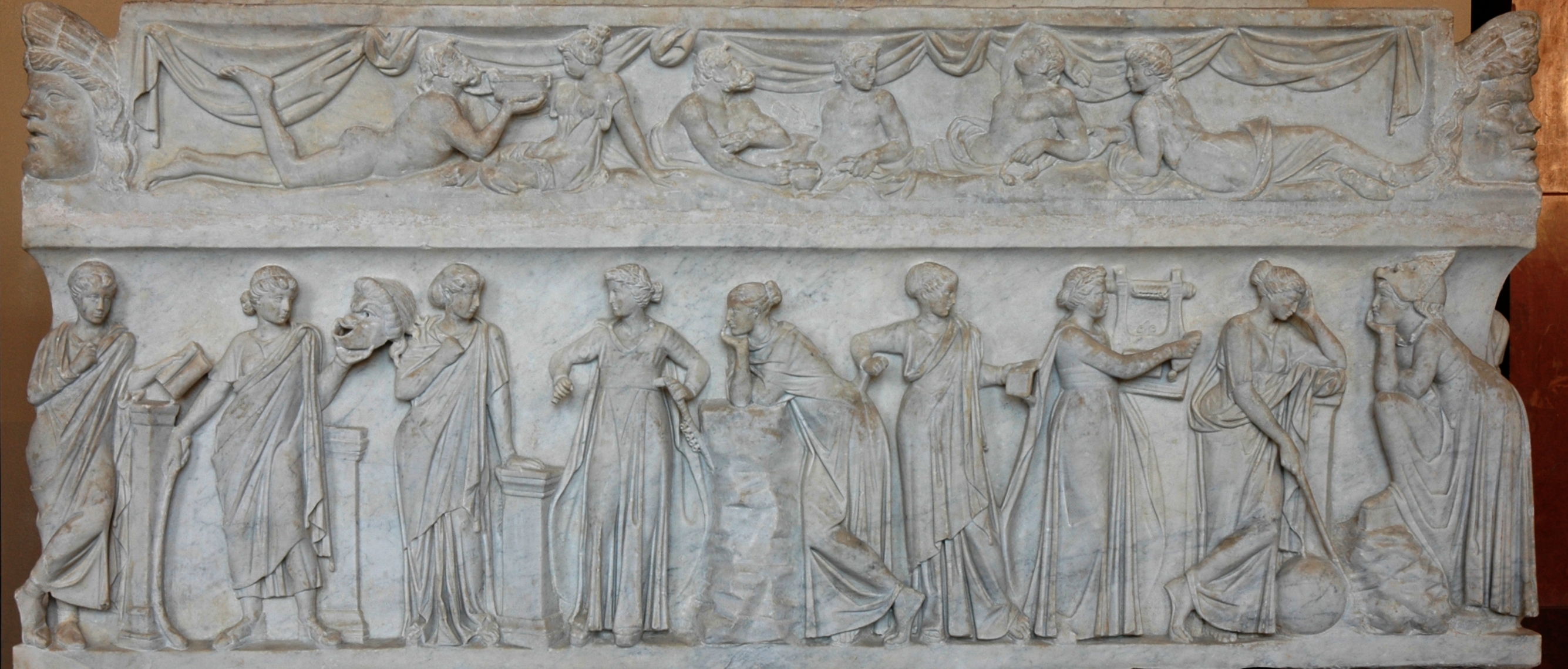
My consideration of the Vogue cover got me thinking about KK as a type of modern anti-muse, and more generally about the idea of the muse in the first place. Muses have been around for a long time, as you undoubtedly know, dating all the way back to the Greeks. They were supposedly the inspirational force that helped artists create their products. The Greeks had nine of them, each of which represented different disciplines:
It's funny how 'Thalia, Muse of Comedy' and 'Salome, Beheader of John the Baptist' could be easily confused in this depiction
The concept of the muse has been around for a very long time, likely because anyone who is creative knows how hard creativity can be. What causes that spark of inspiration (or lack thereof)? That being said, the role and personification of the muse has changed drastically. In fact, I recently argued (on a different blog) that Annie Wilkes in Stephen King's Misery is effectively a muse, only a nightmare version of one, because sometimes you need some tough love to complete your creative work. By which I mean, sometimes you need to be hobbled and in fear of your life to write a novel.
However, there can also be those who hinder creativity. For the sake of this post, I am calling them anti-muses (which is oversimplifying the situation), and they too have a long history. In the modern context, anti-muses are women (but not always), which is a reflection of how genius has been construed over the past couple of centuries in Western culture (a brief history of genius, from Antiquity to present, is summarized in this review of Darrin M. McMahon's book about this topic). Around the eighteenth century, a genius was viewed as a man who possessed great talent, but who had to struggle with it to share this talent with the world in its truest artistic form. Women could not share in genius because they had other roles, the most important of which was motherhood. They could create life, whereas men could create art. Gendering genius was inherent in the concept from its origins in Antiquity, but became particularly powerful during the nineteenth century, when (European) women would willingly give up their creative endeavors because they felt their contributions were less meaningful than those of men. My background is music, so I can think of numerous female composers whose outlook adhered to this philosophy. Clara Schumann, for instance, was hailed as a great interpreter of genius in her piano performances, but her compositions were deemed less worthy of attention--and the genres that she chose were most often the types of pieces that would be performed in the home (such as Lieder and piano works) rather than grandiose, public performances of symphonies or operas. Fanny Mendelssohn gave up composition once she was married because she felt it was no longer an appropriate activity for her with her domestic and familial obligations. Perhaps the most maligned figure is Alma Mahler, whose penchant for creative men led to this delightfully misogynistic summary of her life, portraying her as combination slut, magically temptress, and harridan:
If you're interested, Alma Mahler's compositions are very interesting. She gave up composing while married to Gustav Mahler because he felt that her work impinged on his genius.
By now, you're probably thinking of one of the best-known recent anti-muses, Yoko Ono, whose relationship with John Lennon was the subject of much ridicule during his life. Ono's fame as an avant-guard performer and artist has been re-evaluated since then, as has that of Alma, Fanny, and Clara, which I feel is a great step forward in putting the genius/muse model aside and acknowledging that creativity can stem from either direction, without a need for gender--this trope remains stunningly persistent. There is even a (sort of) nice song about Yoko (even though it mocks her artistic creativity, and implies that John 'gave up musical genius' for her):
In fact, there are select cases where both couples can be admired for their creative ability on almost equal footing. Let me present the couple (and work) that I think most fully represents the ideal of the creative pair today:
(If you're curious, Beyoncé did contribute to writing this song, so she is not simply a performer here).
There is a peculiar dynamic between KK/Kanye and Jay-Z/Beyoncé, at least in the court of public opinion. I have no idea what kind of dynamic they share behind closed doors. Jay-Z and Kanye have a professional relationship in that they have collaborated on albums (Kanye produced The Blueprint's 'Izzo (H.O.V.A.)'....okay, maybe he is a genius). One of Kanye's most infamous moments occurred because of Beyoncé, when he interrupted Taylor Swift on stage at the 2009 MTV Video Awards to definitively state that Bey deserved the best video of the year (or possibly of all time). More recent news stories have speculated that Jay-Z does not want to be best man at Kimye's wedding if it will be later featured on a reality show and that Beyoncé may go so far as to boycott the event all together. Are they friends? Enemies? Frenemies? Is KK Kanye's Beyoncé? Is this an Illuminati plot? No lack of speculation.
I suspect that part of this public perception of a peculiar dynamic involves creative inequality. As I mentioned in my previous post about the Vogue cover, many (most? all?) of us find KK to be a bewildering celebrity. She has seemingly attracted an enormous amount of attention for accomplishing almost nothing. How is this possible? No one has cracked this code yet--I mean, there have been proto-KKs, such as Paris Hilton, but they seem to have faded more quickly. If anything, KK may be even less talented than Paris. I submit to you their singles:
Shut up, I kind of like 'Stars are Blind.' 2006-2007 was a tough time for pop music:
Brit Brit was out of the zone
Rihanna was okay but not 'Please Don't Stop the Music' good
Lady Gaga was just a sparkle in Stefani Germanotta's eye
Beyoncé was all Dreamgirls, which is fine, but not 'Crazy in Love'
This song is terrible. It has no redeeming qualities. In fact, it may have one quality that makes it even worse: it was 'released' as part of an episode of Keeping Up with the Kardashians. There, you feel really icky now, don't you, and you want to go get your ears cleaned out with soap.
Perhaps KK peaked at the right time, with the advent of media like Twitter and reality shows becoming the predominant genre of television. But if she is famous due to luck (and money), then what is even more bewildering is the fact that she is engaged to Kanye West. Certainly, we should all be skeptical about his claims about his own genius, but he has had a lasting and profound effect on popular music. It is hard not to ask questions, Arrested Development style, about what KK is doing with him.
All of this skepticism came to a head when Kanye released his video to 'Bound 2,' a video that, once you have seen it, you can never unsee (and I am not embedding to this post for that very reason). I likely do not need to detail what happens, since it was all the talk for a week or two there, even inspiring parody videos and an episode of 'South Park.' In a sense, Kanye wins again, because he has created a work that is now inextricably linked to the song, just as Michael Jackson did with 'Thriller,' Britney Spears did with 'Baby, One More Time,' and Nirvana did with 'Smells Like Teen Spirit.' This is part of the role of the video, of course: to provide a lasting visual association with the song. But the criticism (positive and negative) leveled against Kanye for 'Bound 2' ranged drastically, from uncanny valley, to covert critique of American society, to Kanye's Gigli moment. Honestly, I am still not sure what to make of it, but I'm still not sure what to make of Yeezus as a whole, so maybe that is not surprising. If you are the type of person who feels that Kanye is being led astray by KK, then you are probably in the appalled camp, since it seems that a talented man is under the spell of a talentless hack and creating a sensationalistic video with little artistic merit. In other words, an anti-muse. You might even blame all of Yeezus--undoubtedly Kanye's most divisive album to date in terms of public approval--on KK. This falls into the 'it's all her fault that the genius has lost his touch' trope of the anti-muse, much like those New England Patriot fans who blame Gisele for the lack of recent Superbowls. The gendered genius returns, bereft of the muse he needs to succeed.
I would like to suggest that KK may have been Kanye's muse for longer than was immediately apparent. One of the (bizarre) facts that has been revealed in the course of their relationship is that Kanye has waited for years to have the opportunity to date KK, but she was always with football players or basketball players or busy recording the single worst song ever to emerge from a recording studio and I am including 'Popozao' in that assessment. This unrequited desire may have surfaced a bit earlier in Kanye's career, because if this video is not meant to depict KK through its blatant inclusion of a KK look-alike, then I will watch 'Bound 2' again by choice:
As with my post about the Vogue cover, I am left with more questions than I began with:
1) What on earth would it say about Kanye and KK's relationship if this is meant to be some kind of Kanye fantasy? Because I HAVE A LOT OF QUESTIONS. Beautiful, dark and twisted, indeed.
2) These lyrics seem remarkably acute in describing KK, particularly her love of all things material. But they seem remarkably inaccurate in describing contemporary Kanye (trips to Florida? He hangs out in Paris now). This leads to another great puzzle in the Kanye canon: has Kanye changed? Is Kanye allowed to change? (Yes) Has he lost it because of these changes? Were these changes effected by his anti-muse? Or is his anti-muse symptomatic of these changes? Can change be good?
The general public opinion seems to be not in this case, as evinced by the countless YouTube comments asking 'What happened to you?' on Kanye's more popular tracks (like this one. I had to add 'Homecoming' because it has been stuck in my head for the past week or so). There is a larger question here about artistic development--one that I hope to address in a future post--and I would always caution against mapping biography too closely onto artistic products. But this is my question time, and these are my questions.
Yesterday morning, I gave a lecture to about 130 students on orientalism in art and music. I talked about Puccini's Madame Butterfly at one point, and I think I might have terrified my students a little bit by sharing with them something I call the "Madame Butterfly effect:" the European-American feminization of East Asia. I showed them Madonna, Gwen Stefani, and Katy Perry playing "geisha"(look up Katy Perry's reasons for playing a geisha. I just can't even right now). In feminizing the East, I argued, the West (used loosely here) also distorts/dismisses/rejects Asian masculinity as well. Which, I told my students, is why the Asian male character in the tv show, "2 Broke Girls," is, um, disappointing. We're supposed to see him as asexual, incapable of wooing any American woman regardless of his antics. He's a small child, a boy - not a man - who is trying to act much older than he is. When he attempts to be a strong and stern manager, he's "play-acting" his manhood. Because he doesn't have any.
I'm digressing. I also showed my students a clip from Bizet's opera, Carmen (the Franco Rosi 1984 film version, OBVS):
The gypsy Carmen is a loose amalgam of different possible ethnicities, especially in the original novella by Prosper Merimee. With wild hair and olive skin, Carmen is ethnically ambiguous, causing Don Jose at one point to ask her (in the novella) if she's possibly a Moor or (dare he think it!) Jewish.
As I was watching this youtube clip with my students in class my mind wandered over to the fact that at some point in the 20th century, Carmen became a character that many African American singers could take on. Last year at the annual American Musicological Society Conference in Pittsburgh, musicologist Kristen Turner from UNC-Chapel Hill presented her research on the first African American opera company from the early 20th century. One of the first productions they staged was Bizet's Carmen. By the 1960s, it seemed perfectly acceptable for African American singers to play her:
A young (and very pretty!) Grace Bumrby in the role of Carmen.
The fabulous diva, Leontyne Price, as Carmen. Which I find a bit odd, given her voice type, no? Regardless: she is SERVING IT on this album cover. Serving it to the Gods.
The mezzo-soprano Denyce Graves has made a name for herself playing Carmen as well.
But this Carmen business goes beyond a few singers being type-casted for the role. When we see new interpretations or retellings of the Carmen tale, they're retold as black tales (African American, more specifically).
Carmen Jones is an excellent example of that. Premiering in 1943 as a Broadway musical (and later in 1954 as a film), Carmen Jones now takes place during WWII at an American parachute factory instead of a Spanish cigarette factory. I think most people are familiar with the 1954 film version, starring Dorothy Dandridge and Harry Belafonte. It's colorful, entertaining, and an intriguing retelling to think about.
Musicologist Annegret Fauser's article on Carmen Jones might be a good place to start if you're looking for more information: "“Dixie Carmen”: War, Race, and Identity in Oscar Hammerstein'sCarmen Jones(1943)" in Journal of the Society for American Music, Volume 4, No. 2 (May 2010), pp. 127-174: http://journals.cambridge.org/action/displayAbstract?fromPage=online&aid=7530408
Of course I would be remiss if I didn't mention the *other* other Carmen, which is Beyonce's 2001 TV Movie, Carmen: A Hip-Hopera (I kid you not):
This production has everything my pop-culture addled brain and spectacle-loving heart desires. This time, Carmen Brown is an aspiring actress who causes trouble wherever she goes. The cast in this production reads like a "who's who" list of late 90s/early 2000s actors and pop/hip-hop musicians: Mekhi Phifer (!), Mos Def (!), Wycleaf Jean, Joy Bryant, Lil Bow Wow, and Jermaine Dupri (!) all make an appearance at one point or another.
And because we all need to see a clip of this in action:
As I mentioned in one of our previous SGS posts, I'm drawn to spectacle, so I'm eating this up like it's cake.
Obvious fact of the day: Black American singers have historically had a difficult time landing roles in the opera world. I don't have time to get into it, but let's just say that there were (and still are) racial biases in operatic typecasting. But what is intriguing to me about Bizet's opera, Carmen, are the many transformations it's undergone since the late 19th century. It's not just that Bizet's original production lent itself well to having different singers perform it. Rather, by the end of the 20th century, the opera became (in American popular culture anyway) black-owned. Beyonce's Carmen was *ridiculous* in a glorious late 90s/early 2000s pop music sort of way. But it's not like Queen Bey (all hail!) was stepping into uncharted territory by reimagining this tale. In fact, critics denounced it as unimaginative.
I'll keep picking away at the "Black Carmen" phenomenon over the years, I'm sure. I'm not done mining this yet. There are just too many gems in this history. Any thoughts on other "black Carmens" out there that I might have missed? Please post in the comments.