Showing posts with label Star Wars. Show all posts

Friday, March 28, 2014

Richard Brody Sounds Off About Music in Movies

Earlier this week, Richard Brody, film critic for the New Yorker, posted a piece about how Lars von Trier had literally RUINED Franck and Handel for him. I'm exaggerating, but less than you think.  Brody also made some bold claims about the role of music in film.  I guess he has that right, as a film critic, but I don't think that the situation is as rigid at this article might lead one to believe.  For example:

For better or worse, there’s an entire realm of music that becomes indissociable from the movies in which it’s used. The touchstone for the phenomenon is when it’s impossible to hear the music in any context without the movie scene in which it’s featured coming to mind.

Better.  Do you need some proof?


There is so much good here, where to begin?  The piece is Schumann's Piano Quartet, op. 44, second movement.  It is a riff on the Beethovenian funeral march, as seen in Beethoven's Third Symphony, which you can tell from the key and the form and the march-like elements at the end of this film clip (around 1:56).  The funeral march is important because our character, Alexander, will attend two family funerals in this film, so it is foreshadowing some of the most important plot events.   

But there's more!  This is not the beginning of the movement.  The movement is in rondo form, which is what happens when you keep returning to the opening section throughout.  The part that we hear at the end of the clip (around 1:56) has been heard before, but Bergman cut it out so that we begin with the lush yet melancholic string part that opens the B section.  I think that this is ingenious.  While the scene opens with flowing water, we quickly shift to Alexander playing with his theater characters in a miniaturized stage (the stage is also an important part of the movie).  As he walks around his home, we see a richly-decorated room with intricate and beautiful furnishings (1:48!).

Yet we know all of this is ephemeral, and the music gives that away from the start.  This section of the movement never settles in terms of harmony or rhythm.  The melody is very clear and could be harmonized in a simple way, but instead, Schumann opts for a relatively sophisticated harmonization that does not come to a clear conclusion (this is typical of Schumann's style, but particularly poignant here).  Furthermore, the piano and strings are working against each other in terms of rhythm: the piano part is in a hemiola with the inner strings, which is subtle enough that the ear does not notice right away, but distinct enough that it is hard for the listener to rest.  As the movie progresses, this beautiful home also becomes ephemeral, as Fanny and Alexander move to a new place and a sad, difficult life.  This is musical nostalgia, in a way, because it is too delicate to settle. 

Scorsese did the exact same thing in Goodfellas when he drew on the piano exit from 'Layla,' another piece that features the same harmonic qualities (never quite comes together), while integrating a melodic line that has too much motion to establish stability.  This melody is also rife with suspensions that lend a feeling of incompleteness; while they do resolve, they don't resolve where they should, which creates an effect of longing.  In terms of harmony, there should be a clear V_I motion to cadence, but there isn't because of that Bb chord that doesn't belong.  That's how you make musical nostalgia, in a nutshell.  What is clear from this moment in the film is that things will never be the same; the life that the Goodfellas have led is drawing to a close and cannot be recaptured.  Indeed, this scene marks the definitive break between Jimmy as a potentially respectable character (he has murdered everyone around him instead of giving them their due) and Tommy (SPOILER ALERT: he doesn't get made).  The silence in the score immediately prior to the piano exit adds to the effectiveness because your ear is drawn to the music right away:


Back to Bergman: at the end of the clip, we realize that Alexander is alone, wandering through the house and calling out the names of his sister, nanny, and others.  No one responds to him--it is in this section that the funeral music also begins.  Alexander will later learn that he is never fully alone, that the ghosts of his past (funereal music) are always with him and that he cannot escape them.  But now, as a child, he can have a moment that I think we understand to be an uncertainty.  He walks around the house and the music loses its lushness.  I am not sure if on first viewing this seems like a form of loneliness--it has been too long since I viewed this with fresh eyes, and I can only see connections with what is to come--but it is clear that, at least for now, he is alone, and the music is sparse as well.

Why do I remember these scenes so keenly?  Because they are good.  They are perfect associations with these moments, both in terms of its musical content and foreshadowing.  After reading Brody's piece, I tried to think of a bad association between film and music, and I was unable to do so off the top of my head.  I suspect that part of what Brody is reacting to here is his proximity to Nymphomaniac, and that with time, his inability to dissociate will subside.  This, to me, is what differentiates good and bad in terms of musical usage.  The good sticks with you.  The bad fades, maybe with time, but it will fade.

I take great umbrage with the following statement in the Brody article:

That’s the argument in favor of the score composed for a movie: it comes with no associations and derives its identity from the film in which it’s used. For that matter, it exists in order to emphasize the moods and emotions of the specific movie—which is why, for most good movies, the score is superfluous (and watching a scored movie silent is a crucial test of its merit).
 Disagree.  Okay, I don't disagree with an argument for original film music, that's fine.  I would argue that pre-existing music used well can do an equally good (if not better) job, as in the cases I outlined above.  However, I disagree wholeheartedly with the idea that 'it comes with no associations.'  I'm bringing out the big guns here and you better go get your DVD of Star Wars, Episode IV, 'A New Hope' because I am not playing (and I couldn't find clips online).  Two examples should suffice.

First, when the droids crash onto Tatooine there is a scene where they have some dialog, then they take off in different directions.  After the fade (10:29), you hear a vaguely Stravinskian accompaniment in the score, by which I mean something that sounds like it is the opening of part 2 of The Rite of Spring:


This works in Star Wars because it is doing exactly what it is supposed to do in Rite of Spring.  We are disoriented in terms of harmony, melody, and meter.  We don't know what is happening, where we are going, or why.  The music mimics the experience of the droids and what we know right away is that they are on a strange planet, heading off into directions unknown--we even see the backbone of a giant skeleton (10:50), which might remind listeners of Fantasia and the dinosaur scene that also uses Rite of Spring, arguably for the same sonic qualities.  I am not knocking John Williams for being Stravinsky-esque here.  On the contrary, I think that a big part of his success as a film composer is his ability to capture moments sonically by selecting the best composers to parody (in the non-comic sense) at the right moments.  This is the ideal place to borrow a few techniques from Stravinsky because the overall effect is the same.

Now, you might be able to glean the general gist of this scene without the soundtrack--which Brody suggests is the acid test for good film-making--but I would still argue that it aids the overall understanding of the film a great deal.  Silent, this scene is not as effective, because you do not have the same sense of displacement and isolation.  My next example, though, is unquestionably ameliorated (IMHO) because there is music.  It is the moment when Luke meets old Ben Kenobi (29:40).  If you haven't watched it in a while, go grab your DVDs and check it out (what?  You don't have a copy of Star Wars on DVD?  Then go buy them and join us again!).  What we hear is the same theme that we heard earlier (25:46), as Luke gazed off into the far-away sky and dreamed of exciting adventures:
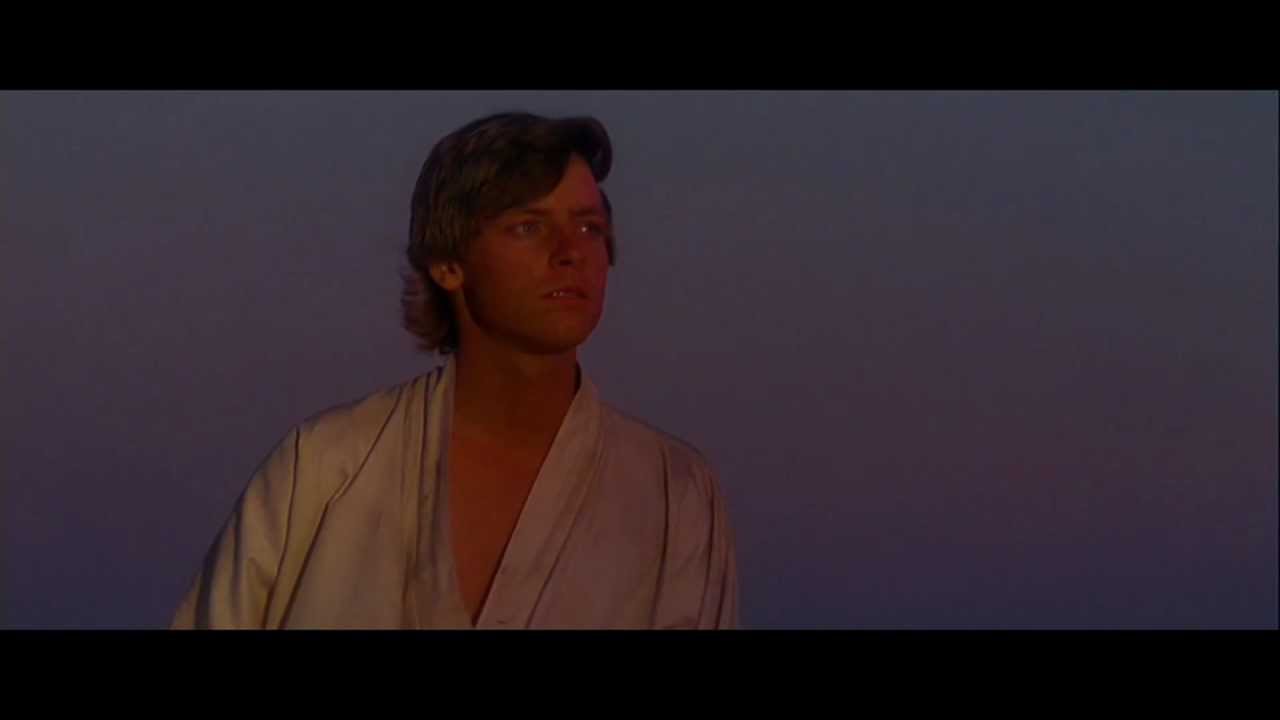
Look at me, fostering delusions of grandeur!


When we first hear this musical line, it is in a solo French horn to start, then the strings swell in and take it over.  We have the feeling that Luke can be the hero and leave this dusty, desert planet.  But when we hear this theme with Ben Kenobi, the effect is changed.  The harp part leading into the line gives the sense that something (or someone) important has been unveiled, but there is a sinister harmony underneath the melody that does not change when it should.  Instead, it makes the line unstable, taking away its easy dreams of heroism.  If Luke is going to have adventures, perhaps they will be less simple than he thought at first.  Perhaps there is more complexity in the world around him than he saw as a farm boy.  And of course, all of this is true.

Would this work without the soundtrack?  Maybe, but I would suggest that the film would lose a vital part of its nuance.  And isn't this part of what makes the film good in the first place?  To isolate (or exclude) one element from the whole seems to detract from the overall experience instead of enriching it and a musical soundtrack, as seen in these cases, can be very enriching indeed.

Thursday, March 20, 2014

Why do we still like epics?

We live in an age where brevity is the soul of...well, it's basically our soul.  It's an age where there is a truncated manner of expressing that something is too long, and therefore that we didn't read it (TL:DR).  An age where an entire form of communication has been constructed around images/clips/animated GIFs to express our sentiments and feelings (Tumblr).  An age where a medium for exchanging information limits our responses to 140 characters or less (Twitter).

And yet, somehow we love sprawling, time-consuming, wordy epics.  For those who feel that they are TL, these epics are available in multiple media forms, such as the movie franchises of Lord of the Rings or Harry Potter [Ed. note: it would probably take less time to read The Hobbit than to watch all three movies].  However, I don't want to discount the fact that people are reading books, long books that one might assume are TL, but that, in fact, people do read (which, confusingly, is also DR).  In fact, we are almost inundated with epics in our culture, possibly to an unprecedented degree: in addition to the ones listed above, there is also Stephen King's Dark Tower, George R. R. Martin's Game of Thrones, and even epic-lite in those Twilight books (which also spawned Fifty Shades of Grey.  This is probably not epic, unless you are referring to epically bad writing). 

Why do we love epics so much?  Maybe the better question is, when have we not loved epics?  One of the oldest recorded works of literature is The Epic of Gilgamesh, of course.  Countless other examples have survived through the ages.  Even for those unfamiliar with the originals, the classical epic continues to exist in the cultural imagination in forms such as Troy.  But there is a significant difference here.  I suspect that your average person on the street would not be as familiar with the Iliad even when it did star Brad Pitt or the Chanson de Roland [Ed. note: this one kind of goes on, sometimes, in places, while fair Roland climbs a hill for what feels like forever, so maybe it is good that we are not so familiar with that one any more], but that this same person would be familiar with the modern versions listed above.  So perhaps the question is better framed as, why do we love these epics? 

You may be wondering why I haven't mentioned the most sprawlingest, time-consumingy epic of our age, which has to be Star Wars, especially when you consider the wealth of literature, film, commentary, and other cultural references that it has spurred [Ed. note: there is even a 70s variety show holiday special, which you would think would be hysterically funny because it has to be so bad, but then somehow transcends to an entirely new level of bad that you never even thought possible, even in your wildest dreams.  If that's not 70s enough for you, then how about the disco medley of themes from the original movie as featured on Dutch television?].  Indeed, this post was motivated by the fact that I have consumed an alarming quantity of Clone Wars episodes now that they have become available on Netflix Instant.  For the sake of my dignity, I will refrain from telling you where I am in terms of the whole series [Ed. note: Chewbacca has shown up].  Part of Star Wars' appeal, of course, is that it dabbles in many of the same kinds of themes that are so common in epics throughout the ages.  There is the hero on his quest, in the form of Luke (and, as we learn in the earlier movies, his father).  There is the conflict between father and son.  There are hints that a larger power binds us together, but can also be harnessed to pull us apart; in the Iliad, these were the gods, whereas in Star Wars, it's The Force.  There is the fear of death and questions about the afterlife, which is found all the way back with Gilgamesh.  There are a series of wandering characters that have either lost their actual homes (the Jedi in the later movies, Leia after the destruction of Alderaan) or their perceived ones (Anakin, which is one of the routes to his downfall).  Undoubtedly, these timeless conflicts are part of why Star Wars remains so appealing--in fact, there is a Jungian analysis of an episode of Clone Wars that seeks to uncover some of the age-old themes contained within this particular series.

However, I don't think that these themes are the only reasons that epics are so hip right now.  Instead, I think that it is the possibility unveiled in the epic world, and the ability to translate that 'world' into a form of reality--or at least a form of online reality--in a way that never existed before.  To fully get this idea, imagine if Wagner's Ring cycle came out now.  People would make a Wagnerpedia to trace characters and backgrounds.  There would be Wagner blogs, Wagner websites, and general Wagneriana as everyone tried to find even more hidden connections between each of the music dramas--this does exist, in a way, but it has been sanctioned instead as scholarly work and musicology instead of fandom.  I totally see a graphic novel.  In fact, I totally want to see a graphic novel and someone should get on this.  Fans did exist, in a way, even back when these works debuted.  They created 'listening guides' so that audiences could follow along with the themes (German musicology scholar Christian Thorau has discussed the importance of the leitmotiv as a concept in his book Semantisierte Sinnlichkeit, if you are interested in finding out more on this topic).  But an entire Wagner world was out of most people's reach, unless you happened to be King Ludwig of Bavaria, who re-created the grotto from Wagner's Tannhäuser at his Linderhof Palace:


Probably not the best use of taxpayer money

I would like to submit that part of the fascination with epics now is that we have an unparalleled way of visualizing the worlds that are contained within them.  These worlds can emerge in obvious ways, as in film adaptations, but there are even more ways in which these worlds are being brought to life:

1) New Zealand has actual Lord of the Rings tours so that you can immerse yourself in the landscape seen in the film--or, if you prefer, the vision of the landscape found in the books as imagined by Peter Jackson:

Actual epic-looking figure in foreground will likely not be part of your tour
2) There is Harry Potter Land (better known as The Wizarding World of Harry Potter).  It exists at Universal Studios in Orlando, FL.  Not only can you 'see' Harry Potter, you can also 'live' parts of the books by consuming such delicacies as butterbeer or candy treats from Honeydukes:

I selected this photo because I feel like no one would mistake these park-goers for Hogwarts students

3) To the best of my knowledge, there is no Star Wars Land, or if there is, it is wholly housed in some guy's basement (don't worry, Disney is already on this).  And there have been virtual Star Wars worlds, in the form of the MMORPG The Old Republic.  This expanded world also exists in digital form through the Wookieepedia, a website that (as you may have guessed) replicates Wikipedia, only for the universe of Star Wars.  It is a remarkably comprehensive chronicling of every possible character, planet, or other feature to do with the Star Wars universe.  In fact, it is so comprehensive, that if you need basic information about some character, you may sometimes find yourself reading the article introduction, obtaining the basic facts that you wanted, then realizing that there remains an entire article whose information is not even necessary.  Take, for instance, the Nightsisters, which has a four-paragraph introduction providing an outline of their history and purpose, then has eight more subsections in case you want to know more (it's okay to say TL:DR here.  Don't feel bad.  If you have no idea who the Nightsisters are, or why they are important to the plot of Star Wars, as I mentioned above, Clone Wars is on Instant Netflix).

[Ed. note: I have read the entire Nightsisters article]

It's worth taking a moment to consider the history of the encyclopedia, which originated in the Enlightenment as a means of discovering, classifying and documenting the world as interest in science overtook belief in religion.  We take encyclopedias for granted now, since we have such easy access to an unprecedented amount of information; even (the much reviled by those of us who teach) Wikipedia provides a wealth of knowledge about arcane topics that may not be found in any other resource.  Where else can you turn quickly when you forget the names of the Thundercats, for example?  Just as Wikipedia documents a more complete picture of our world than its print forebears like Encyclopedia Britannica--which does not have information about the Thundercats--a project like Wookieepedia gives the impression that it is documenting a world that is fully developed, coherent, cohesive, and operates as a unit.  Without modern technology, such documentation would be virtually impossible.  It is this epic world-building, I would argue, that keeps epic storytelling relevant in our post-modern world.

To finish up, enjoy the modified Clone Wars version of the Star Wars theme, which has been changed so that it is more militaristic and less heroically bombastic--this is, of course, a universe at war: