Thursday, September 24, 2015

Aida at the Met in 1925, Viola Davis in 2015, and Shifting Targets

There's a joke that I'm sure you've heard before about pianists in New York City. If you shake a tree in New York, the saying goes, three pianists will fall out all ready to play Rachmaninoff's third piano concerto. There's an overabundance of talent and few chances for musicians to flash their brilliance.

Something in the same spirit as this joke (minus the tree-shaking and musician-toppling) actually happened in New York in the summer of 1925. The popular Italian tenor Eduoardo Ferrari-Fontana put out a call: were there any black women in America who could sing the part of Aida? He would stage a competition to see if he could find a singer, and the winner was to perform with him in the opera at the Metropolitan Opera House.
Much to his shock, over 250 classically-trained singers replied, ready to audition for the part.

"I have never heard such remarkable voices in all my life," he told the New York Amsterdam News. "All of them can sing, and it is difficult to eliminate a single one of them."

It's true. The women who made the top 24 cut were remarkable. Florence Cole Talbert, Muriel Rahn, and Nettie B. Olden were among the names I immediately recognized. And they all had fabulous careers in the United States and in Europe.

Muriel Rahn

Florence Cole Talbert

Why did Ferrari-Fontana hold this competition? Did he really believe that the Metropolitan would welcome a black singer? He told the New York Amsterdam News, "It has always been a mystery to me why impresarios have not sought a Negro voice for an opera like Aida." Really? A mystery? Huh.

So here's the thing. We know that 1925 wasn't the year that the first black woman performed at the Metropolitan Opera House. No. That minor miracle didn't occur until 1954- thanks, Marian Anderson! So what happened?

Eventually realizing that it would be impossible to bring a black woman to perform in a lead role at the Metropolitan Opera House in 1925, Ferrari-Fontana settled on holding semi-final and final auditions to award two women the chance to study grand opera with him privately.

But for a moment, just a brief moment, the opera world faced up to the fact that there was a brilliant, sparkly, shiny pool of rich, beautiful talent that they had assumed did not exist. That they thought was incapable of existing.

I mention this story because Viola Davis's instant-classic speech at the Emmy awards sparked my memory of this competition. 
Viola Davis, in all her glory and splendor (praise be to God)

Here's an excerpt from her speech:
"‘In my mind, I see a line. And over that line, I see green fields and lovely flowers and beautiful white women with their arms stretched out to me, over that line. But I can’t seem to get there no how. I can’t seem to get over that line.’

That was Harriet Tubman in the 1800s. And let me tell you something: The only thing that separates women of color from anyone else is opportunity.

You cannot win an Emmy for roles that are simply not there." 

She's right, of course. But how do you convince people to take you on for roles that are? That was the problem in 1925, and as much as I'm excited to see more diversity (of all kinds and stripes!) in performances (theatrical, musical, artistic, etc.), I still worry about shifting targets. It's long been an accepted fact that black opera singers have to be three times as good as everyone else to get noticed. Heavens knows what Hollywood is like. 

I think my suspicion here is that it's not the role itself that promises opportunities to all who are talented and deserving of recognition. It's not the equalizer that we hope it will be. It's a good start; of course we need more characters expressing a vast array of life experiences. But I still believe that directors, impresarios, producers, talent agents, and musicians will find ways to rhetorically tap-dance their way out of hiring different voices, in part out of intellectual laziness and lack of imagination. The yardstick will grow, the target will shift, the explanations will change in tone and color.

But history-making moments from 1925 or 2015 teach us how to identify them. And how to call out marginalization when we need to. And above all, they teach us to keep on musicking, to keep on dancing, and to keep on singing our songs anyway.

Thursday, August 6, 2015

Singing Our Selves: Stromae and the Case for Afro-European Music

Something that I've been thinking about a lot lately is how we don't have ways to talk specifically about a distinct Afro-European culture. We don't have (or we haven't recognized) markers for Afro-European identity in the way that we do for things like Afro-Cuban music, African American poetry, and the like. Our understanding of black diasporic cultures tends to come from more well-trodden locales such as the Caribbean and the Americas.

In a really smart piece in the New York Times recently called "Being African in Europe,"Afro-Italian journalist and activist Vittorio Longhi reflected on this dilemma: "In the United States, there has been a comprehensive cultural construction of African-American identity, and a movement that responds when there is injustice or violence. We Euro-Africans still lack our own positive, inspiring symbols and leaders, our Martin Luther Kings, our Rosa Parkses, our Barack Obamas."

Some would ask, do we really need to carve out an Afro-European identity anyway? Why can't we just embrace a more universalistic approach to all races and accept everyone as "equals"? The advantage to thinking about Europeans of African descent as a collective identity, though, is that we're more able to make them visible on a continent that has rendered them invisible for centuries. In making Afro-Europeans more visible, we can highlight the ways in which they're marginalized and discriminated against by their fellow citizens.

Moreover, weaving together an Afro-European culture makes it more possible to see that Afro-Europeans have had their own longer history. Far too often, we assume again and again that black people in Europe are a new phenomenon. They must be "fresh off the boat" (literally) from a war-torn country, a refugee of some sort, or an immigrant coming over here for work. True, that is a good percentage of the black population in Europe today. But they represent only a portion of the black experience in Europe. To reduce our understanding of blackness in Europe to the most recent wave of African migrants coming off of a ship is, as Chimamanda Ngozi Adichie warns us, only telling one story. But Afro-Europeans (like everyone else) are comprised of many stories.

Take Vittorio Longhi, the author of the NYT piece. He identifies as Italian because his parents also identify as Italian. His father was born in Asmara, Eritrea during Italian occupation yet he rarely thinks of his ties to Africa. There have been three generations of my family in Vienna, Austria. I grew up around the corner from my grandparents' house. Clearly our ties to Vienna are old, spanning several decades.

And I haven't even touched on historical figures that we hold up as examples of Afro-Europeans in the past:
Philosopher Anton Wilhelm Amo (1703-1759) might be the most recognizable example. But others like British composer Samuel Coleridge-Taylor (1875-1912) are also good entryways into the history of blacks in Europe.
But I'm still struck by how fragmented and isolated our stories are. Is it possible to create a collective identity formed out of shared experiences and expressed in a creative manner? Is it possible to create, in other words, a sense of a distinct "culture"?

Because I think about everything musically, I've been pondering lately how the crazy-popular musician, Stromae, might actually point us in that direction.

Born to a Rwandan father and Flemish mother, Stromae first became popular in 2009 with his hit song, "Alors On Danse":
But it's his big hit song, "Papaoutai" that I'd like to think about right now. It is such a great song. It has a wonderful pace to it, really great lyrics, and fun musical moments for your ear to get into.
Stromae wrote it as a way to come to terms with the absence and eventual loss of his father, who was killed during the Rwandan genocide of 1994. In the refrain, Stromae asks, "Where are you? Papa, where are you?" repeatedly. The inspiration for this song apparently came from a line in his previous hit song, "Alors On Danse": [a loose translation] "Whoever says love says kids... Whoever says love says mourning." To love, in other words, is to mourn.

Lots of people have picked up on the fact that Stromae's song is a song of mourning to his father. If his childhood was anything like Ika Hügel-Marshall's or other Afro-Europeans raised in single-parent households, he also experienced the pain of being different without the parent who looked like him to help him navigate through that. Growing up as an insider/outsider, whose visible difference in Belgium was tied to a man he rarely saw and who later died, it's understandable that he'd sing about longing for this absent father. That he'd reflect on all the ways in which the loss of his father shaped his life. Stromae's story is a pretty resonant story for many Afro-Europeans in this way.

The music video itself also narrates Stromae's attempts to come to terms with the absence of his father. The young boy in the video pleads with his father - who looks like a plastic ken doll - to interact with him. He watches as the other dancers in the video - all biracial or Afro-European like him - interact with their parents or siblings, and he tries to cajole his dad into dancing with him, too. He wants what the other dancers have. But by the end of the music video, he has become like his father - frozen, plastic, empty.

But Stromae's song, "Papaoutai" also gives us a really fascinating musical expression of Afro-European identity that I don't think anyone has picked up on yet. In many ways, it sounds like a really awesome French pop song. In fact, the beat reminds me a lot of the music of French pop musician, Yelle. Songs like "Je Veux Te Voir" and "A Cause Des Garcons" might be good places to start for those who aren't familiar with her work.

It sounds like a European pop song, yes. But something really remarkable happens around the 2:28 minute in Stromae's song, "Papaoutai." And if you're not listening for it, you might not even notice that it's there. He introduces an instrument that sounds like an African mbira:
The mbira or "thumb piano" here gets plucked in a way that's immediately recognizable if you've had much exposure to it. Here's a really great demo of the mbira that I love. It's a song called "Zambezi" by a Zimbabwean musician named Tinashé and it is beautiful and heartbreaking. 
Back to Stromae: I'm not sure what instrument he's using in the song, "Papaoutai" and googling around didn't provide that much information on the instrumentation for his song (if anyone figures it out, let me know!). But I think it's striking that this instrument plays in the background throughout the end of the song. It gives the French pop song an anchor in an African musical style that's all the more meaningful when you understand Stromae's story.

I think that "Papaoutai" is a creative cultural expression of a distinctly Afro-European experience. Stromae integrated or blended different musical styles and heritages in order to give listeners a unique perspective on his life. It's one song. It's one story. But I'm hoping there's more like this (past and present) for us to discover.

Saturday, May 30, 2015

Meredith Vieira's Exotic Hip Hop Adventure


Now, I know, I have talked about jet skis on this blog before, but a music video recently surfaced that is making me revisit this topic. Thanks, Internet, for making this clip readily accessible:


Previously, when I was talking about jet skis, it was in reference to what I claimed was a parody video mocking hip hop's expectations from Empire. The video in question was being made in support of Hakeem's veritable masterwork, 'Drip Drop,' and while I wasn't able to find any good clips from when they were shooting it with a green screen on a jet ski, you need to just take my word for it that this happened. There is more insight into the overall aesthetics of the 'Drip Drop' video later in the episode:


Earlier in the episode, Hakeem states that he wants to create a video that shows he is the heir apparent of Empire Records and that he feels like this message will be sent via a video filled with scantily-clad women and jet skis. I view this entire song as parody, particularly because it is so vapid (and so close to a generic Rihanna collaboration) yet so catchy. What makes it even more of parody is the fact that Hakeem thinks this image is what he needs to succeed in the family business. Meanwhile, up at Ghetto Ass Studios (which is an actual location in Empire), Hakeem's brother Jamal is recording a song from his heart, a song with meaning, a song that conveys his struggle as he attempts to distance himself from his disapproving father. Notably, it does not feature a green-screen jet ski video.

So if we can agree that Hakeem's video is demonstrating the profound shallowness of his character (and by extension, the generic hip hop song that he has just created), then what exactly are we to make of Meredith Vieira, who has taken almost all of the same tropes, only brought them to a day time talk show and therefore made them weird? First, let's identify what these tropes are:

1) Scantily clad women: a seemingly unending stream of them appears in Hakeem's video shoot. Meredith was apparently not ready to 'go there' (I feel like this was an actual note in some production meeting). So instead, she wore a t-shirt that projected the notion of a scantily-clad woman.

2) A green screen: on Hakeem's set, some random cameramen note that they expected to be in Miami filming Hakeem on a jet ski. Instead, they are stuck in New York, filming a jet ski in front of a green screen. If anything, this moment adds to the irony of Hakeem's assurance that this video will show him to be, in his own words, 'king' (also, you don't want to be king of an empire. You want to be emperor of an empire). Meredith notes that such videos should take place on the beach, but then goes to the green screen instead. This seems particularly ironic for a song entitled 'Going Down For Real' since they are getting down for fake.

3) Bling: Flo Rida and Hakeem share very similar watches. However, Flo Rida missed out on the gold chain. Instead, Meredith got the gold chain.

4) Intimations of a Strip Club: neither video is set in a strip club, although there are intimations of such. Hakeem is carefully evaluating the ladies and their various assets, which places him into the role of a consumer, much as he would be in a strip club. Furthermore, the raining gold in the backdrop turns the set into an enclosed area with low light. While Meredith is not in any way in a club, she is making it rain. While on a jet ski. With a t-shirt that projects the notion of a scantily-clad woman. I am not sure what to make of this. Also, I am not sure why you would want to make it rain on a jet ski. I don't think you're going to impress strippers with that kind of precipitation.

5) Dranks: both Hakeem and Meredith have champagne. Hakeem treats it in a more understated fashion, whereas Meredith is guzzling it down like it's the last bottle on earth. Have some decorum, Meredith.

6) A Bunch of Women Touching On the Artist: there are a number of these near the end of 'Drip Drop' touching on Hakeem. What Meredith is doing around 0:50 makes me slightly uncomfortable.

I'm not even going to talk about the fact that the two songs are not that far off in terms of style and content. You can just make of that what you will. If Flo Rida had done 'Drip Drop,' though, I have total faith that he would have been promoting it on Meredith's show. 'Going Down For Real' was featured prominently in Furious 7 during a scene steeped with overstated opulence in Abu Dhabi, although I would make a larger argument that the FF franchise basically takes hip hop tropes and pushes them to excessive extremes, much as it does with, well, everything. This is what happens when your movies co-star Dwayne 'The Rock' Johnson and Vin Diesel.

In case you were curious, Wikipedia claims that the instrument used in the sample was not, in fact, an oboe.

This whole Meredith incident could be viewed as nothing more than a scene gone wrong or a tone-deaf segment (or really freaking funny because what just happened there, depending on your point of view), but I feel like Meredith's frenetic actions in it suggest that she is taking advantage of what is, for her, an 'exoticized' moment. She is placing herself in a world that is very distant to her, yet from her exhortations to 'Shake it' (and encouraging others to yell/shake the same?), she is momentarily attempting to join it.

That Meredith 'exoticized' Flo Rida's music is a bigger problem when considering who her audience is. I wasn't able to find any specific statistics about the demographic that watches her show, but from recent rumors that it is going to be canceled, some clues emerge: the network is looking for someone who draws a 'younger' and 'more multicultural' audience, which implies to me that Meredith's is primarily 25+ and white. Hip hop in general, then, is being conveyed to an audience that is not familiar with its conventions--unlike the viewers of Empire, who were more likely to know a parody when they saw it. What is the image that emerges here? This is a style that seemingly lacks deeper meaning, that can be reduced to its most overarching stereotypes; in other words, that can be summed up by a bikini t-shirt, bling, champagne and a jet ski. Even the actual video for 'Going Down For Real' is arguably more sophisticated as it features a women's basketball team facing off (I'll leave that as 'arguably,' since there is plenty of booty shaking too).

We're at a cultural moment when hip hop is being transformed into a larger means of dialogue across a broader audience. The runaway success of Empire as a prime-time soap reinvigorated by a fictional hip hop world was one sign, and I would argue that the wide-spread integration of hip hop culture into the Fast and Furious franchise is another. There is also the upcoming studio (!) film Straight Outta Compton, which (LET'S ALL HOPE) will portray the social conditions that led to NWA's album (ALLOW ME TO DREAM). In contrast--and contemporaneously--the Meredith segment represents hip hop as little more than its most basic and distancing tropes to an audience likely unfamiliar with the genre. I, for one, truly wish that Meredith had never donned that bikini t-shirt.

Tuesday, May 26, 2015

Ready to Pimp a Butterfly Dropout: the hip hop concept album


As a historian, I feel leery at claiming that every ten years or so, a hip hop album emerges of such fundamental importance that the genre is changed thereafter--a simplified (and potentially spurious) notion of history-in-cycles. And yet, when I first heard Kendrick Lamar's To Pimp a Butterfly last week, I almost immediately thought of a 10-hour road trip I took in 2005 with Kanye's College Dropout effectively on repeat for the whole time because I was so thoroughly entranced with the album. That was ten hours each way, resulting in almost a full day's worth of 'Ye when all was said and done. I would do the same for To Pimp a Butterfly in a heartbeat, and I cannot think of an album that has had such an immediate effect on me. My only question is why it took me until last week to discover it, but at least I can now rectify my ignorance by listening to it incessantly on repeat while at work.

When I listened to College Dropout a decade ago, I was struck by the singular sound that 'Ye had managed to produce, a sound that was very unlike what had come before. He did not limit his producing skills to his own album, but also worked with artists such as Common to incorporate this new hip hop aesthetic that featured soaring vocals and grandiose sounds:


But while Common's challenging rhymes were ideally paired with this new and challenging sound, one could argue that some of 'Ye's lyrics delved into the mundane (seatbelts for safety first) or even the absurd (pick whatever you want, there are plenty of examples):


In contrast, one of the most notable features of To Pimp a Butterfly is the sophistication of both rhymes and sound on the album. In fact, Lamar conscientiously fuses references to blackness in a variety of media to create a reflection on black culture as a whole. It is, I feel, nothing short of a masterwork, while simultaneously featuring tracks as catchy as this one:


There is much to be said about this video (and much has been said already) and about the imagery itself, turning around the main character of Alex Haley's Roots from a slave into a king--Kunta Kinte has taken over Compton as King Kunta, replete with a throne sitting in his driveway. Just as Lamar reimagines this iconic 70s black figure, he reinvigorates funk while drawing on its main indicators. It's hard not to hear the numerous exhortations of wanting the funk at the end of the track as parody.

If you haven't heard the album, please do not think of 'King Kunta' as typical of its sound. In fact, there is no 'typical' sound as each track ranges widely from sultry, jazzy big band:


To a Curtis Mayfield-inspired track that might simultaneously reference Kanye's 'Touch the Sky' (the repeated lyric in the chorus 'I love myself' could not be a better parody of 'Ye, really):


And beyond! Including spoken word tracks and a dialog with Tupac. That's right, he's still releasing albums from beyond the grave.

To Pimp a Butterfly is also quite clearly a concept album: a work that is meant to be understood as a coherent whole rather than what most albums present, which is an assemblage of individual tracks that do not depend on order. That Lamar sees the tracks as interwoven is undeniable since he presents a series of spoken-word lines at various points in the album. The first two lines are heard after 'King Kunta,' then are repeated and expanded as the album continues. It is only in the final track, 'Mortal Man,' that the poem is heard in its entirety, presented in a 'dialogue' with Tupac that intersperses a 1994 interview with Lamar's observations. That Lamar is reflecting on hip hop--and by extension, black culture--is apparent throughout To Pimp a Butterfly in subtle and blatant ways.

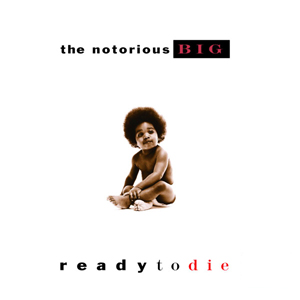
By presenting a concept album, I also see a parallel between Lamar's project and Notorious B.I.G.'s Ready to Die--an album that came out in 1994, so almost twenty years ago in keeping with the 'every ten years' idea. I would not characterize Ready to Die as a reflection. Instead, it is a provocation, from its lyrical content to its front cover, which features a black baby juxtaposed with the album title. Biggie was seeking to capture his world with its oppression and paradox, a world where a black man was ready to die as soon as he was born.

The reception of Ready to Die, particularly through its radio-friendly songs such as 'Juicy' and 'One More Chance' (in the remixed version specifically), makes it easy to forget about the more hard-hitting tracks that appear on this album as well. Through them, we are exposed to the ways in which the protagonist sees the world: at times its hope and promise, but also its insurmountable difficulties that eventually lead the narrator to suicide on the final track. 'Juicy' is the most optimistic moment of the album, although the verse opens with the line 'It was all a dream,' creating an immediate (and unanswered) question about whether the song should be understood as truth or fantasy. There is no ambiguity about how this album ends: a gunshot and an incredulous friend on the phone who has aurally witnessed a suicide.

Just as I am reluctant to claim that there is some mandated ten-year cycle for hip hop albums that indelibly change the genre, I am equally wont to suggest that hip hop is 'evolving' as time goes on--genres do not evolve so much as they shift and change. What I would suggest instead is that these three albums demonstrate the profound variety of responses that hip hop has grown to accommodate: from Biggie's provocation to Kanye's stylization and now Lamar's sophistication. If you haven't yet had the chance to listen to To Pimp a Butterfly, I hope you will take the time to check it out, as I have only scratched the surface in terms of what could be said about it.

Saturday, April 25, 2015

The moment we stop believing them: ageism in opera and pop music

My mother-in-law was the one who pointed out this Madonna video to me. Appearing on the Jimmy Fallon show a few weeks ago, Madonna sang one of her new tracks called, "Bitch, I'm Madonna" with her usual gusto.

With long blonde hair, gold chains, a leather jacket, fishnet stockings, and no pants (of course), Madonna pranced and danced around stage, humping multiple men (including an audience member) in the process. 

Her appearance on Jimmy Fallon occurred shortly after her performance at the Grammys that some critics found "distasteful" because they believed she was "too old" to sing and dance in such a highly sexualized manner (see her Rolling Stone interview responding to that). 
And her Jimmy Fallon debut also occurred right before that now-legendary and, to some, shocking kiss she smacked on Drake. (It does seem to be a pattern with her: Brit-Brit, Xtina, and so on)
I thought for sure there'd be more memes out there about this incident. Internet, you have surprisingly failed me.

I have big issues with Madonna's takes on race in America. I will never be okay with her or anyone's use of the "n" word. And I'm not comfortable with her comparing sexism to racism, mostly because what she's really doing is pitting them against each other ("No one would dare to say a degrading remark about being black or dare to say a degrading remark on Instagram about someone being gay... But my age – anybody and everybody would say something degrading to me. And I always think to myself, why is that accepted? What's the difference between that and racism, or any discrimination?" My answer: A WHOLE EFFING LOT.)

But I agree with her statement in Rolling Stone that "[Ageism] is still the one area where you can totally discriminate against somebody and talk shit. Because of their age. Only females, though. Not males. So in that respect we still live in a very sexist society."

Just this past week, comedian Amy Schumer debuted a hilarious sketch featuring Tina Fey, Julia Louis-Dreyfus, and Patricia Arquette playing with the fact that each woman in her career at some point faces a moment when the media tells her she's no longer "eff-able." 
The idea here is that women like Madonna, Tina Fey, Sally Field, and others all reach a moment when they have outlasted their usefulness as beautiful objects to be gazed upon by society. They have overstayed their welcome, have outworn their membership cards in the Young and Beautiful Club, and have stayed too long at the party even though the DJ has begun to play the "you don't have to go home but you can't stay here" music to get them to leave.

Before I move on, I do want to point out how most of these conversations center around white women losing their beauty and allure (in the eyes of an American popular imagination). Women of color are few and far between in these conversations, even though many like Viola Davis have been saying for ages that they were never really considered beautiful and "eff-able" to begin with. Sometimes it feels like they've been shouting into the wind, speaking into a terribly sexist and racist vacuum which sucks up their words to make sure they never truly reach a multitude of ears. You have to deliberately tune in to hear them, to find their frequency, because lord knows the other noises are much louder and are constantly drowning them out.

Anyway. Where was I? Ageism exists. There's a reason why we talk so breathlessly about Meryl Streep, why Viola Davis gives so much of us LIFE, why Shonda Rhimes is a goddess, why Miss Tina's wedding will go down as the stuff of legend. Why even Madonna, who I find so problematic in so many other ways, speaks to us. They're the exception to the rule, right? They're defiantly showing us other ways to live as women, as adult women, as mature women. Whether or not they're always truly doing it, they appear to be wresting themselves free from the strictures of patriarchy and sexism.
Miss Tina serving face.

But make no mistake: American pop culture regularly decides when a woman is no longer an acceptable romantic interest. The age of the woman shapes people's perceptions of her vitality and beauty (which is always there; people just choose to dismiss it).

I've been wondering lately how the world of opera both resists and submits to this view of women. Opera provides such a fascinating conundrum for its consumers here. So many of the plots involve young women living for the men around them, sacrificing themselves for a doomed and ill-fated love or falling for despicable creatures because they're too ignorant to know any better (I'm looking at you, Don Giovanni). 

Plenty of people have already written about this - Susan McClary (Bizet's Carmen), Catherine Clement (Opera: The Undoing of Women), and Naomi Andre (Voicing Gender: Castrati, Travesti, and the Second Woman in Early Nineteenth-Century Italian Opera), to name a few.

The conundrum, though, is that in order to produce these operas portraying either young, naive women seeking love in a cruel world or highly sexualized temptresses seducing strapping young men, opera companies today have to rely on voices who can actually take on these roles. Professional voices, experienced voices, mature voices. A quick glance at the roster for the Met's Live in HD series, which reaches movie theaters all over the US and in Europe, confirmed many of my suspicions. Anna Netrebko (43), Joyce DiDonato (46), Renee Fleming (56) all played young love interests this season. And the truly "young" and up-and-coming singers who offered something "fresh" and new to viewers were in their 30s (Anita Rachvelishvili, Isabel Leonard). Because of the nature of singing and the demands opera places on singers, it's very difficult for a young singer in her 20s to land a gig. In fact, it's actually quite dangerous for a young singer to try to take on opera before her voice has matured (which, from what I understand, really happens in her 30s). Young singers can ruin their voices if they're not careful if they try to do too much before they're ready.

Thinking about the matter geometrically, the height of a woman's singing career (30s-50s) does not align or intersect with the key years American society has deemed a woman to be at her most beautiful (20s). Unlike women in Hollywood, women in opera can sing about love, desire, and lust in their 40s and 50s. Indeed, they're expected to. 

What this means, then, is that operagoers' ears and eyes have become accustomed to - or perhaps even expect or demand - figures like Debbie Voigt (55) to perform for them. The world of opera tends to value, in other words, the Meryl Streeps over the Miley Cyruses. 

Or does it? There were grumbles back in 2011 when Debbie Voigt took on the musical, Annie Get Your Gun at Glimmerglass and Puccini's opera, Girl of the Golden West at The Met. And as we pointed out in a previous blog post, the opera world has fat-shamed women for years. They, too, have been held to socially constructed standards of beauty that glorify thinness and whiteness. Again: opera, like all other institutions, participates in the maintenance of sexism.
Debbie Voigt, singing in Annie Get Your Gun at Glimmerglass in 2011 (New York Times)

But I still find it really fascinating and secretly appealing that in order for operas to be performed, opera houses have to rely on mature bodies. Biology shapes the performance and production of opera, and in ways that cannot easily be overcome. Although this truism might not hold up quite so much anymore, the principle went that a woman retired from opera when she could no longer sing, not when she was no longer considered beautiful. 

So perhaps opera is a paradox floating through American and European cultures, making it more difficult for audiences determine when they should stop believing that a mature woman can be a romantic love interest. High culture, in this case, encourages us to revisit that moment when we begin to think of older women's musical engagement as "age appropriate/inappropriate." Opera calls us to pay attention to the moment when we stop listening to mature voices around us, when we stop wanting to hear what they have to tell us, and when we stop believing the veracity of their performance based on their age.

Wednesday, March 18, 2015

Drip Dropping the Music of 'Empire'

If you have not been watching FOX's 'Empire,' you may not know that one of the most integral elements of the show it its music. After all, it is the story of a hip hop label called Empire Records, one that was founded by the protagonist of the show Lucious Lyon, who you can see as a kind of fictional Jay-Z. Right now, his sons are battling over who will take it over; two of his three sons are also talented musically, while the third one feels left out of the family because he is not (unless it involves something called 'music therapy' where J-Hud sings to you or joining in for a trio of 'Lean on Me' in an elevator. If you aren't watching this show yet, I must ask WHY NOT???). As a result, we get a lot of songs on 'Empire.' Sometimes, these are songs being recorded in Ghetto Ass Studios, which is a real place in the Empire universe--in fact, to prove that the title is not just a nickname, they have recorded at Ghetto Ass Studios more than once. Sometimes, these songs are performed in the club, Leviticus, with family and friends and people who just signed record contracts with Empire and Rhianna-stand-ins named Tiana and random bystanders joining in:


In fact, 'You're So Beautiful' shows up a number of times on the show: Jamal (middle kid) alters the lyrics to publicly come out of the closet at the annual Lyon White Party (okay, maybe picture a blend of Jay-Z with Sean 'Puffy' Combs); we see Lucious singing the song to Cookie right before she goes to prison; and we even see Cookie consoling herself with the song while she is in prison, sans weave, sans animal prints, and sans heels (could this even be the same Cookie?):

Thanks for this screen capture go to Price Peterson, over at Yahoo, who has arguably the best 'Empire' recaps in all the land
'You're So Beautiful' is this feel-good hit, one that everyone in the Empire universe knows, and one that has clearly been around for at least seventeen years since that is when Cookie originally went to jail. It works as a feel-good song because it has that catchy chorus, with all credit due to Timbaland, who is writing the music for the show. This song is very much in the vein of Timbaland's number-one hit, 'The Way I Are,' which operates on similar catchy-chorus principles--except that 'You're So Beautiful' has better grammatical conceits.

But what is 'Empire''s 'best' song? I need to put that in scare quotes because it depends on how you want to evaluate that. Certainly, I would put 'You're So Beautiful' in the running because of its general all-around catchiness and its versatility for various key points throughout the show (e.g., coming out at a party, singing in the club with friends and family, pre-trial ballad, prison consolation song). But I'm going to make a controversial choice for best song of 'Empire' and say that, for me, it is unquestionably youngest son Hakeem's 'Drip Drop':


First things first: this is a terrible song on many levels. Please don't misunderstand me when I say it is 'Empire''s best. It is inane to a point where I might have to look through Kim Kardashian lyrics to find something worse. Just one screen capture from a video with the lyrics should help to demonstrate my point:

This cracks me up every time I look at it.
But I feel very confident that if 'Drip Drop' were recorded with the right combination of artists, it would be a giant hit. For is it any worse than Rhianna's 'Birthday Cake'? I would argue no (those of you who follow the blog would likely not be surprised by this, given my animosity toward 'Birthday Cake'). What I think 'Drip Drop' does is parody the exact kind of hit that we would expect from a Drake and Co., right down to the mandatory Rhianna-eseque appearance by Tiana. I would love for Lil' Wayne to drop by Empire Records and add a verse because I think it would fit perfectly, plus I have faith that he would find a way of parodying the parody and invoke toilets or something <-- NSWF link. Don't listen if you are easily offended. Not censored.

Let's move on to the the ridiculous video featuring ridiculous hip hop girls in ridiculous outfits, dancing around in a ridiculous manner. When Hakeem first presents the idea during an Empire board meeting (this company has the best freaking board meetings), he suggests using a green screen to allow him to be on a jet ski with several girls hanging off of it while singing the song--if you want a recap, the best can be found at Grantland. And what, I ask, could be more of a parody than a jet ski? It screams ostentation, unnecessary, and ridiculous. Perhaps that's why it was the favorite toy of Eastbound and Down's anti-hero Kenny Powers? <-- NSWF link. Don't watch if you are easily offended. You may need more context if you don't know the show. But it most certainly involves a jet ski. If you think of Hakeem as as hip hop's Kenny Powers, but with Jay-Z/Sean 'Puffy' Combs as his father, frankly his whole character starts to make much more sense.

Now there have been other songs on 'Empire,' arguably better songs. The most popular of these was likely Jamal's 'Keep Your Money,' which he recorded in response to Lucious cutting off his money (which all ties back to the fact that Jamal is gay, and Lucious is very much not okay with that). 'Keep Your Money' also benefited from Cookie's intervention, as the link demonstrates, as she walks in to Ghetto Ass Studios and offers her opinion about how the song should be mixed. 'Empire' is drawing on two common tropes here: the Empire is strongest when family members work together and the artists are at their best when they are speaking 'from the heart.' The first reduces the show to a cliché; as last week's episode demonstrated, this is a deeply broken family, one that can also be torn apart by these same characters when they are at their worst (things got all bordering on a V.C. Andrews novel). Cookie is trying to be the glue that holds them together, but she is also constantly hurt by the actions of those around her. Maybe she can fix a studio recording, but she hasn't been able to fix all of their problems yet.

As for the second conceit, that artists need to draw on their inner lives, this is certainly a thread that has permeated 'Empire.' In the show's opening scene, we saw Lucious in a recording studio, urging a young star to draw on her most painful memories to bring out the emotion in a song. Must we be so romantic, I ask? Must Jamal feel the pain of living in some non-gentrified neighborhood in Brooklyn with tacky kitchen cupboards to find his voice in 'Keep Your Money'? Is this not simply reinforcing the notion that artist biography and output must be intertwined? Why can't we just 'drip drop' with Hakeem? The show seems to posit that 'Keep Your Money' was a breakout song for Jamal, one that cemented his reputation beyond the small clubs where he had previously been playing. Implicitly, its hit status grew because of its authenticity and its ties to Jamal's life. But I doubt that would happen in reality.

It's worth noting that in the week that FOX released 'Drip Drop' and 'Keep Your Money,' the latter was downloaded more than the former; however, I wonder if the fact that 'Empire' purposefully presented the former as verging on parody influenced this reaction. For my money, 'Drip Drop' still wins, simply because it so succinctly sums up a specific sound and ambiance that I expect to hear on the radio. Is it good as an artistic product? Not even I would claim that. Would it be popular? I suspect yes. Throw Lil' Wayne on that track and you'd have a hit song in no time.

Sunday, February 15, 2015

On being black and rediscovering that you're also European


(A trailer for the short film, Ackee and Saltfish, directed by Cecile Emeke)

So here's the deal. When I first meet someone new in the United States, I avoid telling them anything about my life for as long as I can. I answer the dreaded "where are you from?" question by saying, "my family lives in Atlanta, Georgia." Notice: I didn't actually answer the question. I simply stated a fact. My parents do currently reside in Atlanta, Georgia. Are they from there? No. Heck, no. But I throw the line out there hoping it'll distract them long enough for me to change the topic.

I learned this trick when I moved here at age 15. It was simply too much for people to process my identity as a black girl who'd spent her entire life in Vienna, Austria, I think. They'd want to deny it or downplay it, or they'd think I was a freak of some kind. Worse, they'd want to talk out their feelings about this strange fact that they'd learned. My being black and European is still a contradiction to many Americans. So in order to avoid being someone else's therapist for 15 minutes as they processed their feelings about me ("Why?" "How?") I learned to tell a different story to fit into people's boxes.

I still get into trouble, though. People tell me that I talk white. I was once asked by a well-meaning hairdresser if I was adopted. After hearing me ask for help at a hotel in Nashville, Tennessee, the receptionist asked me suspiciously where I was from (I told her I was from New York, and that seemed to help).  Moreover, what I know about African American culture has been intentionally learned over the past 15 years. I have pockets of knowledge here or there but I also have HUGE gaps. I've learned to love Erykah Badu but that's after intentionally listening to her albums on repeat until I figured out what the hell was going on. I still haven't read any Toni Morrison. I don't know classic African American tv shows. But I've learned to "blend" in well enough, I suppose. To fit the label people want me to have.

What also doesn't help matters is that when I'm in Germany or Austria, I also get the question, "where are you from?" And that in order for people to make sense of my identity in Europe, I have to tell them I'm from America. It's easier, less exhausting, to say that I'm American than to tell Germans that I consider German-speaking Europe also my Heimat (homeland). My blackness can't make me European here, either. It has to be located someplace else. So I say (in German) that I'm African American like Barack Obama, and that helps people to put me in a box.

Here, too, I get into trouble, though. Why is my German so good? A lady at a Viennese bakery asked me that question a few years ago. If I was an American student, why did I speak the language so well? I had to confess that I'd lived in Vienna for a little bit in the past. But only for a few years. I downplayed how long I'd lived in Vienna before.

I've lived on both continents now (Europe and the United States) for 15 years each. And for the past 15 years of my life, I've been trying to find ways to erase my European identity. Which is all kinds of crazy because my research is on the history of the black diaspora to Europe. But in order to avoid feeling schizophrenic all the time, I've focused on expressing and performing mostly one identity (American/African American).

Over the years, I think I've lost touch with this other half of my self. I deliberately abandoned her when I moved to the States, tried to lock her up in a small crate and let her out only when I was in Berlin or Vienna walking around on the streets. Why did I do that?

I have a few theories:
1. Language. I have such a complicated relationship to the German language. It will never be my mother tongue. I sound like I should be a native but I still stumble over words, especially when I'm nervous. And this makes me insecure. So it's hard to claim an identity in a language that I speak instinctively but worry that I'm getting wrong all the time. I grew up speaking English at home and at school and German while out and about. Psychologists and linguists will tell you that language learning is a fascinating non-linear process, and I think I'm proof of that. Also, I'm hearing-impaired, and that tends to make language learning more difficult, too (I didn't get hearing aids until I moved to the States). So my relationship to German is weird: I sound like a teeny-bopper and can speak quickly, but I worry all the time that I've gotten something wrong.

2. Representation. Growing up, I didn't know the term "Afro-German," or that there was a long history of people who looked like me in Europe. I discovered them in graduate school, thanks in part to a generation of Afro-European activists who had started demanding societal recognition as citizens and insiders. They laid the groundwork for public discussions on these topics starting in the 1980s, when I was a toddler eating Käsesemmel in Vienna.

When I finally began to positively embrace my blackness (which took a while; it wasn't until my mid-to-late 20s), I turned to African American women (Marian Anderson, the Williams sisters, and yes, Beyonce) to think about what my blackness meant.

But I've been learning lately that I don't have to do that anymore. Or rather that I can also find representations of Afro-European women that really do celebrate them (and me!). I don't have to ignore my European self anymore.

I've been thinking about that lately because of the film director, Cecile Emeke, who's been filming Black Britons strolling about the streets of London for a short series:
She wants to capture real people living their lives in Europe sharing their experiences. Some of these girls look like they could be my cousins (literally: my maternal side is Jamaican/British)!

In an article she wrote for Afropunk, Emeke explains, "Not only did I want to document these conversations, but also I was also tired of being invisible & powerless as a black, working class female living in Europe. When you are black in Britain, or in Sweden, or in any other “obscure” place in the African Diaspora (and by obscure I mean deliberately erased,) it feels like you don’t exist and therefore society encourages you latch on to whatever representation feels like the closest match. Not having your own cohesive identity is damaging. I wanted to be a part of ending that by increasing the visibility and volume of voices that are usually ignored and silenced in their respective societies. I also wanted to help “internationalise” these problems that many of us seem to have in common despite living on opposite sides of the word. "

I just love that quote. I don't have to latch on to whatever representation feels like the closest match. I can look for people who look like me who've experienced life like me - life as a black person, as a European, as an outsider/insider, who live that double consciousness that Paul Gilroy talked about every day.

Thanks to the marvelous age of the internet, it's also become easier to follow blogs and magazines and sites dedicated to celebrating being black and European. There's a brand new magazine in Austria called Black Austria, for example (I wish this had been around when I was a kid!):
There are also campaigns from organizations like Black Austria, too: 
Organizations and websites like ISD (Initiativ Schwarze Menschen in Deutschland), Afropean, M-Media, DeutschPlus, and so on are also celebrating black bodies in European spaces.

It's funny because I've known all of this for a long time. Again: I've dedicated the last 8 years of my life to researching Afro-Europeans! But for the longest time I resisted thinking that I was one of them, too. It was easier that way.

Now that I'm in my 30s, though, I really am learning to give less of a shit what people think. It's so freeing! And thanks to so many other black European activists encouraging and empowering others to celebrate their lives (in spite of the rejection they constantly face from society), I feel like it's time for me to just throw caution to the wind and start claiming this part of myself more fully and publicly, too. I can tell people, in other words, that I have Jamaican/British/Canadian/American/Austrian/German ties and connections. No, that is not too many. That is just enough. 

I don't have to hide. I don't have to explain myself to anyone. I can just... be.