Showing posts with label hip hop. Show all posts
Tuesday, April 22, 2014
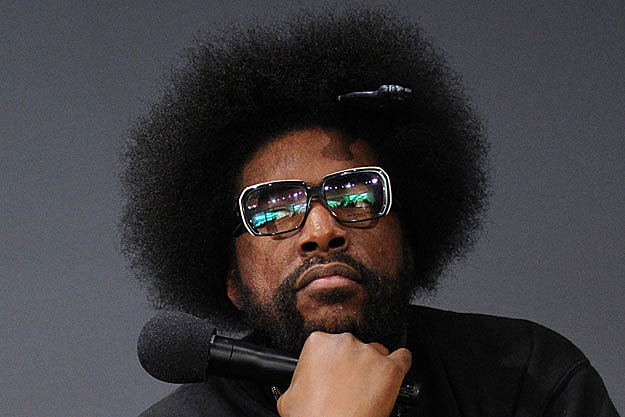
Questlove's Contemplations on Hip Hop, Week 1
Esteemed hip hop artist Questlove will be sharing his thoughts about the current state of hip hop in a series of six posts that will be appearing on Vulture. We are lucky people! I feel certain that his observations will inspire a number of responses and I wanted to start by offering one here. If you haven't read the post yet, I would highly recommend that you take a moment to do so because it offers an insightful look at some of the ways that hip hop has morphed over time.
Questlove's main concern is that hip hop has simultaneously become omnipresent and impotent. Because it is everywhere, it is no longer challenging the norms--instead, it is reinforcing them, ensuring that the top artists remain at the top and making it difficult for others to obtain the same success. He notes that few black musicians are succeeding in any other style, which he sees as a dangerous shift. For those who would argue that this situation has happened before--and that it will correct itself in the future--Questlove responds that hip hop, itself, will likely not survive because popular music styles tend to disappear once they start their decline. While there are historical cycles, Questlove claims that the specific artistic forms do not come back. The fact that hip hop is no longer conveying truths suggests that its time is over.
In some respects, history does repeat itself. In fact, much of what Questlove is observing in hip hop did occur previously in American culture, with jazz. And it was jazz--or at least the styles that derived from jazz--that helped lead to hip hop. I guess you could either say the dinosaurs are dead (Questlove) or that the dinosaurs evolved into birds (my argument).
Indeed, many of the critiques that Questlove has for hip hop now were also leveled against jazz at various points in its long history. Today, we are accustomed to thinking of jazz as a fixed phenomenon, but in reality the term was coined only in the 1920s to describe a new style of music. What precisely it comprised was up for debate. Jazz brought together a number of earlier styles, most notably ragtime and the blues, both of which were typically associated with African-Americans. For the most part, these styles had been limited to specific geographical locations since it was hard for an aural tradition to travel far before recordings became widely available. Some areas, such as New Orleans, had further developed specific practices that were unique. However, the term 'jazz' eventually encompassed all of it. There were later developments too: big band, swing, and cool jazz, to name just a few. Also free jazz. Free jazz will be back.
Questlove feels that hip hop's reach has gone too far, spawning such concepts as 'hip hop fashion' and even 'hip hop architecture,' which has little to do with the music itself. But I think he errs in his claim that this type of conflation is unique to hip hop. There is another clear parallel with jazz here, since there was such as thing as 'jazz fashion'. Significant changes to women's clothes were associated with jazz, specifically 'flappers' and the dresses that were best suited for dancing to this new music. Were these clothes tied to some previously unknown truths revealed by jazz? I don't think so, but it's notable that this term is linked in such a ubiquitous way. In fact, there is an entire 'jazz age,' a moniker not yet applied to our era with hip hop.
Some of Questlove's critiques sound familiar and have been heard before about jazz. As Ingrid Monson has demonstrated, many jazz performers were criticized for their lack of engagement with civil rights movements during the 1950s and 1960s, which led to music that was perceived as being less relevant to society. Black nationalists also felt that jazz would help spur their movement, as Michael Hanson has shown. Specifically, these organizers claimed that free jazz would be ideal since everyone could participate in whatever way they innately felt. The problem, of course, was that free jazz is, you know, free jazz, and people weren't really all that into it. They went with funk instead, then wound up disappointed when it had a great beat for dancing but little to no political engagement.
Questlove's first article in this series brings up the question of what hip hop has achieved in its forty-year history. As he notes, 'the music originally evolved to paint portraits of real people and handle real problems at close range.' 'Evolved' is an important term here. Certainly hip hop did not burst forth as a means of social critique when it started, unless the soggy macaroni described in 'Rapper's Delight' is considered a 'real problem at close range.' In fact, hip hop may have accomplished more in terms of raising awareness about the injustices inherent in the African-American situation than any previous popular style. Albums such as Straight Outta Compton and Ready to Die did convey the challenges unique to black people in a direct and confrontational way--and in a way that jazz never achieved. As Eithne Quinn shows, the gangsta rap that emerged in the late 1980s/early 1990s reflected a population that was actively oppressed, and these songs targeted the oppressors. But for the most part, this socially engaged hip hop with a popular following was limited to only a small part of hip hop's forty-year history--perhaps about a decade. This is not to say that other artists have not been creating music that is socially engaged, but instead that the albums most associated with this specific type of civil rights issues are only one part of hip hop's legacy.
It is entirely possible that hip hop will never achieve this level of insight toward the culture from which it emerged again. But I don't see this as necessarily the death knell for this style. The roots that jazz provided were deep and strong, resulting in countless later movements. Funk emerged from jazz, leading to disco, which provided the ground for the first experiments in hip hop. More likely, then, the phenomenal influence of hip hop will be channeled into new movements and approaches, which is typical for any type of popular music. I somehow doubt that black musicians will be absent from this discussion; after all, their importance for the early influences of jazz, and several of its key transformations, cannot be overstated. Questlove, as an artist, is justifiably concerned for the style of music that he has made his own. As a historian/critic sitting behind a computer and with little at stake in this argument, I can afford to take a broader view.
Either way, I am looking forward to installment 2!
Monday, April 21, 2014
Great Rap Beefs in History: The Fondue Chapter
In a thought-provoking post for this blog about Nas and the National Symphony Orchestra, Kira asked, 'Are hip hop artists performing the politics of respectability in these spaces?' This past weekend reinforced to me the fact that hip hop artists have obtained respectability, as evinced by the fact that they have entree into all kinds of 'venues' from which they were previously shut out. Three examples will suffice:
1) Hip hop is all the freak over NPR: Yes, NPR. The station that has long demarcated a certain higher level of radio culture--and is generally perceived as the choice for white, educated listeners, as this parody evinces:
In the past week alone, I have listened to hip hop appearing on numerous shows, mostly in a contemplative or esteemed light. There was the Radiolab segment discussed previously on this blog. Jesse Thorn, on Bulleye, offered his take on Nas's Illmatic as the best hip hop album of all time. A segment on Ask Me Another featured a version of $25 000 Pyramid involving hip hop songs, with actor/comedian Hannibal Buress providing the clues. Evidently, NPR believes that its listeners are conversant with 'classic' hip hop, enough so that they will understand the clues of this game. I think that NPR is correct here, but this is a bold statement about how completely hip hop has been absorbed into contemporary American culture. Also, there is a very white rap of 'Rapper's Delight' here (at around 1:30). The contestant even substitutes 'NPR' into one of the lines. That's right. There is now, theoretically, an NPR rap.
2) Hip hop at hockey: I attended Game 2 of the Tampa Bay Lightning versus the Montreal Canadiens on Friday night. During the second intermission, as the zambonis were driving around the ice, they were accompanied by the start of Notorious B.I.G.'s 'Hypnotize.' This is new, at least since 2011.
I cannot think of a single sport that is whiter than hockey. When I was a kid, there would be, literally, one black player in the league at any given time, and that one guy was Grant Fuhr (there is a whole Wikipedia category for precisely this topic).
'Hockey music,' in my experience, tends to reflect this demographic. Favorite styles include heavy metal (perhaps not surprisingly, this track gets played to start the third period at Lightning games) or dance music from the 90s. Yes, it must be from the 90s. Yes, it must be dance music. You might be wondering what we listened to before that and the answer is organ music and Stompin' Tom Connors. A great example that is even featured on the EA Sports 2011 NHL Game:
Biggie? No. I used to think that the fact you could hear hip hop anywhere was notable, but that was at bars and such. Now that you hear it at hockey and on NPR, I am willing to declare that we have reached a new era of cultural saturation.
3) Terrible rap beefs on TSN: What is TSN? The Sports Network. It is the Canadian equivalent of ESPN. And you won't believe what Drake said this week on TSN about Jay-Z. At least, you shouldn't believe it, because it's pretty silly:
Drake claims that Jay-Z eats fondue. From a plate. If you can imagine. I can't because I don't know, exactly, how you eat fondue from a plate. It needs some kind of warming mechanism to keep it viscous, like the type traditionally placed under a fondue pot.
Let's take a moment here. What does this even mean? Supposedly, that Jay-Z is not keeping it real, because only fancy people eat fondue. At least, this seems to be the general interpretation of this statement. He has moved beyond bougie, to whatever class where you eat fondue off a plate on a regular basis. Now, I am not, by any means, advocating a return to the violent outcomes of previous rapper beefs. But when one side is accusing the other of fondue eating? That seems like we have entered a new level of respectability, to go back to Kira's quote. Drake made no claims against Jay-Z's ability to rap or produce or do all of that music stuff. He just might be a little high-faluting for your average person.
Be sure to read this story on A.V. Club, which features some classic commentary on this particular beef. Perhaps Alton Brown will weigh in for Team Jay-Z. Perhaps Jay-Z will respond by besmirching poutine. Perhaps those radio bleeps ('f******') really are bleeping out 'fondues.' 'Cheese rules everything around me.' And let's not forget that Jay-Z has claimed in the past that he 'checks cheddar like a food inspector.'
Stay tuned for what shapes up to be the most mouth-watering rapper beef ever to go down. Or at least one of the most respectable.
1) Hip hop is all the freak over NPR: Yes, NPR. The station that has long demarcated a certain higher level of radio culture--and is generally perceived as the choice for white, educated listeners, as this parody evinces:
In the past week alone, I have listened to hip hop appearing on numerous shows, mostly in a contemplative or esteemed light. There was the Radiolab segment discussed previously on this blog. Jesse Thorn, on Bulleye, offered his take on Nas's Illmatic as the best hip hop album of all time. A segment on Ask Me Another featured a version of $25 000 Pyramid involving hip hop songs, with actor/comedian Hannibal Buress providing the clues. Evidently, NPR believes that its listeners are conversant with 'classic' hip hop, enough so that they will understand the clues of this game. I think that NPR is correct here, but this is a bold statement about how completely hip hop has been absorbed into contemporary American culture. Also, there is a very white rap of 'Rapper's Delight' here (at around 1:30). The contestant even substitutes 'NPR' into one of the lines. That's right. There is now, theoretically, an NPR rap.
2) Hip hop at hockey: I attended Game 2 of the Tampa Bay Lightning versus the Montreal Canadiens on Friday night. During the second intermission, as the zambonis were driving around the ice, they were accompanied by the start of Notorious B.I.G.'s 'Hypnotize.' This is new, at least since 2011.
I cannot think of a single sport that is whiter than hockey. When I was a kid, there would be, literally, one black player in the league at any given time, and that one guy was Grant Fuhr (there is a whole Wikipedia category for precisely this topic).
'Hockey music,' in my experience, tends to reflect this demographic. Favorite styles include heavy metal (perhaps not surprisingly, this track gets played to start the third period at Lightning games) or dance music from the 90s. Yes, it must be from the 90s. Yes, it must be dance music. You might be wondering what we listened to before that and the answer is organ music and Stompin' Tom Connors. A great example that is even featured on the EA Sports 2011 NHL Game:
Biggie? No. I used to think that the fact you could hear hip hop anywhere was notable, but that was at bars and such. Now that you hear it at hockey and on NPR, I am willing to declare that we have reached a new era of cultural saturation.
3) Terrible rap beefs on TSN: What is TSN? The Sports Network. It is the Canadian equivalent of ESPN. And you won't believe what Drake said this week on TSN about Jay-Z. At least, you shouldn't believe it, because it's pretty silly:
Drake claims that Jay-Z eats fondue. From a plate. If you can imagine. I can't because I don't know, exactly, how you eat fondue from a plate. It needs some kind of warming mechanism to keep it viscous, like the type traditionally placed under a fondue pot.
Let's take a moment here. What does this even mean? Supposedly, that Jay-Z is not keeping it real, because only fancy people eat fondue. At least, this seems to be the general interpretation of this statement. He has moved beyond bougie, to whatever class where you eat fondue off a plate on a regular basis. Now, I am not, by any means, advocating a return to the violent outcomes of previous rapper beefs. But when one side is accusing the other of fondue eating? That seems like we have entered a new level of respectability, to go back to Kira's quote. Drake made no claims against Jay-Z's ability to rap or produce or do all of that music stuff. He just might be a little high-faluting for your average person.
Be sure to read this story on A.V. Club, which features some classic commentary on this particular beef. Perhaps Alton Brown will weigh in for Team Jay-Z. Perhaps Jay-Z will respond by besmirching poutine. Perhaps those radio bleeps ('f******') really are bleeping out 'fondues.' 'Cheese rules everything around me.' And let's not forget that Jay-Z has claimed in the past that he 'checks cheddar like a food inspector.'
Stay tuned for what shapes up to be the most mouth-watering rapper beef ever to go down. Or at least one of the most respectable.
Labels:
Drake,
Fondue,
Grant Fuhr,
hip hop,
hockey,
Illmatic,
Jay-Z,
Nas,
Notorious BIG,
NPR,
Rap beefs,
Stompin Tom Connors,
Zamboni
Monday, March 24, 2014
Black masculinity and the violin
This is going to sound odd, but I think that the 2013 calendar year was the year for African American male violinists:
The film, 12 Years A Slave, took on the narrative of Solomon Northup, a talented violinist forced into slavery. Musicologist Guthrie Ramsey has already written a great piece on this topic in Gawker, entitled "There Was Music in 12 Years A Slave? Yes. It Sounds Like Get Lucky." In it, he tackled how music functioned, how music *worked* to help maintain social order and perpetuate categories of racial difference. For example, Northup is at one point "ordered to be human Muzak" at a slave boutique where people are being sold. In another instance, slaves are singing a song about running away as their master preaches to them a Christian sermon. (For more information, please read Guthrie Ramsey's piece in Gawker here: http://gawker.com/we-re-up-all-night-to-get-lucky-or-there-was-music-in-1-1460666699)I must confess that I still haven't seen the film yet because I'm a scaredy cat (if you know me, this confession will come as completely and utterly unsurprising) but I'm curious to know how many Americans (regardless of ethnic background) were taken aback to see an African American man playing the violin. "Huh," I imagine they said, "that's unusual. I've never seen something like this before." Being a black male violinist must have been such an irregularity/oddity throughout American history, right?
Hold on a second there. It would be wrong of me to make the claim that there were thousands of Solomon Northups just fiddling throughout America since the very beginning, all working on a Mozart violin sonata and complaining about that one passage in the Tchaik concerto. But what I do find interesting is how little people know about African American classical musicians, and, more importantly, how frequently their histories tend to be forgotten or expunged from the record.
A few other African American violinists to think about:
Joseph Douglass, the famous abolitionist Frederick Douglass's son. He got his big break playing at the Chicago World Fair in 1893 and ended up on the faculty at Howard University.
Clarence Cameron White is another example of a working violinist in the 19th century. A product of Oberlin's Conservatory of Music, he lived in London for a time studying the violin. He came back to the States to teach at Virginia State College and Hampton Institute.
Will Marion Cook, also a product of Oberlin's Conservatory of Music, studied violin at Berlin's Hochschule für Musik in the 1880s. Following his arrival back in the States, he studied with composer Antonin Dvorak for a year and then formed a chamber orchestra that toured throughout the United States.
The last name I'm going to mention (and there are others) is Samuel Coleridge-Taylor, who is perhaps the most celebrated black composer in music history. He's not African American, which people forget, but he tends to be smushed into the greater category of "black people making classical music." So fine. Whatever. He was a violin student at the Royal College of Music. Really, I just wanted to post this image that I found of him:For some reason, my googling of black male violinists a while back led me down a particular rabbit hole that I'm not entirely sure how to get out of just yet. In the process of putting this blog post together, I came across this group:
Their name is Black Violin, and they're a hip hop duo from Florida who play the violin and viola. Here's one of their music videos:
And I don't know if the world can handle it yet, but here's *another* hip hop duo named Nuttin But Stringz who also try to blend hip hop and classical music:
Nuttin But Stringz (lord help me for writing that name more than once) was originally a group that tried out for some reality show and made it to the finals:
What are we to make of these two musical ensembles? I'm both surprised and not surprised by them, I guess. I *think* that they think they're being subversive by combining hip hop and classical violin together. I *think* they think they're being radical by being black male violinists in 2014. And I *think* they think they're trying to raise awareness and encourage money to be funneled into music education programs in African American communities...?
I think they mostly prove to me how histories are forgotten. How the Solomon Northups are made to become oddities. So that when these ensembles come around, we're supposed to think they're doing something new, when really, they're not.
What I do find intriguing about these musicians, however, is how they're performing a certain kind of black masculinity. With Nuttin But Stringz (again! gah!) especially, their exaggerated gestures and stomps seem to be their attempt to align themselves with hip hop, which, as plenty of scholars have excellently pointed out already, has been constructed to be black and male (more so than black and female, white and male, and white and female). Oh, and this black masculinity is, of course, hetero. It's super hetero. Lord help us if we start picking that piece of this performance puzzle apart (said snarkily).
Again, I think that we're supposed to see this as subversive. And perhaps it is. Perhaps there's something radical about having these performers own so grandly and confidently their black male identities while performing a musical instrument that many assume doesn't "belong" to them.
Mostly, though, I'm ambivalent. Do these groups demonstrate musical fusion/hybridity or are their performative acts further perpetuations of difference? Each ensemble seems to suggest that it's pointing American audiences towards the future, where "classical" and "pop/hip hop" will blend together into a commercial success. Perhaps this will happen. Perhaps it's already happening. I just don't want us to forget our Solomon Northups again.
Subscribe to:
Posts (Atom)


