Tuesday, April 17, 2018

Styles of DAMN


When news broke yesterday about Kendrick Lamar winning a Pulitzer for his album DAMN, social media (not surprisingly) responded with Strong Opinions. Equally unsurprisingly, much of my Twitter felt it was about time. A few lone voices (which I saw only through retweets) balked at the fact that hip hop was now being elevated to the status of classical music or jazz, which many seem to think are the only repertoires that have won Pulitzers in the past--my guess is that Hank Williams, who won posthumously in 2010, might not feel at home in either of those categorizations. One of the recurring discussions from my friends on Twitter was the fact that while they liked DAMN, and it was great and everything, it was no To Pimp A Butterfly, Lamar's 2015 acclaimed album that, infamously, did not win the Grammy Album of the Year. As I have processed this flurry of discussion around DAMN, I have realized that I agree with the committee in this case: this is Lamar's strongest album to date and most worthy of this award.

On Style

Ken Ueno and Du Yun performing at MATA, April 2018
One of the most prominent names, Pulitzer-wise, to celebrate Lamar's victory was the previous Pulitzer winner, Du Yun. Last year was also historic, as it marked the first time all of the finalists were women. Du Yun won for her opera Angel's Bone, which ostensibly fits into the category of 'classical' music, but her works do not all easily belong here. Her 2011 album Shark in You was released as her 'pop diva alter ego duYun' and would more likely be heard in a club than a concert hall (if you're curious, my favorite track is 'Johnny, I Hardly Knew Ye Remake').

What do we gain by forcing Du Yun and her contemporaries into the narrow category of 'classical' composers? She is classically trained, but her music ranges far beyond this style. These rigid divides create artificial barriers, barriers that the artists themselves may be working to dismantle.

On Styles


When I say that Lamar's DAMN is his best album to date, I hope we can generally agree that this is not meant as a criticism of his previous albums. On the contrary! I am a huge fan of To Pimp A Butterfly (and Good Kid, M.A.A.D City as well, for that matter). All of them deserve immense accolades, success, and, minimally, a Grammy for Album of the Year over, say, to name an artist at random, Macklemore. But DAMN contains a universe: virtuoso performance, complex interwoven themes, and a remarkable ability to range from the deeply personal to the broadly theological. The opening and final tracks (along with some of the tracks in between, particularly 'FEAR') root this album in the tradition of hip hop that foregrounds the anxiety of living as a black man in America--precisely why Notorious B.I.G was Ready to Die. At the same time, it addresses Trump's America, a world governed by 'PRIDE,' 'LUST,' and the FOX-News-styled announcers that lead off 'DNA'.

DAMN is easy to listen to while being very hard to understand; the tracks often flow easily, making the lyrics easier to gloss. One of my theories about why so many people are invoking To Pimp A Butterfly is that this listening experience is on the whole, more germane--as an example, who among us has not spent most of a car ride or an afternoon listening to 'King Kunte' endlessly on repeat? The album contains, essentially, a history of black music in its tracks, ranging from funk ('King Kunte') to jazz (the stunningly languid opening to 'How Much A Dollar Cost') to scat (For Free). Even though these tracks are often subject to interruption, there are many points where album is so engaging musically that it becomes easy to lose the lyrics in the sound, despite the fact that the words are crafted so beautifully.

But even at his finest on To Pimp A Butterfly, I am not sure that these examples top the sheer virtuosity and power of what Lamar unleashes in the final minute of 'DNA'. While there are narrative structures on his previous albums, I continue to spend more time contemplating the themes in 'PRIDE' and particularly how to reinterpret them in light of the next track, 'HUMBLE.' Echoes of Lamar's previous albums abound--'FEAR' is essentially a gloss on the narratives that tied together Good Kid, M.A.A.D. City and To Pimp A Butterfly. Truly, this is a remarkable work of art and one that does not yield its meaning easily. If you are the type of person who is more likely to throw on his earlier albums (and I think that most of us are this type of person) because they are catchier and easier to listen to, then it is worth taking the time to remember that often the most meaningful works of art are the ones that pose the most formidable challenges for us to understand them.

Monday, December 4, 2017

Phantasmagoric Monsters

Source

A friend once told me that she was reading Hofmannsthal's libretto for Richard Strauss's Ariadne auf Naxos and that the plot was very silly. I agreed, but also stated that despite the ludicrous plot, it was my favorite Strauss opera, possibly one of my favorite operas of all. My love for it did not stem from the text or plot, but entirely from the music. And the music justified whatever plot it set.

Any fan of opera is accustomed to some suspension of disbelief: the characters onstage occupy a world where they sing to each other, but cannot hear the orchestra accompanying them. Ariadne is one of the most extreme examples of this, as it is an opera about putting on an opera, complete with characters that are singers, comedians and even a composer. Dramatic tension arises in the first act arises because the work itself is not sacrosanct, a state that the composer riles against. The irony here is that the work that we are hearing is sacrosanct. This composition, then, is a work about a Work and the conditions necessary to make it a Work of Art.

'Suspension of disbelief' arguably understates the case for opera. Opera leans heavily toward phantasmagoria, a term that Adorno borrowed from Marx and applied to the works of Wagner. Phantasmagoria hides its means of production, it creates a coherent yet imperfect world view, it declares itself in the medium of sound. While it can be analyzed, more often it is understood sui generis. For Adorno, it is a form of  'magical delusion.'

Opera, particularly in its modern guise, particularly at an institution such as the Met, is a magical delusion. The Work of Art rests at its core, with all other elements subservient to it. Even the repertoire is gradually diminished because while audiences crave magical delusion, they want to experience delusions that are familiar to them.

It takes an effective magician to maintain magical delusion. Such a magician was kept on at a very high cost. Open secrets circulated, but magical delusion around Works of Art prevented anyone from taking action.


I once attended a Met Live in HD production at my local movie theater of Strauss' Salome. The theater next to it played a High School Musical movie. High School Musical had a PG rating, meaning that it was not recommended for children under the age of 13. Salome had a G rating, meaning that it was open for anyone to attend.

There is an easy and glib joke to be made here about which of the two screenings had a strip tease (I am making an assumption that High School Musical did not). But that neglects the fact that Salome's violent fate, enacted before our eyes, is equally unsuitable for children. Her stepfather's soldiers crush her to death with their shields on stage. Even by the standards of opera, this end is grotesque, but her demise is purportedly justified by her grotesque actions: she talks to the moon, speaks erotically to a holy man, performs a striptease, kisses a decapitated head. Perhaps she is a monster. 'Monster' (Ungeheuer) is the label her stepfather gives her immediately before he orders her death.

This same stepfather demanded that a teen-aged girl--the daughter of his wife--unveil for him. He walks off the stage. Monsters can also hide in plain sight and walk freely. These are the scarier monsters.

It is a strange condition of opera repertoire that monsters are so abundant. We pretend that artistic quality somehow excuses their terrors. We ask that performers participate in them regardless of any past traumas they may have experienced. In theory classes, Mozart's incorporation of sonata form into an ensemble is more highly valued than the fact that one member of the ensemble is an exemplary case for toxic masculinity. We dig deeply into the score to find reasons to disbelieve Zerlina's scream and question Donna Anna's accusations of impropriety. We passively accept overt Jewish stereotypes, Japanese teenagers sold to foreigners for sex, women rendered voiceless by an encroaching patriarchy. We care more instead about the performers and the productions. We prefer that the score remain sacrosanct.

I once heard Tristan und Isolde six times in the same month--phantasmagoria at its finest. The conductor was Christian Thielemann. I knew nothing about his 'open secret' of antisemitism. The prelude to Act III was all I cared about.


We should not be surprised in the least that this operatic world of magical delusion should have deluded itself into thinking the many rumors that accompanied James Levine were nothing more than rumors. After all, the repertoire that we value, more often than not, protects the villains and rewards the abusers. We have convinced ourselves that the repertoire is fixed because of its musical merit instead of questioning why works with such monsters are still being performed. If we cannot be sure that Zerlina's scream is authentic, why would we believe the abused?

My very favorite Ariadne auf Naxos moment comes from a rehearsal featuring James Levine and Jessye Norman. 'This is the best section of the piece!' he declares, as he plays piano to lead her into her Act II entrance. When this moment aired last year during a Live in HD performance, I was brought to tears. Knowing now that the Met knew about Levine's abuses, that they were still allowing him to work there, and that all of this complicity was to preserve Levine's interpretations of Works of Art, I am not sure I will be able to watch this clip ever again. These productions, even at their most magnificent, are not worth the price that was paid by Levine's victims.

The Music Director's final line near the end of Act 1 in Ariadne auf Naxos is 'Du hast es erlaubt!' (You have allowed this). As long as we are valuing the Work above all, and at any price, we are all allowing this.

Saturday, April 8, 2017

Fast and the Furious and the Opera of Spectacle

Okay, everyone, it's happening. It's really happening. The latest chapter in the Fast and Furious saga will be in theaters less than a week from now. Here's what I know for sure: it will involve a submarine:


Another thing I know: some of it is set in Cleveland. That's right. Cleveland. Fun fact: Kurt Russell's character in Escape from New York, Snake Plissken, escaped from Cleveland. Kurt Russell is also in FF8. Coincidence?

My love of Fast and Furious movies is sincere and pure, and it's because I see them as the closest thing we have today to what I am going to call the 'opera of spectacle'. To be clear, I am not calling the style of Fast and Furious movies opera; they clearly draw on hip hop videos for their imagery. You are pretty much guaranteed that there will be at least one scene involving a bunch of guys, cars, and scantily-clad gals dancing around. One of the best examples of this hip hop aesthetic was in FF7, when the gang went to Abu Dhabi, then later had cars fly from one skyscraper to another, as you do in the FF universe:


So if the movie itself is not drawing on opera, what do I mean by comparing the FF series with 'opera of spectacle'? I'm looking back at the type of opera that has almost disappeared from the performance repertoire, but that was immensely popular, so much so that these works became cultural touchstones. Operas were far more social, loud, boisterous and occasionally, there would even be riots:

Image credit: http://www.vam.ac.uk/content/articles/0-9/18th-century-opera/

This is no longer the case. Opera today belongs to the realm of high art and therefore it is treated as such. Consider that audiences attending an operatic broadcast in a movie theater will refrain from eating popcorn so as not to distract from the experience. It is even considered by many to be bad etiquette when the opera is 'interrupted' by applause over a great performance. Opera has also become confined to a smaller social sphere--specifically audiences that are aware of the conventions associated with attending a performance. But this shift to opera as art caused a good deal of repertoire to be lost as well. Part of this is a matter of practicality: operas are expensive and companies need a guarantee that audiences will attend performances (hence the stunningly dull season taking place at the Met next year). Presenting these works as artistic apogees is another good marketing tool. But viewing opera as high art limits the types of works that are considered to be acceptable. Specifically, it leaves out these operas of spectacle.

Opera is, of course, always a spectacle to some extent. However, the truly spectacular ones are relatively rare now. Traces of them still remain: think about Verdi's Aida, with its dramatic (and exotic) processional. So why do I see the Fast and the Furious series as similar to these operas? Two main criticisms leveled at operas of spectacle are also frequently applied to FF movies:

1) They are ridiculous

Let's start with the obvious point that all opera is ridiculous because no one walks around singing all of the time apart from those voice majors you knew in college. I'm also going to ignore the fact that there are some truly ridiculous operas that are firmly entrenched in the canon. One example that leaps to mind is, like, every single thing Wagner ever wrote, although, as I have argued elsewhere, Wagner's operatic universe is akin to Star Wars in its ever-sprawling and all-encompassing mythology--if there isn't already a Walkürepedia to match the Star Wars Wookieepedia, there really should be.

No, I mean the really ridiculous operas that have almost been forgotten and are very rarely staged. Take Adriana Lecouvrer, for instance, where the plot hinges on murder by poisoned violets. Or how about La muette de Portici, with its cameo appearance by Mount Vesuvius in the process of eruption during Act V:

Image credit: http://digital.philharmoniedeparis.fr/0909043-la-muette-de-portici-de-daniel-francois-esprit-auber.aspx
French grand opera was a fount of this kind of spectacle, particularly with its action-packed plots and extensively detailed scenery. It was also immensely popular and played to huge audiences throughout the nineteenth century. French grand opera has not fared well in the modern canon, perhaps in part because it was too spectacular--from a practical standpoint, it is also expensive to stage. When traces of them can be found, they are not above criticism. Verdi's Don Carlos belongs in this category, between its dramatic auto-da-fé scene and that ending where Carlos is abducted and dragged away into a tomb by what may be the ghost of his grandfather but honestly it's not clear and this is my favorite Verdi opera. That's some good, spectacular stuff there. It also took a long time for Don Carlos to reclaim its place in the repertoire. The music is some of Verdi's best, but overcoming this plot was challenging for audiences.

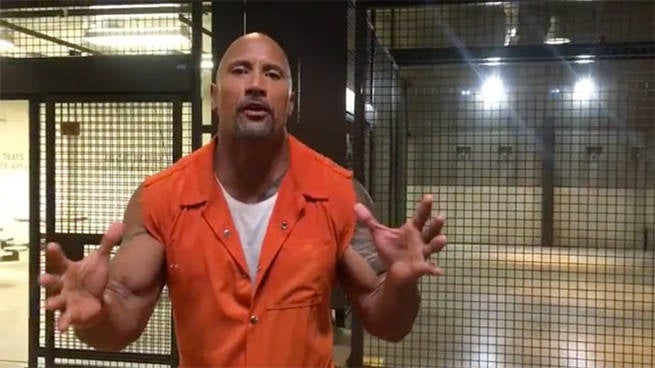
Fast and the Furious movies are also spectacular, taking full advantage of their medium to emphasize this point. From the trailer of the most recent movie, it looks like we will enjoy a prison break that could be a choreographed ballet sequence, except one involving Jason Statham and--you guessed it--Dwayne 'The Rock' Johnston (also of note: apparently prison uniforms that are sized for The Rock do not come with sleeves).  Is this any sillier than the bathing suit ballet in Meyerbeer's Les Huguenots? I would argue no. Is all of this spectacle? Absolutely. Is the spectacle part of what makes this experience enjoyable for the audience? Indeed. Can a car best a submarine or, as occurred in previous FF installments, a huge safe, an airplane, several skyscrapers, or an omnipotent satellite system? Probably only in this spectacular world.

2) They are formulaic

I have noticed lately that FF movies have been a real critical punching bag in various publications, often with a tone of 'Oh no, not this again.' The implication is that these movies are formulaic. Well, if you mean, 'At some point a FF movie will involve cars doing something ridiculous and probably Vin Diesel saying something vague about family,' yes they are. I am not suggesting that watching a FF movie will wrestle with existential issues or offer a new and vital perspective on contemporary society. But I do want to take a stand against the idea that a formula automatically means a lesser product. It's precisely this kind of thinking that gets Wagner enshrined in opera houses and keeps Haydn's many (often formulaic) operas out.

To whit: there is nothing inherently wrong with drawing on a formula. Sure, a work that is overly formulaic, and therefore overly predictable, will likely be dull; at the same time, most successful formulas offer enough flexibility so that they remain interesting. Handel's operas can be both formulaic and engaging--and spectacle, like when he brought in live birds as part of his early productions of Rinaldo (spoiler alert: this was a bad plan in a closed theater). The idea that we should value works that deviate from formulas is the basis of Joseph Kerman's Opera as Drama and too often the view espoused by musicologists, scholars more generally, and critics. However, audiences for film and for opera are often content with formulas. More importantly, a gifted artist can take a formula and find ways of modifying it enough to make it engaging.

Perhaps you are not the kind of person who will run out to your local movie theater this weekend to see FF8. That's okay. I'm the first to admit that it will probably be pretty silly. But do be the person who rushes to champion formulaic works that are filled with spectacle. They were popular in their day for good reason and they deserve better consideration today.

Monday, February 6, 2017

Schenkerian Gang Signs Presents: Selected Siri Notes from Beyoncé's iPhone


Siri, add to list of potential baby names (in the spirit of Blue Ivy):
Turquoise Magnolia
Ochre Tulip

_______________________________________________________________

Siri, note to my assistant. I have decided what I want as the background for my pregnancy announcement photo. I want a floral arrangement that would not be out of place in the Sun King's court. It should be at least three feet tall and include flowers that are the size of a pomegranate. I am not exaggerating.

_______________________________________________________________

Siri, add to list of potential baby names:
Orange Hyacinthe
Sable Iris

_______________________________________________________________

Siri, write an email to lilmonsterno1@gaga.com: Dearest Lady G, I extend my heartfelt gratitude to you for inviting me to perform with you at the Superbowl this year--my apologies for the fact that you have not been able to reach my telephone! Unfortunately, I must decline, as I am with three hearts. This is not some weird Illuminati thing, but my way of saying that I am pregnant with twins. I would like to offer you some advice based on my experience last year, when I stole the show from some band that no one remembers. Be sure to have sufficient leg strength that if you appear to fall during your set, you can pull yourself right back up. All of America will then question whether you did almost fall, or if you are, in all things, Flawless. With the most profound love from all three of my hearts, B.

_______________________________________________________________

Siri, add to list of potential baby names:
Fuchsia Willow
Saffron Meadow

_______________________________________________________________

Siri, note to my assistant. Please notify the florist that while the original floral arrangement sent over was passable, I will require one that it at least three times as big. And more elaborate. And with more flowers. Also some of the flowers should be larger. And with more accompanying foliage in the background.

_______________________________________________________________

Siri, add to list of potential baby names:
Lemon Æd 
Purple Reign
No wait, scratch that, isn't one of the Kardashian kids named Reign?

Sunday, January 22, 2017

A Day in DC


Yesterday, I traveled to Washington, DC along with a million or so other people to participate in the Women's March that took place following Donald Trump's inauguration event. I sure that most participants would agree that the trip was a whirlwind of emotions and experiences. In my case, four songs surfaced over the course of the weekend that helped me make sense of the event, and perhaps a little more sense of how the world looks after the most recent election.


One of many MLK quote signs seen on the walk from RFK Stadium to the rally. Out of town buses parked at RFK Stadium and marchers walked from there to the Mall.

The Beatles, 'Across the Universe'
I took a bus to DC and on the way down, we watched the movie 'Across the Universe,' a 2007 'British-American jukebox musical romantic drama film' (convoluted genre definition per Wikipedia). While the film itself did not leave much of an impression, I did get the song 'Across the Universe' stuck in my head as a result. One line of it stayed with me throughout the weekend: 'Nothing's gonna change my world.' As I looked around DC and saw the juxtaposition of the inauguration aftermath and women's march, this line took on new meaning.

'Nothing's gonna change my world' felt particularly applicable to those who claim they can 'make America great again'--bring it back from its current changes to some kind of better time. This slogan has already been subject to great criticism, and rightly so, as it is hard to envision an era when America was equally great for all. This imagined time and place fits what Svetlana Boym identified as a key trait of nostalgia:
It is the promise to rebuild the ideal home that lies at the core of many powerful ideologies of today, tempting us to relinquish critical thinking for emotional bonding. The danger of nostalgia is that it tends to confuse the actual home with an imaginary one. In extreme cases, it can create a phantom homeland, for the sake of which one is ready to die or kill. Unelected nostalgia breeds monsters.
The term 'unelected' feels particularly ironic here. Boym was writing in 2001 and her subject was primarily the nostalgia that permeated the Soviet Bloc, encouraged and established by its dictators. Today's nostalgic longing to 'make America great again' is cut from the same cloth, but was produced in a democracy by a group of people who refuse to let anything change their world. Boym identifies this type of nostalgia as 'restorative,' a type of nostalgia that relies on concepts of 'truth and tradition'--although in this 'post-truth' world (as in the Soviet Bloc), there are many ways to inflect truth with fiction. Boym continues:
Restorative nostalgia is at the core of recent national and religious revivals. It knows two main plots—the return to origins and the conspiracy...Restorative nostalgia takes itself dead seriously.
Restorative nostalgia is a danger because it is a fiction that presents itself as truth. As such, it is nearly impossible to argue with its catchphrases. 'Make America Great Again' presents exactly this problem: I cannot cogently maintain that America was 'never great'. I can nuance the discussion by suggesting its greatness was mired in inequality (arguments that others have made far more expertly than I) or its triumphs have benefited some individuals rather than the greater good. But it is wholly impossible to counter nostalgia with facts. If nothing's gonna change your world, then nostalgia is the only means available to preserve it.


Public Enemy, 'Fight the Power'
For the first part of the day, I was unable to get close to the speakers because there were so many people at the rally, so my experience was remarkably free of noise apart from the murmurs of the crowd (and occasional chant/cheer). Participants in the march were told ahead of time not to bring large bags because they would be subject to search, but not everyone heeded this guideline. Early in the afternoon, one man walked by where I was sitting with a boombox playing 'Fight the Power.' On the surface, this song seems like an appropriate one for the march, whose mandate was not limited to women's rights, but rights for all who experienced inequality. Indeed, why were we all there unless we were fighting the power? But as I thought more about it, I couldn't reconcile this song with this event.

'Fight the Power' is also a slogan, although clearly it does not draw from the same nostalgia as MAGA. But it is a unilateral declaration by Chuck D in the song. The Women's March, in contrast, did not have a single slogan. Instead, marchers brought signs, many of which were made by hand and sharing different messages. Calls for public art brought varied interpretations of the march's ideas--several of these signs were brought by those marching, along with art by Shepard Fairey. As we were walking from the bus to the Mall, a young black girl held up one of Fairey's posters:


'Thank you!' she yelled enthusiastically as the crowd walked by. 'Thank you all for coming!'

While the Women's March may have sought to fight the power, it was the multiplicity of voices that made it such a powerful event. All of the signs were rooted in the fundamental idea of equality, but the variations on this theme were almost overwhelming in their volume. Signs were seen all over town--many left on display near the National Gallery--imparting their messages even as the event wound down.


Beyoncé, 'Formation'
I did finally manage to get to a place where I could hear the speakers for the rally as the speakers drew to a close (I missed the Madonna moment, for instance--this is the hazard of attending rather than watching the highlights). There was also indigenous music performed to wind up the official ceremonies--while I was unable to find a clip of that performance, Indigenous Women Rise was an important presence at the march. Once the ceremonies concluded, music turned over to a DJ, who started off the party with what was, perhaps, the obvious choice: Beyoncé's 'Formation.' Naturally, the crowd responded enthusiastically.

As I have written about before, 'Formation' is an important song within Beyoncé's oeuvre because it engages with her identity as a black female artist. It accomplishes this in part by imbricating personal details: she has 'hot sauce in her bag swag,' we learn about her origins as a 'Texas bama.' What struck me listening to 'Formation' in this context is that the women around her bring their identities too. We hear their voices later in the track during the 'slay/okay' section, as they get in formation. This imagery fit the event almost perfectly as so many different people came together for the cause.

Undoubtedly this struck me because I was deeply moved by how variegated the crowd was. It was impossible to know what motivated each person to participate, but it was incredible to witness so many people who felt strongly enough to fight for equality that they traveled to DC and participated in the event. We all slayed, everyone who marched, wherever you marched. Thank you for being in formation.


Kid Rock, 'All Summer Long'
As I was leaving the rally, I almost stumbled into an event held by Bikers For Trump up the street from the Mall. The music playing sounded like Kid Rock (it may not have been), and it brought back a nostalgia that was almost wholly absent from the rally. Even the name 'Kid Rock' is nostalgic: he is no longer a kid, and this reference to 'rock' hearkens back to the 60s or 70s. 'All Summer Long' is a song that doubles down on its nostalgia, quoting from Lynyrd Skynyrd's 'Sweet Alabama'--an ode to the nostalgia of place in its own right--in the process. In an instant, I was back in a place that wants to Make America Great Again with its pseudo-rock music that longs for another time. In the distance, I could still hear chants from the world that yearns for change.

Thursday, December 15, 2016

Only in Florida: Pitbull Courts Controversy By Releasing Terrible Song


Let's start with saying what needs to be said: Pitbull's song, 'Sexy Beaches' is terrible. Some of you know that I have no lost love for Rhianna's 'Birthday Cake.' 'Sexy Beaches' is worse. 'Sexy Beaches' is on a par, artistically, with a song by Paris Hilton. It sounds like washed-up Flo Rida. It sounds worse than the made-up hit single 'Drip Drop' from Empire.

It is terrible. Don't say I didn't warn you (it's so bad, I can't even get Blogspot to post it from YouTube).

But here's where it gets all Florida (there is a more detailed summary here).

1) This song was commissioned by Visit Florida, the state-sponsored tourist organization that tries to entice people to visit the Sunshine State. In what can only be viewed as a bureaucratic move, the good people at Visit Florida felt that having Pitbull sing a Florida song might entice millennials to visit. I would love to read the minutes from that meeting. My imagined version of those minutes:
Bureaucrat #1: Do you know what millennials love? Pitbull.
Bureaucrat #2: Who?
Bureaucrat #3: We're rescuing pitbulls?
2) In case you were not already aware of it, the state of Florida has some interesting laws. Some of them pertain to openness in all government dealings, also known as the Sunshine Law. This is where Pitbull courted controversy: apparently he viewed his deal with Visit Florida as a 'trade secret' and refuses to disclose the paperwork surrounding this song. Except that the contract has now been disclosed. Someone may be prosecuted. It may be Pitbull. This story got very confusing the more sources I read.

3) As a result, lawmakers may eliminate all of the money that previously went to Visit Florida from the state budget. All $74 million dollars of it. A Florida legislator is on the record with the following statement:
“This Pitbull ad called 'Sexy Beaches' has women walking around in thongs and their chests hanging out,” [Richard] Corcoran said. “There’s just no one in the Florida Legislature buying the argument that this was necessary to get millennials to come to Florida.”

I have a lot of questions:

1) Will Visit Florida cease to exist? By extension, will people no longer visit Florida?

2) How are you going to have a Pitbull song without mention of 'Mr. Worldwide' (perhaps not appropriate for such a Florida-centric song) or at least a yell of 'Dale'? This song is the Pitbull equivalent of phoning it in.

3) Is this simultaneously one of the most banal and costly advertising jingles in history? I'm basing this on the assumption that Visit Florida loses its $74 million per year. So this song cost an agency $74 million, in addition to being a terrible song. Plus they paid Pitbull one million. That's $75 million for 'Sexy Beaches.' I suspect that if you put the lifetime salaries of Handel, Bach, Haydn and Mozart together and adjust for inflation, you might get one quarter of 'Sexy Beaches', tops.

4) Did no one, no one, say the words 'Sexy Beaches' out loud before signing this contract? Because the contract (yep, that links to the actual contract) stipulates that the song would be called 'Sexy Beaches' and was being released by the state tourist agency.

And lastly, one surprise twist: this is not even the worst tourist video ever made of Florida. Or even the worst tourist song. Behold!


And just in case you don't have 18 minutes to spare, the song.

Wednesday, August 17, 2016

In which Zoë perhaps dives too deeply into Bob Seger's 1978 Live in San Diego Performance of 'Still the Same'


This blog often engages in important work about music, culture, race, and, you know. The important stuff.

This is not one of those posts.

Instead, it is an unabashed appreciation of Bob Seger's Live in San Diego 1978 performance of his classic song, 'Still the Same.'  A song that I have spent the past four days listening to unrelentingly:


I offer no apologies, only this extended excursion into why this video has earwormed its way into my heart.

First, this is a great song. It just is. I shall hear no dissent on this point. If it were by Schumann, everyone would be studying it as a prime example of the Lied. With a little analysis, I could probably elucidate why this is so, but I prefer to enjoy this song in a pristine, somewhat naïve state. I will merely allude to the descending bass line that comes in every so often but never fully resolves or rests, suspending a harmony that remains 'still the same.' Indeed, 'some things never change.' Perhaps this idea will surface later as my discussion continues.

But let's talk about the performance, because I own a copy of Bob Seger's Greatest Hits, but I haven't been listening to the studio version over and over again. And to be clear, my fascination with this performance is not limited to the start when you can try and figure out what is on the Banner That Cannot Be Read.

First, Bob Seger himself. Trim that hair and get rid of that vest, and 1978 Bob Seger Live in San Diego is effectively the modern-day hipster. This fact is particularly noteworthy when you compare him to his band mates, who could be extras in Spinal Tap--Mr. Bass Player, I am calling you out. Bob Seger, on the other hand, could be preparing your nitro cold brew at your local coffeetorium. He could be tweaking the hops ratio for your limited edition in-house craft beer. He may just be the Ur-Hipster, based on this video evidence. Check out those shoes. Again, check out those shoes.

Next, let's talk about the siren calls stemming from the mostly anonymous background singers, whom I have nicknamed Exquisite Pantsuit and Ms. Tambourine Woman. I have some questions about either how those voices were captured on microphone or the performers themselves. This is a velvety smooth background vocal, far more so than is on the album track. Not to go overboard or anything, but I am going to go overboard here: I am reminded of the solo female voice that emerges at the end of Parsifal, Act I, entering as a ray of hope after the precariousness of the knighthood is revealed. Only there are two of them. They are not quite a ray of hope, but rather a smooth wave of sound.

That's right, I brought in Wagner in my discussion of Bob Seger. And I regret nothing.

One more quick note about Ms. Tambourine Woman: if you keep going to the next track from Bob Seger's 1978 San Diego performance that YouTube will undoubtedly recommend, you will see that 'Hollywood Nights' has not one but two unheard tambourines. That is a solid commitment to mimed performance.

Lastly, and this is the key point, I need to you go back and listen to when Bob Seger sings, 'You still aim high'. Now here, his voice quavers even more than on the studio track, quavers in a way that the crowd responds to with an enthusiastic cheer. It's a splendid moment. If you think through the lyrics, that particular line doesn't rhyme with anything at all (consider this within a song that had earlier forced the words 'forsake' and 'fake' to rhyme). 'You still aim high' is only heard once, it extends that dominant seventh without ever resolving it in the vocal because everything, in the end, is still the same. It aims high.

Bliss.


Wednesday, July 13, 2016

Historicizing the Diversity Problem in American Classical Music

The Howard University Orchestra in 1940 (taken from Dial M for Musicology)

It's 6 am and my brain is up and I (Kira) have about an hour to write this before I pack up my bags and fly to Vienna for the weekend. My brain was thinking (against my will at 5 am) about the article we posted on facebook (follow us on facebook, y'all!) listing that less than 2% of orchestral musicians are black and that only 1.5% of the music on an orchestra program is by a woman.

For the sake of time, I'd like to focus on that first number: 2% of orchestra musicians are black. This doesn't mean I don't care about the problems other underrepresented groups face in classical music, or the crazy-ass sexism women face in classical music, either. It's because it's 6 am and I need to get this post done in under an hour.

I think we like having this narrative of progress in our lives. We might look at that first number and think, my goodness! If only 2% of orchestra musicians are black today, how terrible was that number in the past?

And this is where we might consider checking ourselves before we wreck ourselves. Because here's my suspicion, based on my research in different American and European archives: counting for population growth and all that jazz, I suspect that the number of African Americans in the world of classical music has either not budged over the last 100 years or has actually declined.

It's going to take me several years to find the data on this, and it can't happen until after I publish my first book. But here's what pops into my head when I hear conversations about representation in classical music today:
* The Italian tenor Eduardo Ferrari-Fontana asking in 1925 if there were any black women who could sing the part of Aida for the Met, only to have over 250 singers request an audition.
* The formation of several "National Negro Symphony Orchestra" projects in the 1930s and 40s (prior to projects like the Sphinx Orchestra or Chineke Orchestra today!)
* The number of black students from the 1890s-1950s studying classical music not only at places like the New England Conservatory of Eastman but also HBCU's like Fisk University, Howard University, Spelman College, and even the Tuskegee Institute for crying out loud (my own personal records).
* The number of African American opera singers, opera companies, and opera-related projects from the early 1900s until the 1970s/80s. In the postwar period, the Vienna Staatsoper had more African American than white American opera singers performing there. Think about that for a hot minute. More African American than white American opera singers performed at the Staatsoper in 1950s and 60s Vienna than white American singers.
* The number of black conductors with permanent positions with orchestras in Europe (but not in the States!)

Outside of the world of elite concert music, there were tons of black piano teachers, music educators, etc. since the 1870s as well.

I've been calling the 1920s through the 1960s the "golden age" of classical music in African American life, and I think other books and articles that I've been reading lately would probably back me up on that claim.

If I'm right, if my suspicion eventually gets confirmed, then what does that tell us about diversity in classical music education today? Being a historian, of course I'm going to say this: we need to look to the past to see where/when/why African Americans began to move away from classical music. Above all, we must acknowledge black agency in all of this as well as the greater systemic problems they faced trying to perform the music they loved.

Some, like Nina Simone and Will Marion Cook, got pushed out of classical music and ended up in popular music. Many went to Europe and never came back (that's my project!).
African American opera singer Anne Brown, who moved to Norway in the 1930s and later became a Norwegian citizen

In the world of opera, many were (and still are!) frustrated by the lack of roles available to them, being told all the time that they'd make an excellent Bess (Porgy and Bess) or a fabulous Othello, even when the person is a light Mozartian tenor. Um, what?

Others began to question the popular notion at the time (1930s and 40s) that performing classical music uplifted the black race and showed their advancement as people of color in America. Langston Hughes, for example, became critical of African American involvement in classical music for this reason.
The Ways of White Folks (1934) is pretty critical of black performances of classical music.

Outside of the professional world, black musicians also faced economic challenges. Over the past several decades, the erosion of public and private funding for music education has led to fewer full-time music teacher gigs. Becoming a music teacher became a less secure way to entering and then maintaining a comfortable middle class lifestyle, no? There's a decline in general of the full-time piano teacher who can support his or herself through that kind of work. Working as a K-12 music teacher anywhere has also become a less financially rewarding (and more frustrating!) career. Church organist jobs have also declined over the years.

So. Instead of thinking about diversity in classical music as a contemporary phenomenon, instead of doing this weird victim-blaming thing ("why don't underrepresented groups like classical music? Why can't they appreciate it?"), let's look for its origins in the past. Let's find ways to celebrate amazing black talent who sang Verdi or performed Buxtehude during a long history of Jim Crow while also thinking more seriously about the long-term repercussions of this unique history of racism and discrimination. Which pathways were open for black talent and which ones were not? If you're a talented young pianist in 1940s Ohio, what do you do with the choices that you have?

I need to go pack. But I'll be thinking about this later. What might it mean if the number of African Americans in classical music hasn't really changed or might have actually grown smaller? How might this knowledge change how we talk about diversity in classical music today?

Friday, July 1, 2016

Hey everyone, it's okay to like Lil Wayne


Before I get to the main topic of this post, I want to make it clear that it's okay to like any kind of music that you like. Far be it from me to judge what you enjoy listening to, as I frequently find myself unable to resist the lure of Britney Spears' siren song 'Break the Ice' when YouTube suggests it and I'm secretly--now not-so-secretly--hoping for a Skee-Lo revival (it would likely be very brief, as the link there was pretty much the entirety of his oeuvre). But I suspect that I am not the only person in Schenkerian Gang Land who occasionally has qualms about some of the music that I enjoy, specifically when the lyrics refer to women in derogatory terms. Perhaps this reaction is particularly strong when it occurs in hip hop. Those with less power in disenfranchised groups are often the most disenfranchised. More specifically, those railing against authority in hip hop often denigrate those who have even less power: the women around them. There is a much bigger discussion here about how misogyny continues to surround much of hip hop, but I am not the person to do this crucial issue justice. However, I am aware of it, and it is a problem that I wrestle with often in terms of my listening choices.

[As an aside, we do have an almost infinite tolerance for the culture of misogyny when it comes to other genres, even 'high art' ones such as opera, so let's not pretend that this problem is unique or limited to hip hop]

Here is where we come to Lil Wayne.  In a song such as 'Steady Mobbin,' where the chorus repeatedly talks about 'pop[ping] that pussy', it sometimes causes me to reflect about why I am listening to this for the umpteenth time and whether I can (or more importantly, should) simply relegate these seemingly chauvinist lyrics to the realm of entertainment. Well I am here to say that I have reconciled this issue, and not only because I think 'Steady Mobbin' has a great hook that involves this climb to an octave that never quite makes it decisively (a similar trick can be found in Depeche Mode's 'Enjoy the Silence,' although I suspect this is a coincidence. If anyone has any evidence to suggest that Depeche Mode has influenced Lil Wayne's production style, kindly send it my way).

Why do I think it's okay to like Lil Wayne even though he has another song with the less-than-subtle title 'I'm Goin In'? First, it's worth noting that many of his lyrics are quite clever; one of my favorites is from his collaboration with Drake, 'The Motto,' in which he declares that 'money talks/and Mr. Ed.' A Mr. Ed the Talking Horse joke! Who expects that in modern-day hip hop? Later in that verse, he makes a direct reference to 'Baby Got Back,' one of the most novel of all novelty hip hop songs. There are plenty of scatological jokes scattered throughout Lil Wayne's works, several of which are pretty funny (go check out 'Steady Mobbin' for a particularly great line about how Lil Wayne plans to commemorate the size of his giant house. Hint: there are a lot of bathrooms). Even the manner of production makes it feel as though Lil Wayne is having fun as we frequently hear him laughing, a rarity in today's tracks. Second, and maybe this is more important, Lil Wayne tosses around a lot of words that are potentially offensive, but the overall ambiance in his songs are remarkably less so. While relistening to 'Lollipop' in preparation for this post, I realized that there is an awful lot about what the Unnamed Shortay in the song wants. We may not agree with Shortay's Weltanschaaung, but she wants a thug, and Lil Wayne is there to provide. So while there may be elements of misogyny, Lil Wayne is less committed to them in his songs than his lyrics might initially suggest (for contrast, go check out 50 Cent's contribution on a related theme, 'Candy Shop,' which is far more authoritarian in its demands).

That Lil Wayne means to make us laugh points to his role within hip hop: he is a trickster, an archetypal figure from African folk culture that has been integral to black American culture (I am not even going to pretend to be an expert here, but will refer you instead to Henry Louis Gates). Arguably, he is one of the few who has the talent to turn language around in a unique way combined with his trickster-like treatment of topics. Although virtually all rap is in some way engaging with what Gates identifies as signifying, Lil Wayne does it best in his manner of combining rhymes and humor.

Early hip hop was steeped in exactly this combination; going back to 'Rapper's Delight,' much of that track is quite silly, particularly the part where they get going about collard greens. But as hip hop became more tied to activism, the trickster element began to disappear. Perhaps the most memorable figure in this regard was Flava Flav as part of Public Enemy.

I'm going to assume that you don't need this picture as reference, but you do need it because a Viking helmet???
At first glance (and possibly many subsequent glances), Flava Flav seems like little more than comic relief to Chuck D's far more serious persona in songs such as 'Fight the Power.' Why is there a guy with a giant clock asking about the time? But his occasional contributions can also be understood as signifying. 'Fight the Power' begins with Chuck D's pronouncement that it is 1989. Sure, prominently stating the year of the song is a hallowed rap tradition that goes at least back to Big Daddy Kane's 'Ain't No Half Steppin', but Chuck D is raising another point: that in 1989, racial issues persist that have been around for centuries. Flava Flav's references to time, then, are better understood as reminders that the time has come for change. His other exhortation is to 'get this party started right,' which seems like little more than a throw-away line (and a reference to Strafe's 1984 song 'Set It Off'). But 'party' has a second meaning, specifically political, and as the video for 'Fight the Power' makes clear, it is time to take action.

[I have no answer for what happened on 'Flava of Love'. I am not even going to try.]

If Lil Wayne is hip hop's current trickster, then his most significant contribution to date is 'Mrs. Officer,' an R&B-esque song that chronicles Lil Wayne's arrest and subsequent seduction by his arresting officer. The implication is that even when he is totally helpless, Mrs. Officer is unable to resist his sexual energy (worth noting: this song also features the best example of the Renaissance technique of word painting that I know of in the modern age with the depiction of the police siren in the vocal line). On the surface, this song seems like little more than an amusing diversion--it gives another meaning to the phrase 'fuck the police,' if you get what I mean--with great text painting, but there is more here. Lil Wayne hints at one of the justifications that white society concocted for persecuting black men: sexual misconduct, a trope entrenched so thoroughly in American race relations that it is at the core of the widely-read To Kill A Mockingbird. The fear that black men would rape white women was, in part, a fear that white women would succumb to the allure of black men; in 'Mrs. Officer', this is precisely what happens, as Lil Wayne is irresistible. It's not known if Mrs. Officer is black or white here, but on some level it doesn't matter. Lil Wayne has 'infiltrated' (or penetrated, if you get what I mean) the white power structure that is manifested in the police. But this is, naturally, fantasy, and Lil Wayne brings back the reality of what the police can do in an unusual moment when he references Rodney King not once, but twice in a row, as a quick reminder of how dangerous Mr. Officers can be.

So yes, I like Lil Wayne. And upon some reflection, I no longer have any qualms about enjoying his music. His voice is a unique one in the world of hip hop and it is one that should be taken seriously--or at least as seriously as any other trickster.

"GET THE F&CK OFF STAGE!" Nationalism, Racism, and Sexism at the Deutsche Oper's Production of Mozart's "Abduction from the Serail"

"GET THE F&CK OFF THE STAGE!!!"
- The Deutsche Oper, Tuesday, June 28, 2016

I (Kira) am in Berlin for the summer, pretending to do research in archives but mostly trying to write my damn book in the few hipster coffee shops that have wi-fi here. And while I'm here, I do what I always do in Berlin, which is go to the opera. It's almost like I'm a carrier pigeon. The homing device in my brain beeping towards the Deutsche Oper kicks in pretty much instantly once I land at Flughafen Tegel.

I've only seen two productions so far in the week that I've been here (Richard Strauss's Elekra and Mozart's Abduction from the Serail) but the second one (Abduction) that I saw was by far the most disturbing. And it's taken me some time to figure out why I found Tuesday's performance so traumatizing and strange. But I think I've figured it out (mostly) and I'd like to share my thoughts with you all about it.

I'd already been told that the Deutsche Oper's production was a wacky staging of Mozart's opera, The Abduction from the Serail/Die Entführung aus dem Serail. It's an exotic opera (as most of you already know), set in a palace in the Ottoman empire. It is, as critic Edward Said argued back in the late 60s/early 70s in his famous book, Orientalism, an imagining of the Orient. Europeans imagined that harems (the section of the palace where women lived separate from men) were exotic, erotic, sensual, glamorous, and forbidden. That's not what harems were actually like. But that's not the point. It's how Europeans imagined them, and we've been living with the consequences of Europe's imagination for some time now (ugh).

Anyway. A few things about the plot that are necessary to know before I explain what I experienced: Belmonte (dashing young tenor) is in love with Konstanze (despondent beautiful soprano), who has been kidnapped by the scary Pasha Selim (male speaking role). Guarding the harem is Osmin, a brutish baritone who's not the brightest crayon in the box (bless).

I've seen this production many, many, many times. I've seen different DVDs of it. I've seen it at the Staatsoper. I've seen the crazy Calixto Bieito staging that everyone hates.
Calixto Bieito's staging of Die Entfürhung aus der Serail at the Komische Oper (panterre.com)


But this evening, my naive opera-going self did not know what she was getting into.

Where do I even start????

With the booing. There was so much booing. Loud booing. Enraged booing. Shouting back and forth, people saying nasty things to the singers on stage (directly calling them out by name!), saying nasty things to each other. The booing started pretty much instantly and did not let up for about 20 minutes. I'm not kidding! And the shouting was so full of outrage, anger, and venom that I honestly worried I was in a Rite of Spring moment (note: people rioted at the premiere of Igor Stravinsky's ballet, The Rite of Spring in 1913. Booing, fist fights, and everything. Fighting poured into the streets). It was so intense that my heart wouldn't stop beating quickly. It was so intense that a woman about ten rows behind me passed out and the ushers had to call for a doctor as she was carried out of the theater.

Why were they booing? Because the director changed all of the dialogue from German into English. This enraged a woman in the balcony so much she just wouldn't stop screaming about it. Every time a singer opened his or her mouth to say something in English, she howled. "DAS IST DIE DEUTSCHE OPER!/THIS IS THE GERMAN OPERA!" Everything should be in German!

My first thought when I started realizing that people were outraged because the singers (most of whom were American, actually) were speaking in English was of African American mezzo-soprano  Vera Little's debut as Carmen at the Deutsche Oper in 1958.
People were absolutely shocked by the audience's response to her performance. The booing was so vociferous that stories appeared about it in the news for several days after her debut. People wrote in also explaining why they had booed her. It was not (entirely) because she was black, but rather because she was foreign. And they wanted to keep The German Opera House truly German. One local opera-goer wrote,

"In reference to your 'Carmen' critique, I would like to say that the booing did not refer to the singer Vera Little herself, to her achievements, or to her being a Negress. The protesting is focused on the fact that more and more good German [male and female] singers are being laid off. Instead, foreigners are engaged who are not better, but at best just as good. I would be interested to hear how the intendant of the City Opera justifies this fact." (Not naming the source - my own private stash, and I have a book to publish!)

Another separate letter also lays this bare:

"There are only five soloists in the ensemble of the State Opera, who have world-class status and who are beloved by opera visitors: Ms. Grümmer, Ms. Trötschel, Mr. Greindl, Mr. Fischer-Dieskau, Mr. Suthaus. But how much longer before these last great talents will also leave? None of these soloists were engaged by Intendant Ebert, but rather underused. Who does he engage? Names like Parabas, Lane, Pilarczyk, Konya, Heater, Roth- Ehrang, and Neralic."  (same deal here)

What do all of those names have in common? They're all, of course, foreign names.

What's great about this Vera Little example is that it reminds us to historicize our contemporary experiences. The fear or suspicion that the Deutsche Oper is becoming a little less German was palpable on the stage that night, and it's also entered German politics. The far-right, racist, xenophobic hate group PEGIDA, for example, recently denounced avant-garde stagings that don't celebrate German values and the hiring of non-German singers as well. Hm. 

But these fears of foreignness infiltrating the German opera world aren't new. And you know what? It's pretty obvious that the "foreignness" of the Deutsche Oper hasn't made it any less "deutsch" over the years. The world hasn't collapsed. People still buy tickets. We rejoice and we will continue to rejoice over good singing, irrespective of who it was who opened his or her mouth to sing the aria we love deeply.

So in other words: the Germanness of the the Deutsche Oper has always been a sticking point amongst fans of the Deutsche Oper. They see themselves as the vanguards and gatekeepers of the best opera house in Germany (they'd say) and the one most representative of what German opera is capable of. But the irony here, of course, is that the Deutsche Oper excels because it hires the best singers from around the world. Some homegrown (Diana Damrau), some foreign (Joyce DiDonato). 

BUT GUYS I AM NOT EVEN DONE WITH THIS PRODUCTION YET.

So here's to Part II of this blog post, The Production Itself, Which Was Indeed A Hot Mess.

Because I was so distracted by the booing and the shouting and the fighting in the audience, I honestly didn't have much time to think about the opera production itself until the second half, when things had calmed down a bit more.

And guys. I think I pretty much hated it. I'm not against provocative stagings of opera. I loved Barrie Kosky's staging of Rigoletto from a while back, and that one had evil clowns dancing around everywhere in it (my best friend, Connie, and my husband, Joel, still haven't forgiven me for taking them to see it):
Verdi's Rigoletto at the Komische Oper, 2010

But it was a cohesive staging that enhanced (and did not detract away from) the story of Rigoletto itself.

BUT THIS HOT MESS?
Die Entführung aus dem Serail, Deutsche Oper, 2016

Everyone in the opera - including Belmonte and Konstanze, who are supposed to be in love with each other (he travels thousands of miles to rescue her!) - were completely debased, unfaithful, and just all-around terrible human beings. The harem itself was a site of just sheer debauchery. Everyone was on drugs, making drugs, taking drugs, sleeping with each other, etc.  As Belmonte sings of his love for Konstanze in the first act, a film played in the background showing him having a threeway with two other women. True, Mozart always pokes at fidelity in his operas (I'm looking at you, Cosi Fan Tutte), but he does so with a wink-wink and a nudge-nudge. From the perspective of director Rodrigo Garcia, however, everything looks like a nail when you have a hammer. Subtlety just completely went out the window.

That didn't bother me so much as the outright sexism of the staging. All of the women in the harem (dancers mostly) were the same shape and size. Skinny. Big boobs. Flat stomach. You get the gist. 
And I don't think that the director was using them to critique how society defines beauty and womanhood. I think he honestly just thought that this was the model standard of beauty and went with it. 

My other big problem with the staging was that he hired a black woman to play the Pasha Selim, the Sultan-type character who abducted Konstanze to his palace. It's not that I'm against hiring black women in opera (obvs). But it's that he deliberately sought out a stereotype.

The casting call stated that he was looking for tall black women who could play basketball. The woman who won the part, Annabelle Mandeng, jokingly said she got it because she could dribble the best on stage. Um, what?
Annabelle Mandeng as Pasha Selim in Die Entführung aus dem Serail, Deutsche Oper 2016 

Even this I was willing to look past if I thought the director was going to do something interesting with her part. But no. Again and again and again, black female sexuality stands for something deviant, titillating, strange, and debased. How do you want to make Die Entführung wacky? Make the Pasha Selim a black lesbian who leads a sex-crazed, drug-obsessed harem. You know what? I'm over it. So, so over it.

Of course, director Rodrigo Garcia and others are patting themselves on the back for their progressivism, for supporting artists of different "migration background" in their work. But we see through that, right? What kinds of roles are different artists of color being assigned? What do these roles signify? That matters just as much as the act of hiring someone who doesn't look like a traditional white German.

It was her monologue, told in a repetitive, Gertrude Stein kind of way ("I love you, I love you, I love you, I love you, I love you, I love you...") that drew the most ire from audiences. Professed in English from the body of a tall, amazonian Afro-German woman, it made the whole evening all the more strange and, because of the audience's reaction to her, disturbing. 

The singing was beautiful in this production. Gorgeous. Kathryn Lewek (Eastman alum, what whaaaaaat!) was a phenomenal Konstanze! Oh my goodness! Girlfriend can SANG. But the production and the audience's response to it just bothered the hell out of me. Opera is alive, yes! But so are racism, nationalism, and sexism. And they were all on display that evening.

Saturday, April 30, 2016

Kanye contra Swift

Spotted in Boston, March 2015

Fans of SGS may remember that early in this blog's history, we posted about the parallels between two of our favorite megalomaniacs, Richard Wagner and Kanye West. But, as a conversation over beers tonight revealed, it is entirely possible that we missed a time when Wagner was Kanyed, by which I mean that once Wagner was told Imma Let You Finished. By Nietzsche. In print. Which was, perhaps, less immediately provoking than Kanye's comments directed at Taylor Swift, but is now indelibly entrenched in history--only time will tell if Kanye's act that launched a thousand memes has achieved the same notoriety.

Allow me to explain.

1) In 1888, Friedrich Nietzsche published The Case of Wagner, a book in which he criticized the master's operatic oeuvre. This stance contradicted the one that Nietzsche had posited in his earlier work, The Birth of Tragedy (1872), where he hailed Wagner as a figure of such importance that his works were in the process of ushering in a revival of classical Greek civilization--specifically its ability to blend the Apollonian and Dionysian impulses inherent in all societies (I'm not making this stuff up. It's really in there. Also something about the veil of Maya).

2) In The Case of Wagner, Nietzsche made an extensive argument that Wagner's stage works were deeply flawed because of their misunderstand of true culture. One of the most evocative phrases in his critique is 'Senta-sentimentality', by which Nietzsche means Wagner's tendency to imbue his plots with too much idealism in their reflection of society, an idealism molded by a dangerously nationalistic and chauvinistic lens. Nietzsche argued instead that Bizet's Carmen, to paraphrase, was 'one of the greatest operas of all time' because it was a love understood through natural impulses (feel free to disagree with this. I'm simply reporting on what happened). However, since Nietzsche was not appearing live at the MTV Video Awards, he could not be booed off, and instead he wrote an extensive essay about the ways that Carmen succeeded while Wagner failed.

Most people view Nietzsche's stance as one of provocation: he was reneging the support that he had lent to Wagner's works in the past by instead putting forward an opera that was, on the surface, far more salacious and sensuous than the works of Wagner, whose sensuality was underpinned by flawed beliefs. Did Nietzsche genuinely enjoy Bizet's most famous opera or was his choice more of a direct challenge to Wagner? The nuances of Nietzsche's argument remain a point of contention.

So it's time that we ask the many questions that arise from these unexpected parallels: did Kanye really believe that Beyoncé's video for 'Single Ladies' was the greatest of all time? Or was this simply a platform that Kanye took in order to criticize the overall aesthetic that Taylor Swift represented? Is this an example of Swifty-Sentimentality? Or was Kanye putting out a rallying cry for the importance of 'put[ting] a ring on it' as an artistic statement? Does this make Taylor Swift a Parsifal amongst 'Single Ladies', and Kanye both Wagner and Nietzsche? Tune in next time, when SGS finds more unlikely parallels between 19th-century aesthetic arguments and contemporary pop music figures.

Thursday, April 28, 2016

The Beauty of Musical Comedies, or Why The Lonely Island was so damn funny, Tenacious D's "Tribute" made us snort, and "Crazy-Ex Girlfriend" has us giggling

So I had the great pleasure of introducing to a colleague of mine this week several music videos from the comedy group, The Lonely Island.

And you know what I realized? I miss The Lonely Island. I miss good musical comedies. The Lonely Island was so funny. They were so damn funny. Why were they so funny? And in the middle of the night last night (because my brain works that way), I started thinking more seriously about that. And the answer to that question has to do with something really obvious but also unspoken: the music itself.

I remember reading a review of The Lonely Island's album, Incredibad, from Pitchfork back in the day and agreeing with pretty much everything they said.
It's clear that the group (Andy Samberg, Jorma Taccone, and Akiva Schaffer) knew what they were doing as musicians, not just as comedians.

Take our favorite song on the planet, "I'm On A Boat."

It's not a parody of a hip-hop song. It is a hip-hop song. It has the same braggadocio and swag as the music of DJ Khaled, Rick Ross, Kanye, and Lil' Wayne.

And it's musically good, it's aesthetically pleasing, it's well-written. That's what makes it hilarious at the end of the day. I have this theory anyway that the more aesthetically pleasing a creative work, the more convincing (and even manipulative) it is. I think the same thing applies here.

Other Lonely Island songs follow suit. "Three-way" uses classic 90s R&B riffs and lines like "Hop off the bus with the Alizé" that give it its distinct R&B sound.
Pick your favorite Lonely Island song and five bucks says there's something musically interesting going on that makes it work well with the lyrics and video. "Motherlover" and "Boombox" have really great choruses in the major key that temporarily shift the music away from the dominant minor key. "I Just Had Sex" has all of the makings of a 2010 pop song (including Akon as a vocalist). These songs work because they're musically clever and cheeky. Not just because the lyrics are funny. 

Years ago, my brother and I became temporarily obsessed with the song, "Tribute" by Tenacious D. And I think we both liked it so much because it was musically fun to jam to (with our air guitars).
My brother's favorite moment of the song arrives around the 2:40 mark. If you know the song, you know exactly what moment I'm talking about. And that's not an accident. The song is structured like other classic rock songs by groups like Led Zeppelin (Jack Black and Kyle Bass are huge Led Zeppelin fans, and Bass was inspired to write "Tribute" after hearing Metallica live in concert). Tenacious D musically prepared us for the moment when the devil asks, "Be ye angels?" and Tenacious D respond in the negative. They paid homage to other classic rock songs in form and style to make their ridiculous song sound epic and, thus, epically hilarious.

Although the show is hit and miss, the new tv show "Crazy Ex-Girlfriend" operates in the same way. What keeps people tuned in, I suspect, is the effectiveness of their musical comedy. The song, "Sexy Getting Ready Song" works so well as its own musical number:

Reminiscent of the music of Brandi or Toni Braxton circa 2000, it gives the listener classic R&B poppy hooks while slowly unraveling itself and becoming increasingly absurd. The interlude with the rapper is so perfect as well, as the rapper discovers how much work some women put into for a date and then becomes wracked with guilt over the pressures women face in a patriarchal society to look beautiful.

I had *just* been listening to some early 90s hip hop (Public Enemy and Advanced Chemistry in particular) when I heard the song, "Jap Rap Battle" from the show:
The flow of the rhymes, the musical line of the bass guitar, and the back-and-forth interplay between the two female characters and the call-and-response from the group all make it sound like a classic 90s rap song. And it's a good one.

It's all obvious once you say it out loud. Good music makes good musical comedy. It's deceptively simple. It's so deceptive in fact that people paused when The Lonely Island was nominated for a Grammy for best rap in 2010 for "I'm On A Boat." Shouldn't the group have been in the comedy section of the Grammy's? Was "I'm On A Boat" good rap or good comedy? The answer, of course, is both.