Showing posts with label Verdi. Show all posts

Saturday, April 8, 2017

Fast and the Furious and the Opera of Spectacle

Okay, everyone, it's happening. It's really happening. The latest chapter in the Fast and Furious saga will be in theaters less than a week from now. Here's what I know for sure: it will involve a submarine:


Another thing I know: some of it is set in Cleveland. That's right. Cleveland. Fun fact: Kurt Russell's character in Escape from New York, Snake Plissken, escaped from Cleveland. Kurt Russell is also in FF8. Coincidence?

My love of Fast and Furious movies is sincere and pure, and it's because I see them as the closest thing we have today to what I am going to call the 'opera of spectacle'. To be clear, I am not calling the style of Fast and Furious movies opera; they clearly draw on hip hop videos for their imagery. You are pretty much guaranteed that there will be at least one scene involving a bunch of guys, cars, and scantily-clad gals dancing around. One of the best examples of this hip hop aesthetic was in FF7, when the gang went to Abu Dhabi, then later had cars fly from one skyscraper to another, as you do in the FF universe:


So if the movie itself is not drawing on opera, what do I mean by comparing the FF series with 'opera of spectacle'? I'm looking back at the type of opera that has almost disappeared from the performance repertoire, but that was immensely popular, so much so that these works became cultural touchstones. Operas were far more social, loud, boisterous and occasionally, there would even be riots:

Image credit: http://www.vam.ac.uk/content/articles/0-9/18th-century-opera/

This is no longer the case. Opera today belongs to the realm of high art and therefore it is treated as such. Consider that audiences attending an operatic broadcast in a movie theater will refrain from eating popcorn so as not to distract from the experience. It is even considered by many to be bad etiquette when the opera is 'interrupted' by applause over a great performance. Opera has also become confined to a smaller social sphere--specifically audiences that are aware of the conventions associated with attending a performance. But this shift to opera as art caused a good deal of repertoire to be lost as well. Part of this is a matter of practicality: operas are expensive and companies need a guarantee that audiences will attend performances (hence the stunningly dull season taking place at the Met next year). Presenting these works as artistic apogees is another good marketing tool. But viewing opera as high art limits the types of works that are considered to be acceptable. Specifically, it leaves out these operas of spectacle.

Opera is, of course, always a spectacle to some extent. However, the truly spectacular ones are relatively rare now. Traces of them still remain: think about Verdi's Aida, with its dramatic (and exotic) processional. So why do I see the Fast and the Furious series as similar to these operas? Two main criticisms leveled at operas of spectacle are also frequently applied to FF movies:

1) They are ridiculous

Let's start with the obvious point that all opera is ridiculous because no one walks around singing all of the time apart from those voice majors you knew in college. I'm also going to ignore the fact that there are some truly ridiculous operas that are firmly entrenched in the canon. One example that leaps to mind is, like, every single thing Wagner ever wrote, although, as I have argued elsewhere, Wagner's operatic universe is akin to Star Wars in its ever-sprawling and all-encompassing mythology--if there isn't already a Walkürepedia to match the Star Wars Wookieepedia, there really should be.

No, I mean the really ridiculous operas that have almost been forgotten and are very rarely staged. Take Adriana Lecouvrer, for instance, where the plot hinges on murder by poisoned violets. Or how about La muette de Portici, with its cameo appearance by Mount Vesuvius in the process of eruption during Act V:

Image credit: http://digital.philharmoniedeparis.fr/0909043-la-muette-de-portici-de-daniel-francois-esprit-auber.aspx
French grand opera was a fount of this kind of spectacle, particularly with its action-packed plots and extensively detailed scenery. It was also immensely popular and played to huge audiences throughout the nineteenth century. French grand opera has not fared well in the modern canon, perhaps in part because it was too spectacular--from a practical standpoint, it is also expensive to stage. When traces of them can be found, they are not above criticism. Verdi's Don Carlos belongs in this category, between its dramatic auto-da-fé scene and that ending where Carlos is abducted and dragged away into a tomb by what may be the ghost of his grandfather but honestly it's not clear and this is my favorite Verdi opera. That's some good, spectacular stuff there. It also took a long time for Don Carlos to reclaim its place in the repertoire. The music is some of Verdi's best, but overcoming this plot was challenging for audiences.

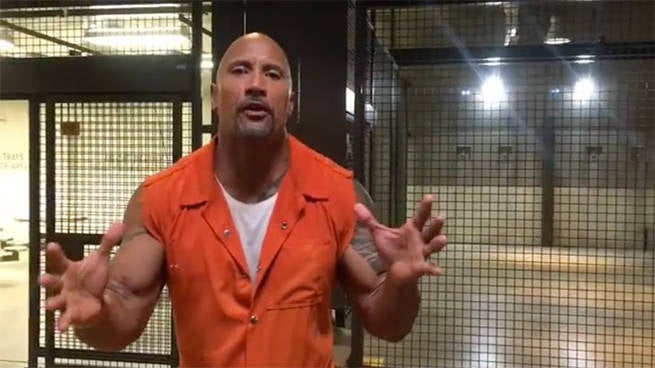
Fast and the Furious movies are also spectacular, taking full advantage of their medium to emphasize this point. From the trailer of the most recent movie, it looks like we will enjoy a prison break that could be a choreographed ballet sequence, except one involving Jason Statham and--you guessed it--Dwayne 'The Rock' Johnston (also of note: apparently prison uniforms that are sized for The Rock do not come with sleeves).  Is this any sillier than the bathing suit ballet in Meyerbeer's Les Huguenots? I would argue no. Is all of this spectacle? Absolutely. Is the spectacle part of what makes this experience enjoyable for the audience? Indeed. Can a car best a submarine or, as occurred in previous FF installments, a huge safe, an airplane, several skyscrapers, or an omnipotent satellite system? Probably only in this spectacular world.

2) They are formulaic

I have noticed lately that FF movies have been a real critical punching bag in various publications, often with a tone of 'Oh no, not this again.' The implication is that these movies are formulaic. Well, if you mean, 'At some point a FF movie will involve cars doing something ridiculous and probably Vin Diesel saying something vague about family,' yes they are. I am not suggesting that watching a FF movie will wrestle with existential issues or offer a new and vital perspective on contemporary society. But I do want to take a stand against the idea that a formula automatically means a lesser product. It's precisely this kind of thinking that gets Wagner enshrined in opera houses and keeps Haydn's many (often formulaic) operas out.

To whit: there is nothing inherently wrong with drawing on a formula. Sure, a work that is overly formulaic, and therefore overly predictable, will likely be dull; at the same time, most successful formulas offer enough flexibility so that they remain interesting. Handel's operas can be both formulaic and engaging--and spectacle, like when he brought in live birds as part of his early productions of Rinaldo (spoiler alert: this was a bad plan in a closed theater). The idea that we should value works that deviate from formulas is the basis of Joseph Kerman's Opera as Drama and too often the view espoused by musicologists, scholars more generally, and critics. However, audiences for film and for opera are often content with formulas. More importantly, a gifted artist can take a formula and find ways of modifying it enough to make it engaging.

Perhaps you are not the kind of person who will run out to your local movie theater this weekend to see FF8. That's okay. I'm the first to admit that it will probably be pretty silly. But do be the person who rushes to champion formulaic works that are filled with spectacle. They were popular in their day for good reason and they deserve better consideration today.

Tuesday, July 8, 2014

Setting Operas in the Heart of Darkness

To avoid the unpleasant task of writing my book, I've decided to spend a few minutes ruminating on 19th century operas that deal with African settings and characters. Many years ago, I sent out a query to the American Musicological Society's listserve inquiring about operas that have black characters in them. Based on the answers I received, I compiled a list of operas to investigate at some point in my life. Little did I know at the time that some really great scholars were also working on interrogating blackness in opera, and they published a book later that year that's literally called Blackness in Opera:
Coolness, right? Anyway. What I want to focus on, however, are 19th century operas that specifically used an African setting or African character. Because they all share a trait that musicologists have kind of picked up on but I'm not sure anyone's discussed at length: although most of these operas claim to be set in "Africa" (as in "sub-Saharan Africa"), they're really not. 

I think the main example that people are aware of here is Giacomo Meyerbeer's popular 1865 opera, L'Africaine:
Supposedly a tale about Vasco de Gama's adventures around the world, a good chunk of it takes place on an African island where the "natives" practice a religion much more akin to Hinduism. The island also appears to be in the Indian Ocean, perhaps near Madagascar or someplace like that. Here's the wonderful opera singer Shirley Verrett singing part of it with Placido Domingo at the San Francisco Opera in 1988:
https://www.youtube.com/watch?v=GoTNo5Zz3RU
(for some reason, the blog won't let me upload the video directly onto the page today)

If you watch the clip, you'll see that Girlfriend is straight-up wearing an Indian sari in the opera. How "African" is Meyerbeer's L'Africaine, I (and numerous musicologists) have wondered?

But Meyerbeer's opera, L'Africaine, isn't the only one that side steps Africanism in its quest to be exotic. Countless scholars have debated how we're supposed to interpret Verdi's Aida:
The opera's set in ancient Egypt, and the main femme fatale/femme fragile is an Ethiopian princess. How "Ethiopian" the opera director chooses to make her has greatly fluctuated over time.

Here's Grace Bumbry as "Aida":

The fabulous diva, Leontyne Price, serving it as usual (girlfriend don't PLAY):
Violetta Urmana at the Met recently (in brownface. Yes, I said it):

And as much as audiences enjoyed the opera when it premiered, some felt uncomfortable with its black African qualities. Here's Hanslick complaining about the work in 1880:

“The politics and religion, the oddities of dress and civilization of the ancient Egyptians are altogether too strange for us [Viennese/Germans]. We do not feel at ease among a lot of brown and black painted men. It may be urged that this is merely external, yet, for all, the spectator's sympathies are chilled…Think of nothing but dark-colored singers on the stage! Then, besides, the ugly, vaulting negroes and the dancing women dressed and painted in the most repulsive manner! An opera should present something of the lovely and agreeable, and no ethnological exactness can compensate for a total lack of beauty."
 (Taken from Dwight's Journal of Music, December 18, 1880, p. 201)
 
Yikes. In Hanslick's review, it seems unimaginable or inconceivable that one could depict black characters in an aesthetically pleasing way.

David Brodbeck has done some really fascinating work looking at Viennese reception of Karl Goldmark's opera, Queen of Sheba (Königin von Saba). Reviews were laced with thinly-veiled (or oftentimes open and hostile) anti-Semitic remarks that claimed that the music and setting reminded the critics of a Jewish service at the synagogue (as if any of them had ever been. But whatever):

Lastly, I want to point out Franz von Suppe's operetta, Die Afrikareise, from 1885:

 Zoe has a fancy fellowship at Harvard this summer to do some digging around, and she's been flipping through the score and libretto for this operetta. So far, she's discovered that the work really isn't set in Africa at all, although they do mention the country Chad at one point. Rather, it seems to have a more traditional orientalist setting (in the Saidian sense of the word).

So what gives, 19th century opera composers? Why this weird avoidance to actually set your "African" operas in Africa? Why limit your stereotyping to Asian characters and North African/Middle Eastern ones?

I wonder, however, if this hesitancy to depict sub-Saharan Africa goes across all of the arts. Orientalist paintings usually focused on North Africa, for example:
Horace Vernet, The Lion Hunt (1836)

And Joseph Conrad's book, Heart of Darkness, might very well be one of the first major cultural products to orientalize Africa that was widely consumed by Europeans:
But it came out in 1899. Were there really so few cultural products that depicted Africa/Africans/Africanness/Blackness that held European popular attention before then?

I remain dissatisfied with our knowledge/lack of knowledge of 19th century musical works dealing with African themes and notions of blackness. All of this stuff is much more fleshed out when it comes to talking about the 20th century (Porgy and Bess, Johnny Spielt Auf, Show Boat, etc.). But there's an earlier history here, ripe for an investigation and analysis, one that can benefit from postcolonial analysis, from a musicologist's fine ear and critical eye looking at the score. Heavens knows that I can't tackle this project right now. But I encourage anyone interested in this blog post to investigate further.